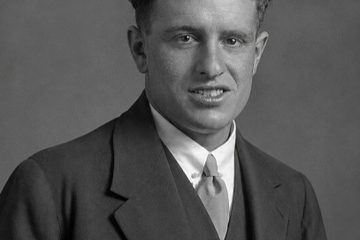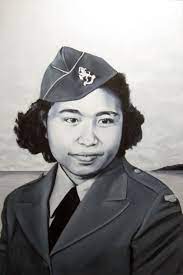
Costavina “Coosje” Ayal was one of the remarkable survivors of the resistance against the Japanese occupation of Dutch New Guinea. Still only sixteen when Japanese forces occupied Manokwari in April 1942, she joined a resistance group that remained in the jungles of the Vogelkop for more than two years.
Her eventual rescue brought her to Australia, where she joined the KNIL Women’s Corps, trained in nursing in Brisbane and became part of the Dutch and Netherlands East Indies wartime community centred on Brisbane and Camp Columbia.
From the Moluccas to Manokwari
Coosje Ayal was born on 15 April 1926 in Titawaai on the island of Nusa Laut in the Moluccas. At the age of six she went to live with her uncle Seth Nahuwae and his wife Tina in Manokwari, Dutch New Guinea.
Her uncle was a government official and Ayal attended Dutch-language schools. As the Japanese advance approached New Guinea, Nahuwae became involved in preparations for resistance, including establishing hidden stores of weapons, ammunition and food in the jungle.
When Japanese forces entered the Manokwari area on 12 April 1942, Ayal joined a group of around sixty military personnel and civilians who withdrew into the jungle under the command of KNIL Captain J.B.W. Willemsz Geeroms.
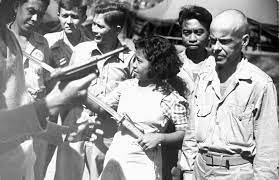
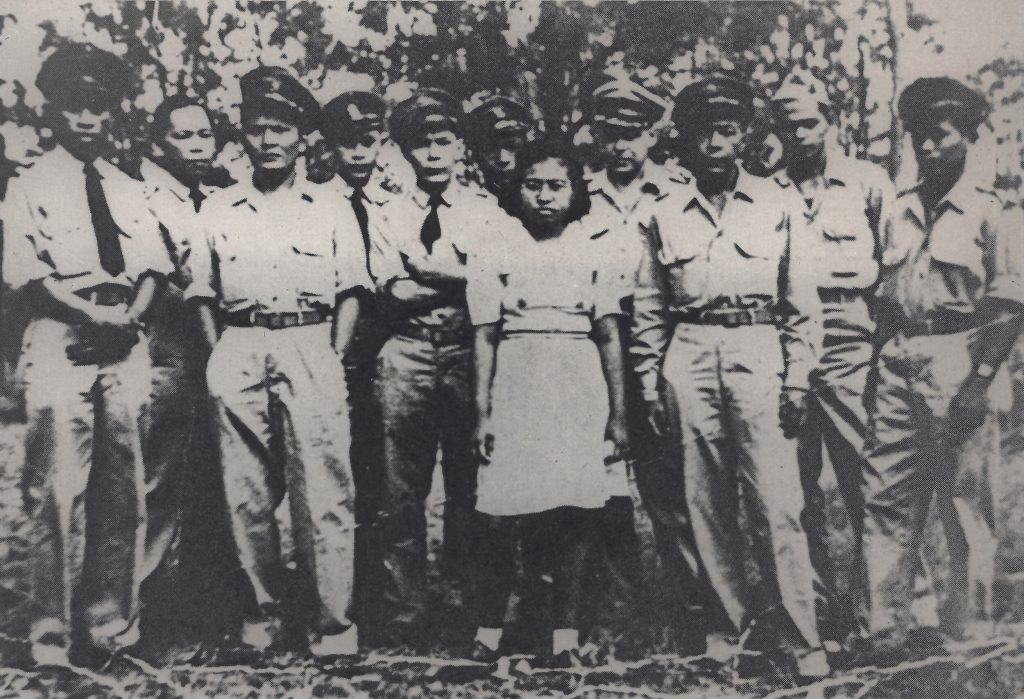
For the sixteen-year-old Ayal this began an extraordinary period of more than two years living with an armed resistance group in extremely difficult conditions. She wore military clothing, carried a weapon and shared the hardships of the group while also helping with food preparation and caring for the sick and wounded.
Local Papuan knowledge and assistance were essential to the group’s survival. Papuans provided information, guidance and other support as the resistance fighters attempted to evade Japanese forces in the rugged interior.
The Japanese attack and the Kokkelink group
By 1944 the resistance group had suffered heavily from Japanese attacks, illness, hunger and the extreme conditions of jungle life.
On 18 April 1944 Japanese forces attacked one of the group’s camps. Captain Geeroms and several others were captured and subsequently killed. Ayal’s aunt Tina was also captured and killed.
Ayal escaped. She was sent through the jungle to warn another part of the resistance group of the Japanese attack, undertaking a dangerous journey lasting several days.
The surviving resistance fighters regrouped under Sergeant Mauritz Christiaan Kokkelink. Their numbers had been dramatically reduced, but they continued to evade the Japanese and maintain their resistance.
Contact with NEFIS and rescue
By September 1944 the Allied advance had transformed the military situation in New Guinea.
The Netherlands Forces Intelligence Service (NEFIS) sent Party RADISH to establish contact with the surviving resistance group. When members of the NEFIS party were unable to penetrate sufficiently far inland, two Papuan scouts carried a message through the jungle.
They reached Kokkelink and the survivors on 22 September 1944. On 4 October the resistance group finally made contact with Party RADISH and could be brought to safety.
This distinction is important. Ayal and the Kokkelink group were not NEFIS agents inserted from Australia. They had maintained their resistance behind Japanese lines for more than two years before a NEFIS mission sent from Australia finally established contact with them.
The survivors were subsequently evacuated and eventually brought to Australia.
Brisbane and the KNIL Women’s Corps
In Australia, Ayal entered a very different phase of her wartime experience. She joined the Women’s Corps of the Royal Netherlands East Indies Army (VK-KNIL), undertook nursing training in Brisbane and was eventually promoted to corporal.
By this time Brisbane had become the principal centre of Dutch and Netherlands East Indies military and administrative activity in Australia. Camp Columbia at Wacol accommodated NEI government departments, military personnel and members of the Women’s Corps.
A remarkable photograph taken at Camp Wacol records Ayal together with Mauritz Kokkelink and other survivors of the New Guinea resistance group. It provides a direct visual connection between their years of resistance in New Guinea and the Dutch wartime community in Brisbane.
In Brisbane Ayal also met Henry Evers, a soldier from the Dutch Caribbean. They married in 1947.
Life after the war
After the war, Coosje Ayal married Henry Evers in 1947. The couple subsequently lived in the Netherlands East Indies, the Netherlands and the Netherlands Antilles before settling in the Netherlands in 1964. They had nine children. Ayal worked for a time in a packaging factory and also established her own catering business.
In later life she became an important witness to the largely overlooked resistance against the Japanese occupation of the Netherlands East Indies. Living in Ridderkerk, she spoke publicly about her wartime experiences and regularly told younger generations about the resistance in New Guinea.
Recognition and remembrance
Ayal received several decorations in recognition of her wartime service. In 1946 she was awarded the Cross of Merit (Kruis van Verdienste). Further recognition followed with the Verzetskruis in 1972 and the Verzetsherdenkingskruis in 1981. She also received other military and veterans’ distinctions.
The Dutch flag that Ayal had carried with her during the long guerrilla campaign became an important symbol of the group’s resistance. The seventeen survivors placed their names on the flag and sent it to Queen Wilhelmina after their rescue.
Coosje Ayal died on 28 March 2015 at the age of 88 and was buried with military honours. Her story has since received increasing recognition as part of both the history of resistance in the Netherlands East Indies and the history of the Moluccan community in the Netherlands.
In Ridderkerk, where she had lived for many years, part of the former Rembrandtweg was renamed Coosje Ayalstraat. The street name was officially unveiled by her grandchildren on 17 March 2023, providing a permanent public memorial to her life and wartime service.
In the pdf below the full story of the heroine is told by Ellen Lock and was published in September 2012 in the SVB/PUR-magazine Aanspraak, Leiden, the Netherlands.
Further biographical material
A fuller account of Coosje Ayal’s life, written by Ellen Lock and published in September 2012 in the SVB/PUR magazine Aanspraak, is available below.
Sources and further reading
Nederlands Instituut voor Militaire Historie (NIMH), “Mee met het verzet. Coosje Ayal” – authoritative military-historical account of Ayal and the Manokwari resistance.
Nederlands Instituut voor Militaire Historie (NIMH), “De Groep van 17” – particularly useful for the final phase of the resistance, NEFIS Party RADISH, the Papuan scouts, evacuation to Australia and the survivors’ flag.
Josine Heijnen, “Ayal, Costavina Aya (1926–2015),” Digitaal Vrouwenlexicon van Nederland, Huygens Instituut voor Nederlandse Geschiedenis – detailed biography covering Ayal’s childhood, resistance activities, Australia and later life. The Huygens biography is also identified as the source used by other Dutch historical projects on Ayal.
Ellen Lock, “Coosje Ayal”, Aanspraak, September 2012 – detailed English-language account reproduced as a PDF in this article.
IndischHistorisch.nl, “In memoriam Coos Ayal (15 april 1926 – 28 maart 2015). Afscheid van een verzetsstrijdster” – useful account of her historical significance and later commemoration.
Verzetsmuseum Amsterdam, “Resistance” – places Ayal within the wider history of resistance in the Japanese-occupied Netherlands East Indies and specifically highlights her experience as a young Moluccan woman in the Manokwari group.
Further DACC research
For related articles, personal stories and archival research on NEFIS, Dutch and Indonesian intelligence personnel, resistance groups and special operations from wartime Australia, see the DACC Research Portal – Dutch and Indonesian Intelligence and Special Operations from Australia during WWII.
This personal story also forms part of the VK-KNIL Research Portal – Dutch women in military service from Australia to Indonesia.