Abstract
This study by A.Y. Brehler examines the experiences of Dutch post-war migrant children in Australia, focusing on how their connections to the Netherlands evolved over time. Drawing on archival research and personal interviews, the thesis explores the concept of transnational ties—social, cultural, and emotional links between migrants and their country of origin—and how these were shaped by government policies, community organisations, and individual life trajectories.
The research highlights the unique position of migrant children as an “in-between generation,” navigating the expectations of rapid assimilation in Australia while maintaining elements of Dutch identity within the family home. During their childhood in the 1950s and 1960s, many experienced a clear divide between private and public life: Dutch language and traditions at home, and strong pressure to become fully Australian at school and in society.
A key finding of the study is that transnational ties did not develop in a linear way. Instead, many migrant children experienced a “transnational time gap,” in which connections to the Netherlands weakened or disappeared during their early years in Australia, only to re-emerge later in life in more symbolic forms—through heritage, memory, and identity. This challenges traditional migration theories that assume continuous links with the homeland.
By combining historical analysis with sociological concepts such as transnationalism and symbolic ethnicity, the thesis provides a fresh perspective on Dutch migration to Australia. It also contributes to broader debates on migration, identity, and belonging, particularly by foregrounding the often-overlooked experiences of children.
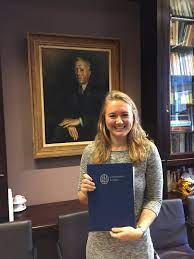
On November 1, 2018 Anne Brehler defended her Master thesis ‘We were the ones that integrated’: Dutch post-war migrant children in Australia. She got cum laude Congratulations.
This research focuses on children of post-war Dutch migrants in Australia and their transnational ties to the Netherlands. The main question is how, why and when the transnational ties changed in different political environments, such as the shift from assimilation to multicultural policy in Australia. The research starts at the migrants’ childhood and ends in their later life.