Why Dutch naval forces regrouped in Ceylon and Australia
Following the collapse of the Netherlands East Indies in early 1942, Dutch naval and military forces were forced into a rapid and improvised evacuation. With Java and surrounding islands falling to Japanese control, surviving ships, aircraft, and personnel dispersed along multiple escape routes, depending on operational circumstances and Allied command arrangements.
A significant portion of the Royal Netherlands Navy regrouped in Ceylon (Sri Lanka), which fell under British control within the Indian Ocean theatre. This included several submarines and surface vessels that had escaped westward via the Lombok and Sunda Straits. From Ceylon, Dutch naval units operated within the British-led South East Asia Command (SEAC), focusing on the Indian Ocean and the approaches to the Malacca Strait.
At the same time, other Dutch naval forces reached Australia, particularly Fremantle and Sydney, which became key Allied bases within the Southwest Pacific Area. These units came under American operational command and were increasingly integrated into U.S. and Australian naval planning. As a result, Dutch naval forces in exile were effectively divided between two Allied theatres, each with different strategic priorities, command structures, and logistical constraints.
This division shaped Dutch submarine operations for the remainder of the war. By 1944, shifting Allied strategy and changing operational needs would prompt the transfer of several Dutch and British submarines from Ceylon to Australia—setting the stage for the renewed Dutch submarine activity described below.
New submarines for the Royal Netherlands Navy
By 1944 the Royal Netherlands Navy had finally received substantive reinforcements. These came from a British request to transfer some Ceylon-based submarines to Australia. On 31 January 1944, the British told USN Admiral Ernest King that by “the latter half of 1944 the number of British submarines in Eastern Theatre will be in excess of that which can usefully be operated against targets in the Malacca Strait”. It was the only viable submarine hunting ground left within South East Asia Command (SEAC).
The British proposed to send a submarine group to work with Rear-Admiral Lockwood’s flotilla at Fremantle so as to expand British patrols into the China and Java Seas. King approved this proposal. He did so on the understanding that the SEAC submarines would be placed under the operational control of the SWPA Commander MacArthur.
The British had to supply a depot ship, as Fremantle was barely able to service the Dutch (K-XIV) and USN submarines based there. The Exmouth Gulf advanced submarine base was often closed due to poor sea conditions.
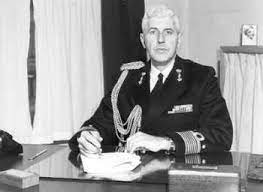
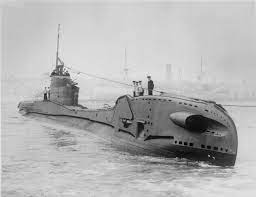
The British chose to send the 8th Submarine Flotilla. It comprised Zwaardvisch (1,170 tons, Lieutenant-Commander H.A.W. Goossens), O-19 (998 tons, Lieutenant-Commander A. Van Karnebeek) plus nine Royal Navy submarines. Zwaardvisch was the ex-British T-class submarine Talent that with Tijgerhaai (ex-HMS Tarn) were transferred to the RNN to replace the severe RNN submarine losses. Zwaardvisch arrived at Fremantle on 7 September 1944. The RNN submarine O-19, after a refit in Britain, reached Fremantle on 18 September 1944.
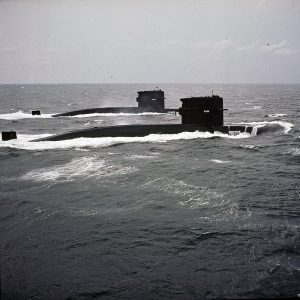
The RNN submariners were aware that they had to prove themselves to their successful USN counterparts, who “were not entirely convinced of the British [and Dutch] submarines’ battle-worthiness.” USN concerns over RNN submarines’ seaworthiness derived the poor serviceability rate of K-IX, K-XII and K-XV. It was a particular concern of King who had stipulated on 26 August 1944 that the RNN submarines would be allowed to transfer to Fremantle provided that an “adequate spare parts supply is furnished by the Dutch Government” and that “a Dutch submarine depot ship should be provided if one is available.” No RNN depot ship was available.
KPM’s Plancius which had been converted to a submarine depot ship had to remain at Ceylon to service O-24. The other submarine depot ship the former Shell oil tanker Ondina was a ‘stop-gap’ depot ship allotted specifically to Exmouth Gulf.
The Royal Navy’s depot ship HMS Maidstone was sent to service all the 8th Flotilla submarines. A RNN shore depot, commanded by Lieutenant-Commander Kolling, was established at Crawley Bay, Fremantle. The US view of the Dutch-built submarines’ unreliability did not apply to the Dutch crews. Lockwood welcomed the additional RNN submarines, stating that from past experience he believed that:
Their crews were hardy and determined … and [being] not so well equipped for habitability and comfort [their submarines] were thoroughly effective. The skippers handled their boats with great skill and need take off their hats to no-one, with respect to daring in making their attacks. I became acquainted with … Dutch submariners…. My observation of their capabilities and their performance in the Southwest Pacific, merely confirmed my former high regard for their hardihood and fighting qualities. When there’s a tough job to be done, I’m ready at any time to team up with a … Dutchman.
For the British of the 8th Flotilla, the Dutch submariners were an interesting contrast. The British noted that the RNN submarines suffered from a shortage of officers as illustrated by the RNN submarine officers being “all men commissioned in peace time and consequently older and more serious-minded than their [British] counterparts.” Not that this serious-mindedness stopped the Dutch from possessing what the British believed to be the best submarine mess at Fremantle at the Ocean Beach Hotel, Cotesloe. Alistair Mars who served on the submarine HMS Thule noted that while the USN submarine mess was well stocked with provisions:
…the Dutch submarine mess …well they had everything…. I embarked on a mad round of the …latter [bottled gaiety] … to the Dutch officers mess where hospitality was staggering.”
RNN submarines divided patrol areas. Zwaardvisch patrolled the South China Sea. O-19 patrolled the Java and Flores Seas and the Malacca Strait. Leaving Fremantle, they sailed north along the coast until they reached Exmouth Gulf to refuel from Ondina. The submarines entered Lombok Strait between Bali and the Lombok Islands. It was a hazardous spot as the Japanese defended the Strait with anti-submarine patrols and coastal guns plus there it had a nasty south-running current. Alternative routes were available via Ombai Strait between the Alor and Ambeno Islands, or through the Timor Sea. Allied submarines preferred Lombok Strait for it was wider and was not heavily mined. Lombok Strait’s currents had the advantage that when “returning from patrol, of course, a submarine merely had to dive at the northern end and be sucked southwards by the current and shot into the Indian Ocean.”
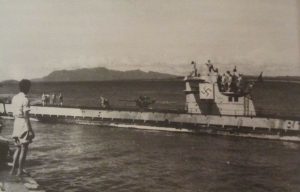
During its first patrol, Zwaardvisch sank a 500-ton Japanese tanker on 4 October 1944. On 6 October, Zwaardvisch scored the 8th Flotilla’s most notable success when Goossens sank the German submarine U-168 (1,140 tons) in the Java Sea. Upon surfacing, Zwaardvisch rescued 27 survivors. Due to the danger posed by so many German POWs being inside the cramped submarine, Goossens seized a passing prahoe and placed 22 POWs aboard. Captain Helmut Aich, his three officers and a badly injured German were kept on Zwaardvisch to go to Fremantle.
Zwaardvisch‘s success was the envy of the other 8th Flotilla submarines such that “although nobody equalled Goossens’ feat of sinking a U-Boat, it was not for want of trying.” On 10 October, Zwaardvisch sank the motor ship Koei Maru (19 tons) and then Kaiyo Maru No 2 (143 tons) on 15 October. On 17 October, Goossens added to his score by sinking the minelayer Itsukushima (1,970 tons) and damaging her sister ship Wakataka. At the northern entrance to Lombok Strait, Zwaardvisch was severely damaged by depth charges from two Japanese patrol boats on 5 December. With a cracked telemotor and both periscopes inoperable, Goossens abandoned his patrol but not before rescuing Balinese fisherman Tima Oemar who had strayed off course.
Tima was delivered to Darwin where Lieutenant Van De Woude (RNN) interviewed him for NEFIS on 12 December 1944. Zwaardvisch damaged a Japanese merchantman on 8 February 1945. It was Goossens’ last success before Zwaardvisch was recalled to Europe where it returned to the British in May 1945. It was replaced by K-XI (611 tons, Lieutenant-Commander P.G. De Black). When K-XI reached Fremantle, it was found to be too obsolete for operations and was decommissioned on 11 April 1945.
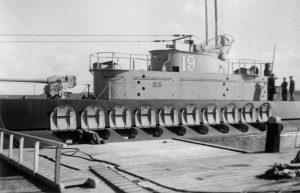
O-19 had its first success on 16 November 1944 sinking Kaishin Maru No 2 (150 tons) in the Java Sea. O-19 laid a minefield in Bantam Bay, Java where another merchantman was sunk. Alerted to the presence of O-19, Japanese patrol craft sought and depth-charged her, causing severe damage. While under repair at Fremantle, there was a change of command. Lieutenant-Commander J.F. Drijfhout van Hooff transferred from K-XIV to replace Lieutenant-Commander Karnebeek on 16 December. Command of K-XIV was given to Lieutenant-Commander J. Smith. Resuming patrols, O-19 sank the converted gunboat Shinko Maru No.1 (934 tons) on 9 January 1945. Soon after, O-19 torpedoed an unidentified vessel of 3,000 tons off Cape Poeting, south of Borneo. As a result, the submarine received another battering from depth charges, forcing its return to Fremantle.[1] On 10 April, O-19 sank the tanker Hosei Maru (896 tons) in the Java Sea. On 13 April O-19 laid 40 mines in the Banka Strait. On 22 April, Van Hoof scored a major success in damaging the heavy cruiser Ashigara (12,000 tons). On 19 April 1945, the 8th Flotilla was reorganized. Maidstone and six British submarines went to Subic Bay in the Philippines. HMS Adamant arrived in Fremantle on 11 April 1945 to serve as the depot ship for the remaining submarines, reorganised into the 4th Flotilla. The 4th Flotilla was allotted to the British Pacific Fleet that was operating within the SWPA.
Of Koenraad’s minesweepers, Merbaboe and Smeroe were stationed at Merauke in SE DNG, the only area not occupied by the Japanese it was used as an staging post early in the war. Rindjani had a refit at Port Moresby before being sent to Hollandia. He minesweeper Abraham Crijnssen was kept in Australia where it was relegated to a training ship for Indonesian recruits. Abraham Crijnssen’s permanent core of Dutch crew became so settled in Melbourne that it was reported in a local newspaper that 22% had married Australians.
A NEI Forces Canteen was established in Bourke Street, with activities run by the Roemah Indonesia Entertainment Committee. Some recruits sent to Melbourne were fishermen taken by O-19, K-XIV, K-XV and Zwaardvisch while on patrol. To dissuade Indonesian collaboration with the enemy and with the Japanese using prahoes, RNN submarines attacked all fishing vessels and took their crews. Nine prahoes (Kota Marino, Vierge, Tongkang etc.) and the merchantman Akegata Maru lost crews in this way. For example a RNN submarine captured two Indonesians sailing a prahoe in the Dampier Strait on 24 April 1944. On 23 June 1944, the prahoe Doenia Baroe was sunk near Pasi Ipoh. Its crew, Captain Soeliman Asik, Kasim, Saptoe Orbo and Koengkoe Hadji, were put aboard a RNN submarine. Captured fishermen were taken by K-XV to Ceylon or by the other RNN submarines to Darwin. NEFIS interviewed the fishermen for information on conditions in the Occupied NEI. They then ‘volunteered’ for the RNN or the Dutch merchant marine. Such were the desperate measures to which the Dutch had to resort to cope with their personnel shortage.
See also: Dutch Submarines operating from Australia during WWII