During the Second World War, the Royal Netherlands Navy operated extensively from Australia following the collapse of the Netherlands East Indies in early 1942. Dutch naval forces, including submarines, surface vessels, and support units, were integrated into Allied operations in close cooperation with the Royal Australian Navy and the United States Navy. Australia became one of the principal bases from which Dutch naval forces continued the war in the Pacific.
It was within this established framework of Dutch–Australian naval cooperation that HMAS Ipswich later entered Dutch service (see below). Built in Brisbane for the Royal Australian Navy, transferred to the Royal Netherlands Navy in the immediate postwar period, and subsequently absorbed into the Indonesian Navy, the ship’s service life reflects the transition from global war to decolonisation in Southeast Asia.
For the Dutch–Australian story in particular, Ipswich—renamed Hr.Ms. Morotai—illustrates how Australian wartime shipbuilding capacity and Allied naval cooperation directly supported Dutch maritime operations during the final years of Dutch authority in the Netherlands East Indies.
An Australian-built wartime vessel
HMAS Ipswich (pennant number J186) was a Bathurst-class corvette constructed by Evans Deakin & Company in Brisbane. She was laid down in March 1941, launched in August 1941, and commissioned into the Royal Australian Navy in June 1942.
Like other ships of her class, Ipswich was designed as a multi-purpose vessel, capable of minesweeping, escort, patrol, and anti-submarine work. During the Second World War she served widely in Australian and regional waters and, by the end of the war, was operating well beyond the Australian coastline. Notably, Ipswich was present in Tokyo Bay at the time of the Japanese surrender in September 1945, placing her among the Allied ships that witnessed the formal end of the Pacific War.
Postwar service and transfer to the Netherlands
Following the end of hostilities, Ipswich remained active for a period, including duties in the New Guinea region. In mid-1946 the ship was selected for transfer to the Royal Netherlands Navy, which was in the process of rebuilding its fleet after the loss of much of its naval capacity during the Japanese occupation of the Netherlands East Indies.
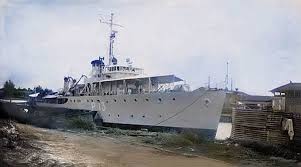
Ipswich sailed to Ceylon (now Sri Lanka), where the formal handover took place. On 5 July 1946, at Colombo, the ship paid off from Australian service and entered Dutch service under the name Hr.Ms. Morotai. The name was a deliberate reference to Morotai Island in the northern Moluccas, a strategically significant location during the later stages of the Pacific War and one of the first parts of the Netherlands East Indies liberated by Allied forces under General Douglas MacArthur in 1944.
Hr.Ms. Morotai in Dutch service, 1946–49
After commissioning into the Royal Netherlands Navy, Morotai sailed to Southeast Asia and entered service in Netherlands East Indies waters. Dutch naval summaries describe the ship as operating primarily in patrol, escort, and security roles during a period of intense political and military uncertainty.
Between 1946 and 1949, the Royal Netherlands Navy was heavily engaged in maintaining maritime communications, protecting ports and shipping lanes, and supporting Dutch civil and military authorities during the Indonesian struggle for independence. Vessels of Morotai’s type were particularly valuable in this context: small, versatile, and well suited to coastal and inter-island operations.
Dutch sources place Morotai in service around Java and other key maritime areas of the archipelago. By August 1948, administrative responsibility for the ship appears to have shifted to the Dutch Department of Shipping, reflecting the increasingly complex division between military, civil, and transitional authorities as negotiations over Indonesia’s future intensified.
Sovereignty transfer and the move to Indonesian service
The transfer of sovereignty from the Netherlands to the Republic of the United States of Indonesia in December 1949 marked a decisive turning point. As part of this process, Dutch government assets located in the former Netherlands East Indies were transferred to the new Indonesian state. Naval vessels still operating in the region were included in this handover.
Within this framework, Hr.Ms. Morotai passed into Indonesian control and was commissioned into the Indonesian Navy under the name Hang Tuah. The ship thus became part of the early fleet of the Angkatan Laut Republik Indonesia, contributing to the formation of a national navy at a time when Indonesia was consolidating its independence and authority over a vast maritime territory.
Final years and loss in 1958
Hang Tuah remained in Indonesian service throughout the 1950s. Her career came to an abrupt and dramatic end on 28 April 1958, during the period of regional rebellions against the central Indonesian government. The ship was sunk in an air attack during questionable CIA operations linked to the USA initially supporting PRRI/Permesta rebellions.
With the loss of Hang Tuah, a vessel that had begun life in wartime Brisbane and served three navies over little more than a decade came to an end.
A ship linking three histories
The story of HMAS Ipswich / Hr.Ms. Morotai / Hang Tuah encapsulates a remarkable sequence of historical transitions. Built by Australia for a global war, acquired by the Netherlands during the final phase of its colonial presence in Southeast Asia, and ultimately absorbed into the navy of an independent Indonesia, the ship’s service life mirrors the broader geopolitical shifts of the mid-twentieth century.
For Dutch–Australian heritage, Morotai stands as a tangible example of postwar cooperation, pragmatic naval policy, and the interconnected maritime histories of Australia, the Netherlands, and Indonesia.
Paul Budde (December 2025)
Sources and references
Australian sources
Royal Australian Navy, Sea Power Centre, service history of HMAS Ipswich (J186)
Bathurst-class corvette histories and Australian naval shipbuilding records
Evans Deakin & Company shipyard documentation, Brisbane
Dutch sources
Onzemarinevloot.nl, entry on Hr.Ms. Morotai
Dutch naval fleet summaries and postwar Royal Netherlands Navy histories
Nationaal Archief (The Hague), Marinestaf collections, 1945–1950
Nationaal Archief, Afscheid van Indië project inventories
International and Indonesian context
Ronde Tafel Conferentie, Final Agreements, The Hague, November 1949
Indonesian Navy (TNI-AL) historical overviews of early fleet development
Studies of the PRRI/Permesta rebellions and Indonesian naval operations in the 1950s