On 28 October 1945, a Netherlands East Indies Air Force (NEI-AF) B-25J Mitchell bomber was forced to ditch in tidal waters in the remote Kimberley region of Western Australia. The aircraft, serial N5-254 (USAAF 44-30900), came down in the Glenelg River system north of Broome, although some contemporary sources refer to the nearby Prince Regent River. All five crew members survived the incident, sustaining only minor injuries.
The aircraft was operating as a disarmed operational trainer with the NEI Personnel and Equipment Pool and formed part of a small group of Dutch B-25 Mitchells tasked with transporting newly printed Dutch currency from Australia to the Netherlands East Indies. These flights were a critical element of post-war reconstruction, intended to re-establish civil administration, banking and economic control following the Japanese surrender.
Flight and crew
The B-25 departed Archerfield near Brisbane and flew to Cloncurry, Queensland, where it refuelled before continuing westward on 28 October 1945. The intended route was via Truscott Airfield to Broome. On board were:
– 1st Lieutenant Bruce J. van Kregten, pilot
– Vaandrig (Ensign) C. Borneman, co-pilot
– S.M. Megens, radio operator
– Sgt. Major R.B. Baert, flight engineer
– A.H.J. Nord, Netherlands Indies Civil Administration (NICA), acting as armed guard for the currency shipment
The aircraft was carrying a substantial consignment of coins and banknotes with a total value of approximately 900,000 Dutch guilders at 1945 prices. N5-254 was one of several B-25s that took off from Australia in late 1945 carrying Dutch currency for use by banks and civil authorities in the Netherlands East Indies.
After departing Cloncurry, the crew encountered severe monsoonal weather. Navigation became increasingly difficult, communications were unreliable, and radio bearings could not be obtained in time. With fuel running low and the aircraft unable to maintain altitude on one engine because of its heavy load, van Kregten made the decision to ditch the aircraft once the coast was sighted.
Ditching and survival
The ditching was carried out in heavy conditions. The aircraft flooded almost immediately and sank nose-first, taking its precious cargo with it. The crew escaped via the cockpit roof hatch, inflated the dinghy, and reached the shore after nightfall in persistent rain.
The following day, aircraft searching the area overflew the stranded men. On 29 October, they were sighted by an RAAF Liberator, which dropped supplies. Four days after the ditching, the crew were rescued by the Kunmunya Mission lugger Watt Leggatt and taken to Derby. The B-25 was later formally written off on 22 February 1946.
Contemporary newspaper reports in The West Australian described the aircraft as an RAAF Mitchell, reflecting a common misunderstanding at the time. In reality, it was an NEI-AF aircraft operated by Dutch personnel, highlighting how closely Dutch and Australian wartime aviation activities were intertwined in northern Australia.
Salvage and the missing money
In December 1945, local mariner Robert Maxted discovered the wreck at low tide near the mouth of the Glenelg River. He undertook a difficult salvage operation and recovered several sealed cases containing Dutch banknotes, which were subsequently handed over to the authorities in Derby. Coins were also found scattered throughout the wreckage.
Press reports later claimed that the aircraft had been carrying the equivalent of £A250,000 in Dutch currency and that some silver guilders had gone missing, with rumours of coins circulating in northern and eastern Australia. These reports prompted prolonged inquiries, and final resolution of the matter was delayed until early 1947.
The loss of N5-254 was one of three Dutch aircraft incidents associated with post-war currency transport flights, underscoring the risks involved in this largely forgotten phase of Dutch reconstruction efforts, which relied heavily on Australian airfields, sea routes and logistical support.
The Borneman watch and 18 Squadron
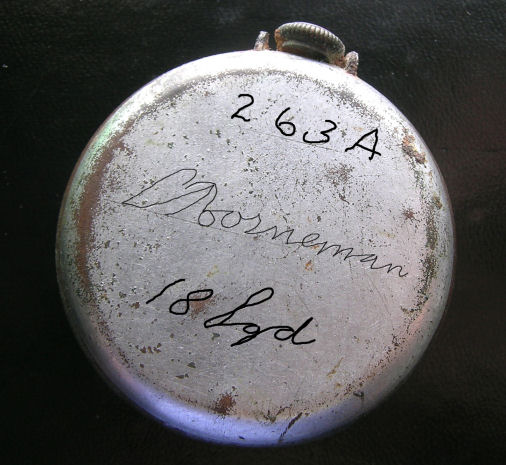
A remarkable personal epilogue to the crash emerged decades later. In the early 2000s, a pocket watch was found near the former Batchelor airfield in the Northern Territory. The watch bore faint engravings, including the name Borneman, a service number, and 18 Sqd.
Subsequent research linked the watch to Vaandrig C. Borneman, the B-25’s co-pilot. 18 Sqd refers to 18 Squadron NEI-AF, the Dutch bomber squadron that operated B-25 Mitchell aircraft from Australia in close cooperation with the RAAF.
The so-called Borneman watch is therefore not only a personal artefact connected to the crew of N5-254, but also a tangible reminder of 18 Squadron and the broader Dutch air presence in Australia during and immediately after the Second World War. Further detail on the watch and its identification is available via the OzatWar website, to which a separate link is provided.
Dutch–Australian context
The ditching of B-25 N5-254 occurred at a moment of transition. Although the war had formally ended, Dutch military and civil authorities were still operating in exile from Australia, including from Camp Columbia at Wacol in Brisbane. Currency flights such as this one were essential to restoring Dutch governance in the Netherlands East Indies.
This incident therefore forms part of the wider story of Dutch–Australian cooperation during and immediately after the Second World War, extending beyond combat operations into the complex, hazardous and politically sensitive task of post-war reconstruction.
The article below draws on contemporary Australian newspaper reports and later Dutch research into the final flight of B-25 N5-254.
See also: “Ditching of a B-25 Mitchell, Glenelg River, north of Broome, WA on 28 October 1945”