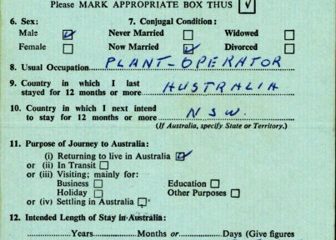
A 2006 episode of Andere Tijden titled Australië: integreren met hindernissen revisited postwar migration from the Netherlands to Australia. What makes this account particularly valuable is that it challenges the long-standing perception that Dutch migration was a largely smooth and successful process.
Instead, it highlights a more complex reality—one in which hardship, disappointment and, for a significant number of migrants, return migration played an important role.
This raises an important historical question: if Dutch migrants are widely regarded as one of the most successful postwar migrant groups in Australia, how do we reconcile that with the fact that a substantial proportion—often estimated at around one-third—eventually returned to the Netherlands?
The video provides a powerful entry point into this question. It shows that, while many migrants ultimately built stable and successful lives in Australia, the path towards that outcome was often far from straightforward.
Expectations and reality
In the Netherlands, emigration to Australia was actively promoted in the postwar years. It was presented as an opportunity for a better life—more space, more work, and a fresh start after the devastation of the war. For many, this vision proved compelling.
However, the lived experience frequently differed from these expectations. Migrants encountered unfamiliar working conditions, often in physically demanding jobs. Many were selected precisely for their practical skills, which placed them in labour-intensive roles rather than in the middle-class positions some had anticipated.
Isolation was another major challenge. Distance from family, limited communication, and the cultural differences of Australian society created a sense of dislocation that is clearly reflected in the testimonies presented in the programme.
Research by Nonja Peters and Desmond Cahill confirms that these early years were often marked by hardship, even among groups that would later be described as highly successful.
The reality of return migration
It is within this context that return migration becomes an essential part of the story rather than an exception to it.
A significant proportion of Dutch migrants—commonly estimated at between 25 and 30 percent—eventually returned to the Netherlands. Others became “see-saw migrants,” moving between the two countries over a number of years.
The reasons were varied. For some, the physical demands of work and the harshness of the new environment proved too much. Others struggled with loneliness, homesickness, or the gap between expectations and reality. Family ties remained strong, and the pull of familiar social and cultural surroundings was difficult to overcome.
The Andere Tijden programme gives voice to these experiences in a way that is often absent from official migration narratives. It shows that leaving Australia was not necessarily a failure, but often a deeply considered personal decision.
The hidden story: returning home
Returning to the Netherlands, however, was not always easy.
Many returnees found that they were perceived as having failed in their migration attempt. In a society still recovering from the war, there was limited sympathy for those who had left and then come back. Some were seen as having turned their backs on the Netherlands during a difficult period, only to return when things had improved.
As a result, many chose not to speak openly about their experiences. This has contributed to the relative absence of remigration stories in both Dutch and Australian historical narratives.
At the same time, it is important to recognise that emigration itself had been encouraged by the Dutch government as part of its postwar recovery strategy. The decision to leave was not simply an individual choice, but part of a broader policy framework.
Policy, adaptation and cultural loss
In Australia, migrants entered a society shaped by assimilation policies. Cultural diversity was not yet recognised as a value in itself, and migrants were expected to adapt quickly to an Anglo-Australian norm.
Support structures were limited, particularly in the early decades before the changes that followed the Galbally Report. This 1978 government review marked a turning point in Australian migration policy, shifting from assimilation to multiculturalism and introducing support for language services, community organisations and cultural maintenance. Before that happened additional pressure was placed on migrants, especially in relation to language and cultural identity.
Among Dutch migrants, this often led to rapid language loss—something that has later been described as a significant cultural cost of what was otherwise seen as successful integration.
Success, but at a cost
None of this diminishes the achievements of those who remained in Australia. On the contrary, many Dutch migrants went on to build stable and prosperous lives and made substantial contributions to Australian society.
However, the existence of a substantial return migration challenges the simplicity of the “successful migrant” narrative. It shows that success was often the result of perseverance through difficult circumstances, rather than the outcome of an easy transition.
It also reminds us that migration is not a single, uniform experience. For some, success meant building a new life in Australia. For others, it meant recognising that their future lay back in the Netherlands.
A more complete story
The Andere Tijden programme provides an important corrective to simplified historical narratives. By including the voices of those who struggled, adapted, and in some cases returned, it allows for a more complete understanding of Dutch migration.
In doing so, it aligns with a broader body of research that emphasises the diversity of migrant experiences and the need to move beyond one-dimensional interpretations.
The story of Dutch migration to Australia is therefore not just one of success, but of complexity, resilience, and difficult choices. Those who stayed and those who returned were part of the same history—each navigating the challenges of migration in their own way.
A 2006 episode of Andere Tijden titled Australië: integreren met hindernissen offers a perspective on Dutch migration to Australia that sits uneasily with the familiar narrative of smooth and successful integration. Based largely on interviews with returned migrants in the Netherlands, the programme highlights hardship, disappointment and the decision by many to go back.
This raises an important historical question. If Dutch migrants are widely seen as among the most successful postwar migrant groups in Australia, how do we reconcile that with the fact that a substantial number—often estimated at around one-third—eventually returned to the Netherlands?
This apparent contradiction does not invalidate the success narrative, but rather calls for a more nuanced understanding of what “success” in migration actually means.
The answer lies not in rejecting the success story, but in refining it.
A highly regarded migrant group
In the postwar years, Australia actively recruited migrants from the Netherlands under the 1951 Netherlands–Australia Migration Agreement. Dutch migrants were seen by Australian authorities as particularly suitable settlers: northern European, skilled, family-oriented and expected to adapt quickly to Australian society.
This perception was closely aligned with the assimilation policies of the time, which favoured migrants considered culturally compatible with the existing Anglo-Australian population.
This positive perception was not unfounded. Over time, many Dutch migrants did indeed establish themselves successfully. They entered trades, built businesses, contributed to agriculture and industry, and became active members of local communities. In later decades, they would often be described as “model migrants”—people who integrated quickly and without major social tension.
However, this official and retrospective view tells only part of the story. It tends to focus on long-term outcomes while overlooking the difficulties experienced during the early years of settlement.
The promise and the reality
Research by Nonja Peters has been particularly important in uncovering the gap between expectation and experience. Migration to Australia was actively promoted in the Netherlands as an opportunity for a better life—more space, more prosperity, and a fresh start after the hardships of the war.
At the same time, Dutch emigration policy was designed to alleviate population pressure and support economic recovery, meaning that migration was encouraged at both individual and national levels.
For many migrants, the reality was quite different.
On arrival, they often encountered:
- hard physical labour, sometimes far removed from their previous occupations
- non-recognition of qualifications and resulting deskilling
- unfamiliar working and living conditions
- a society that was less open to cultural difference than expected
These factors contributed to a period of adjustment that was often longer and more difficult than anticipated.
The idea of Australia as a land of immediate opportunity—sometimes described in Dutch narratives as a land of “milk and honey”—proved, in practice, to require years of adjustment and perseverance.
Hard work, hardship and emotional strain
Beyond the economic challenges, there was a deeper emotional dimension to migration. Peters’ research highlights the psychological cost of relocation: separation from family, loss of social networks, and the strain of rebuilding life in a distant and often culturally unfamiliar environment.
Australia in the 1950s and 1960s operated under a strong assimilation policy. Migrants were expected to adopt the English language quickly and to fit into an Anglo-Australian cultural framework. This expectation often extended into everyday life, where the use of other languages and cultural expressions was discouraged, sometimes even within the family environment. For Dutch migrants—who often arrived without the large, cohesive community structures of some other migrant groups—this could lead to isolation.
Many migrants did not openly express these difficulties. There was a strong cultural tendency to persevere, to work hard, and to make the best of the situation. As a result, hardship was frequently underreported, contributing to the later perception of a relatively smooth integration process. Yet behind this resilience lay experiences – especially by the women – of loneliness, homesickness and, at times, deep emotional strain.
The decision to return
It is within this context that return migration must be understood. The estimate that around one-third of Dutch migrants returned to the Netherlands is broadly consistent with historical research and reflects one of the highest return rates among postwar migrant groups in Australia. This relatively high return rate indicates that settlement outcomes were far more varied than the dominant narrative suggests.
Return migration should not be understood simply as a negative outcome. It was often a rational and considered decision.
For some, the gap between expectation and reality proved too great. For others, family considerations, climate, distance from Europe, or difficulties in adapting to Australian society played a decisive role. Many returns occurred within the first decade after arrival, suggesting that the early settlement period was critical.
Others became what might be described as “see-saw migrants,” moving between Australia and the Netherlands before making a final decision about where to settle.
The voices captured in Andere Tijden are therefore not exceptional. They represent a significant, if often overlooked, part of the Dutch migration experience. However, the story did not end with the decision to return.
The hidden story: returning home
The experience of returning to the Netherlands was often as complex as migration itself.
Many returnees found that they were perceived as having failed in their migration attempt. In a society still recovering from the war, there was limited sympathy for those who had left and then come back. Some were seen as having turned their backs on the Netherlands during a difficult period, only to return when things had improved. This perception could lead to a sense of social stigma, which in turn discouraged open discussion of return experiences.
As a result, many chose not to speak openly about their experiences. This has contributed to the relative absence of remigration stories in both Dutch and Australian historical narratives. In some cases, these experiences remained confined to family circles, contributing to a broader silence around return migration.
At the same time, it is important to recognise that emigration itself had been encouraged by the Dutch government as part of its postwar recovery strategy. The decision to leave was not simply an individual choice, but part of a broader policy framework. This makes the later judgement of returnees as having “failed” particularly problematic when viewed in historical context.
Success after struggle
At the same time, it is essential to recognise that many Dutch migrants who experienced these early hardships went on to build successful and fulfilling lives in Australia.
Over time, they:
- improved their economic position
- established families and intergenerational ties
- contributed to professional, cultural and community life
- developed a hybrid identity, balancing Dutch heritage with Australian belonging
This longer-term trajectory helps explain why the Dutch came to be seen as a well-integrated group. Their success was real—but it was often the result of persistence through adversity rather than immediate ease of settlement.
Rethinking the Dutch migration story
The history of Dutch migration to Australia is therefore not a simple story of success, nor one of failure. It is a story of ambition, adaptation, resilience and, for a significant number, return.
The high return rate does not contradict the broader narrative of successful integration. Instead, it adds depth and nuance. It reminds us that integration was not automatic, and that it came at a cost—economic, social and emotional. It also challenges the idea that staying permanently is the only valid measure of a successful migration outcome.
By including the experiences of those who returned, alongside those who stayed, we gain a more complete and human understanding of this migration history.
The Dutch in Australia were indeed often successful. But that success was not effortless, and it was not universal. It was shaped by hard work, difficult choices, and, in many cases, the willingness to endure and adapt. For others, it meant recognising that the new life on offer was not the right one—and choosing to go home.
Paul Budde (April 2026)
See also:
Dutch immigration to Australia, history, stats and other resources.
Dutch Identity and Assimilation in Australia: an interpretative approach (thesis)
“Lifting the Low Sky:” Dutch Australians – Assimilationists or Accommodationists?