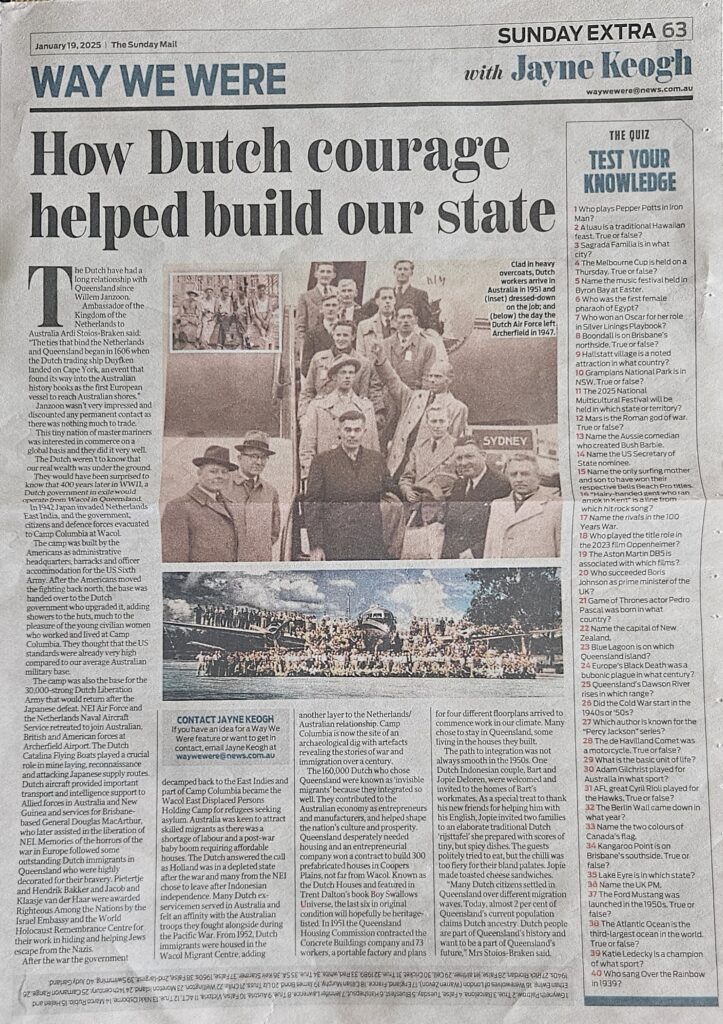
In an article published in The Sunday Mail on 19 January 2025, journalist Jayne Keogh reflects on the long and often under-recognised contribution of Dutch migrants, soldiers and officials to the development of Queensland. The story places this shared history in a broader timeline that begins in 1606, when the Dutch ship Duyfken landed on Cape York — the first recorded European contact with Australia. While early Dutch visits were brief, the relationship between the Netherlands and Queensland deepened significantly during the Second World War.
Following the Japanese invasion of the Netherlands East Indies in 1942, Dutch military personnel, government officials and thousands of civilians were evacuated to Queensland. Camp Columbia at Wacol became a major centre for Dutch wartime administration, military organisation and community life. Dutch air force units operated from Archerfield, while Dutch naval and merchant marine personnel supported Allied operations across the Pacific. The wartime presence of Allied forces transformed Brisbane, with vast numbers of military personnel passing through the city and surrounding areas, dramatically influencing local society and infrastructure.
After the war, the Dutch connection with Queensland continued through migration. By 1949 part of the former military camp at Wacol was converted into a migrant reception facility, later known as the Wacol Migrant Centre — the largest such centre in Queensland. In the early 1950s the camp’s official capacity of about 1,600 residents was exceeded, reaching close to 2,000 migrants at times. Many Dutch migrants were among those who began their new Australian lives there.
These post-war arrivals formed part of a wider migration movement that brought approximately 160,000 Dutch migrants to Australia between 1949 and 1970, one of the most significant European migration waves of the period. Over time, Dutch communities established themselves across Queensland, contributing to agriculture, construction, manufacturing and small business development. Their skills were particularly valued in the context of labour shortages and the urgent need for housing and infrastructure in the expanding state.
Demographically, the Dutch presence remains visible. At the national level, more than 381,000 Australians identified Dutch ancestry in the 2021 Census, highlighting the enduring legacy of this migration wave. Earlier data indicate that Queensland has long been one of the key destinations for Dutch settlers, with tens of thousands living in the state during the late twentieth and early twenty-first centuries.
Today, Dutch-Queenslanders and their descendants continue to form part of the state’s social, cultural and economic fabric. As Keogh’s article suggests, their story is not only one of migration but also of wartime cooperation, adaptation and long-term community building — a shared Queensland–Netherlands heritage that helped shape modern Queensland.