Post-war Dutch migration to Australia reshaped not only industry and housing but also community life. Football became one of the most effective ways for Dutch migrants to build social networks, maintain cultural continuity, and integrate into Australian society. In Sydney, one of the clubs that emerged from this environment was SC Neerlandia, whose origins are closely linked to the Social Club Neerlandia.
From social club to football club
The Social Club Neerlandia was established as a meeting place for Dutch migrants in western Sydney, providing social, cultural, and mutual support during the early years of settlement. Like many Dutch social clubs of the period, it became a focal point for community activities well beyond sport, including gatherings, celebrations, and informal welfare support.
It was from this social base that SC Neerlandia evolved in 1954. The football club emerged as a natural extension of the social club’s activities, responding to strong interest among members—particularly younger migrants—for organised sport. While administratively separate, the football club drew heavily on the social club’s membership, networks, and organisational capacity.
Early years of SC Neerlandia
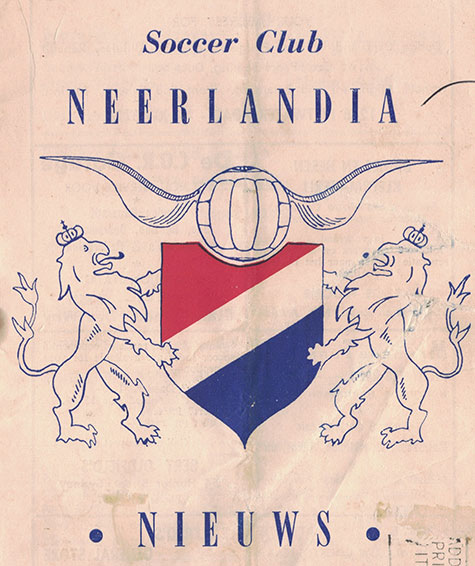
SC Neerlandia entered competition in the Manly–Warringah Soccer Football Association during a period when migrant-based clubs were a defining feature of Sydney football. The club’s early seasons were shaped by the realities of migrant life: players balancing demanding work schedules, limited resources, and family responsibilities.
Competitive success was secondary to participation and continuity. What distinguishes Neerlandia in the historical record is its stability at a time when many migrant clubs were short-lived. This durability points to the strength of the social foundations inherited from the Social Club Neerlandia.
Part of a wider Dutch football network
Neerlandia did not exist in isolation. It formed part of a broader Dutch football ecosystem in Sydney that included clubs such as Wilhelmina, Hollandia (Austral), and later Excelsior. Players, officials, and supporters frequently moved between these clubs as suburbs changed and communities evolved.
This fluid movement was not a sign of weakness but of resilience. Dutch football clubs functioned as overlapping social networks, reinforcing community ties rather than competing with one another. SC Neerlandia’s contribution lay in providing continuity through these transitions.
The transition towards the Kookaburras
By the late 1950s and early 1960s, Dutch migrant life in Sydney was entering a new phase. This shift was reflected in the formation of Kookaburras in 1960. The Kookaburras drew on players and administrators with experience in earlier Dutch clubs, including SC Neerlandia.
The choice of an Australian emblem as the club name symbolised a growing sense of belonging and confidence among Dutch Australians. Rather than marking a break, the Kookaburras represented an evolution of Dutch football culture, building on the foundations laid by clubs such as Neerlandia.
Legacy
SC Neerlandia’s significance lies not in major honours but in its role as a bridge between social and sporting life within the Dutch migrant community. Evolving from the Social Club Neerlandia, it exemplifies how migrant institutions adapted to new needs while maintaining continuity.
Together with the ongoing work of the Social Club Neerlandia and the later emergence of the Kookaburras, SC Neerlandia forms part of a broader narrative of Dutch community-building in Australia, where sport, culture, and social life were closely intertwined.