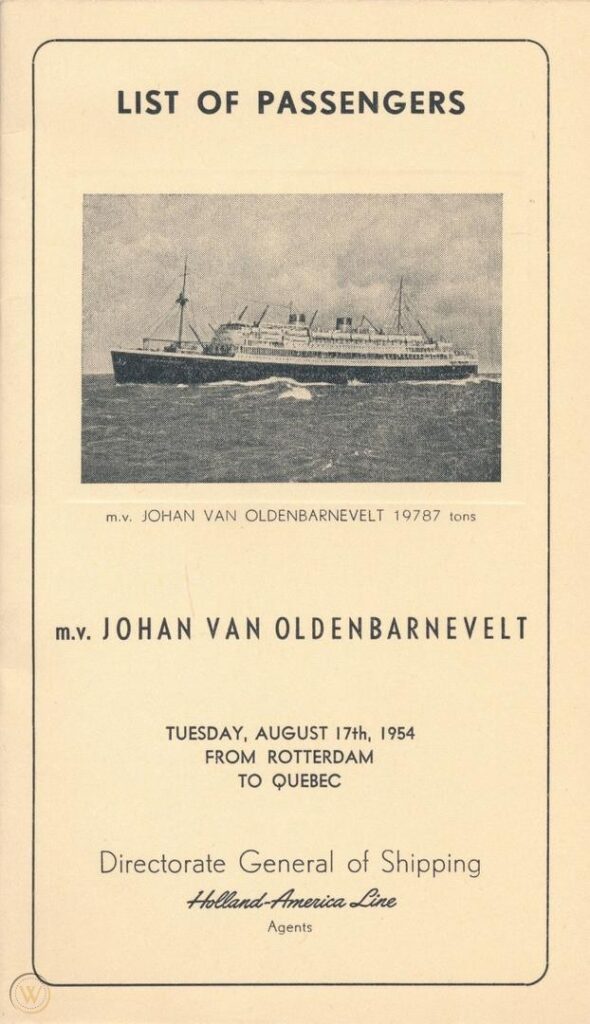
Passenger lists and arrival records can help establish when a Dutch migrant arrived in Australia, the ship on which they travelled, the port where they disembarked and the family members who accompanied them.
The National Archives of Australia holds most Australian Government passenger-arrival records from 1924 onwards. Earlier records are generally held by state and territory archives.
Finding an individual record is not always straightforward. Passenger records were created and organised in different ways over time, and not every passenger’s name can be found through a simple online search.
What information can passenger records contain?
The amount of information varies according to the period and type of record. A passenger list may include:
- passenger’s name
- age or date of birth
- nationality
- occupation
- marital status
- names of accompanying family members
- ship and shipping company
- port and date of embarkation
- port and date of arrival
- intended destination in Australia
- travel or immigration category
Some lists contain only basic details. Others provide enough information to reconstruct a family’s complete migration journey.
Names may be abbreviated, misspelled or recorded differently from the spelling subsequently used in Australia. Married women may appear under their husband’s name or initials, while children may be listed without full given names.
National Archives of Australia
The National Archives of Australia is the principal repository for post-war passenger-arrival records.
Before 1948, the captain of every passenger ship or aircraft arriving in Australia was required to provide a passenger list. From 1948, air passengers began completing individual cards. Ships continued using passenger lists until 1965, when individual movement cards replaced lists for both sea and air travel.
The National Archives holds detailed records of arrivals and departures at Australian ports from 1924, when passenger control became an Australian Government responsibility.
Some earlier records are also held by the National Archives, particularly for Western Australian, Tasmanian and Queensland ports. Most other passenger records created before 1924 are held by the relevant state or territory archive.
Searching the passenger-arrivals index
The National Archives’ passenger-arrivals index in RecordSearch covers more than ten million arrival records created between 1898 and 1972. However, its coverage varies according to the port, period and means of travel.
The index includes:
- arrivals by ship at Fremantle and other Western Australian ports from 1898 to 1966
- arrivals through Perth Airport from 1944 to 1966
- arrivals by air at Australian airports from 1949 to 1964
- arrivals by ship and aircraft at Australian ports and airports from 1965 to 1972
This makes the Fremantle records particularly useful for researching Dutch post-war emigrants. Many Dutch emigration ships called at Fremantle before continuing to Melbourne and Sydney. A passenger may therefore appear in the Fremantle arrival index even when the family remained aboard and disembarked at another Australian port.
Information to collect before searching
Searching is much easier if you first collect as much of the following information as possible:
- passenger’s full name
- alternative spellings of the family name
- approximate year of arrival
- name of the ship
- port of departure
- Australian port of arrival
- names of accompanying relatives
- passenger’s approximate age at the time
Family documents can provide essential clues. Look for passports, tickets, shipping-company brochures, luggage labels, menus, letters, diaries, photographs and naturalisation certificates.
Even an approximate month and year can substantially reduce the search required.
How to search effectively
Begin by searching for the family surname. If no result appears:
- Try the surname without prefixes such as van, van de, van der, de or ten.
- Try spelling the prefix as part of the surname and as a separate word.
- Search for another family member who travelled on the same voyage.
- Try initials instead of complete given names.
- Search for common spelling variations.
- Search by the ship’s name and approximate arrival date.
- Check Fremantle records even if the family disembarked in Melbourne or Sydney.
Dutch name prefixes were not always entered consistently. For example, Van der Meer might be indexed under “Van der Meer”, “Vandermeer” or “Meer”.
Handwritten records can also be misread during indexing. Researchers should therefore treat a failed name search as the beginning rather than the end of the investigation.
Searching by ship and arrival date
Many passenger lists are organised by:
- date of arrival
- name of the ship
- Australian port
If the passenger’s name does not appear in the online index, identifying the ship and its arrival date may allow the complete passenger list to be located.
Contemporary newspapers often published shipping movements and expected arrival dates. Family letters, passports and travel documents may also identify the ship or approximate date.
The individual DACC ship histories can help narrow the search by identifying the periods during which particular vessels operated in the Australian migrant trade.
Records held in different Australian cities
Passenger records are held by National Archives offices according to the port or state in which they were created.
For example:
- Sydney records are principally held by the National Archives in New South Wales.
- Melbourne passenger lists are held by the Victorian office.
- Fremantle records are held in Western Australia.
- Brisbane and other Queensland port records are held in Queensland.
- Adelaide records are held in South Australia.
Digitised copies of Melbourne inward passenger lists for 1924–1964 are available through RecordSearch. Other records may be available only on microfilm or as original documents.
Researchers do not necessarily have to visit an archive. The National Archives may already have digitised the relevant item, or a digital copy can sometimes be requested.
Asking the National Archives for assistance
If a record cannot be located through the passenger-arrivals index, the National Archives provides a passenger-arrival enquiry service.
To make an effective enquiry, provide:
- passenger’s full name
- port of arrival or departure
- name of the ship or airline
- approximate month and year of arrival or departure
The National Archives advises that the date should preferably be known within a two-month period. Without the ship, port or approximate date, a manual search can be extremely time-consuming.
Dutch migration records beyond passenger lists
Passenger lists are only one source of information about Dutch migration.
The National Archives also holds records relating specifically to Dutch migrants, including:
- migrant-selection documents
- assisted-passage applications
- schedules of nominated Dutch migrants
- naturalisation and citizenship files
- alien-registration records
- immigration correspondence
- migrant reception and accommodation-centre records
- government photographs of migrants and migrant centres
Migrant-selection documents can contain considerably more personal information than passenger lists. Depending on the file, they may include photographs, medical reports, employment history, education, family composition and the reasons given for migration.
A large collection of post-war migrant-selection documents is held in National Archives series A2478.
Naturalisation and citizenship records
Naturalisation and citizenship records are another valuable source when the ship or arrival date is unknown.
Applications frequently record:
- date and place of birth
- former nationality
- occupation
- Australian address
- date of arrival
- port of arrival
- name of the ship
- spouse and children
These records can provide the information needed to return to the passenger collections and locate the original arrival list.
Records before 1924
Responsibility for immigration and passenger records was divided between the Australian colonies and, after Federation, the states and the Commonwealth.
For most arrivals before 1924, researchers should consult the archive of the state or territory in which the ship arrived. Relevant institutions include state archives in New South Wales, Victoria, Queensland, South Australia, Western Australia and Tasmania.
Coverage and indexing differ considerably between states. Some passenger lists are searchable online, while others require searching shipping registers, microfilm or original documents.
Commercial family-history databases
Passenger records and indexes can also be found through commercial and genealogical services such as Ancestry and FamilySearch.
These databases can make name searching easier, but their collections may be incomplete or based on indexes rather than complete original records. Whenever possible, compare the result with the digitised passenger list or archival description held by the National Archives or a state archive.
Recording and citing the evidence
When a passenger record is found, record more than the passenger’s name. Note:
- complete archival series and item number
- ship’s name
- arrival date and port
- page number or image number
- names of accompanying family members
- spelling used in the original record
- web address and date accessed
Download a copy of the original document where permitted. Online indexes and website structures can change, while the archival series and item numbers provide a more permanent reference.
Passenger records are not merely administrative lists. For Dutch-Australian families, they often document the precise moment when one chapter of family history ended and another began.
Online research resources
- National Archives of Australia – Passenger arrival records
- National Archives of Australia – Passenger arrivals index
- National Archives of Australia – International movement records and enquiry assistance
- National Archives of Australia – Records relating to Dutch migration held in Sydney
- National Archives of Australia – Passenger records held in Sydney
- National Archives of Australia – Passenger records held in Melbourne
- National Archives of Australia – Passenger records held in Perth
- National Archives of Australia – Citizenship records
- National Archives of Australia – Search for people