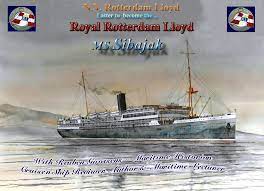
The MS Sibajak was one of the best-known Dutch ships carrying post-war emigrants to Australia. Built as a passenger and mail ship for the route between the Netherlands and the Netherlands East Indies, she later served as an Allied troopship and transported Dutch military personnel before being adapted for mass emigration.
Between 1950 and 1959, Sibajak carried thousands of emigrants to Australia and New Zealand. Among them was the person recognised in 1954 as the 50,000th Dutch migrant to arrive in Australia since the Second World War.
Built for the Netherlands East Indies service
Sibajak was built for the Rotterdamsche Lloyd by the Koninklijke Maatschappij De Schelde shipyard at Vlissingen. Contrary to the earlier version of this article, she was not originally constructed for the Koninklijke Paketvaart Maatschappij.
The vessel was named after Mount Sibayak, a volcano in northern Sumatra. The spelling Sibajak reflected the Dutch spelling used during the colonial period.
Launched in 1927 and completed in January 1928, the ship began her maiden voyage from Rotterdam to Batavia on 8 February 1928. She travelled through the Mediterranean and Suez Canal to ports in Southeast Asia and the Netherlands East Indies.
The motorship was approximately 162 metres long and powered by two diesel engines. Her passenger accommodation included first-, second- and third-class cabins, dining rooms, lounges and public spaces designed for the lengthy voyage between Europe and Asia.
The ship was modernised in Rotterdam in 1935. Before the war, she became a familiar part of the Rotterdamsche Lloyd’s mail and passenger service connecting the Netherlands with its Asian colony.
Allied troopship
When Germany occupied the Netherlands in May 1940, Sibajak was in Surabaya and remained beyond German control. She was subsequently registered at Willemstad, Curaçao.
The British Ministry of War Transport chartered the ship, while operational management was placed with the Peninsular and Oriental Steam Navigation Company. In 1941, she was converted at Singapore into a troopship capable of carrying approximately 2,300 military personnel.
During the war, Sibajak operated between Asia, Australia, the Middle East, Africa, Britain and North America. She carried Allied troops and supplies over hundreds of thousands of nautical miles, frequently travelling in convoy through waters threatened by submarines and enemy aircraft.
The ship survived the war and returned to Amsterdam in March 1946. She was then returned to the Rotterdamsche Lloyd.
Post-war military transport
From 1946, the Dutch Government chartered Sibajak to carry military personnel to the Netherlands East Indies. Return voyages transported servicemen, repatriates and families to the Netherlands.
These journeys took place during the Indonesian struggle for independence. Following the transfer of sovereignty in December 1949, the need for large-scale troop transport declined. At the same time, growing numbers of Dutch people were preparing to emigrate.
The Rotterdamsche Lloyd and Dutch Government consequently redirected Sibajak towards the migration trade.
First emigrant voyages to Australia
Sibajak commenced her Australian emigrant service in 1950. On 15 May that year, she reached Fremantle carrying 933 Dutch migrants, most of whom were joining relatives who had already settled in Western Australia or Victoria.
Of these passengers, 121 disembarked at Fremantle. Most of the others continued to Melbourne, while a smaller group travelled onward to New Zealand.
Among the migrants landing at Fremantle were three former members of the Royal Netherlands Navy who had served from the port during the Second World War aboard the Dutch destroyers Van Galen and Tjerk Hiddes. Their arrival as migrants connected Australia’s wartime Dutch naval presence with the post-war migration movement.
Further Australian voyages followed. In July 1950, Sibajak departed Rotterdam carrying approximately 1,400 migrants. Another sailing in October carried about 1,000 Dutch passengers, including 441 children, as well as prefabricated houses intended to help address Australia’s housing shortage.
Conversion into an emigration ship
In 1951, Sibajak was reconstructed to increase her capacity as a single-class emigration vessel. Her former class divisions and much of her earlier luxury were removed or reorganised.
Following the conversion, she could carry approximately 950 passengers. Accommodation ranged from multiple-berth cabins to large dormitories, some containing well over one hundred berths. The arrangements allowed many more passengers to travel, but comfort and privacy were considerably more limited than they had been during the ship’s pre-war passenger service.
The ship retained dining rooms, lounges, medical accommodation, children’s facilities and deck areas. For emigrants, these spaces created a temporary community during voyages lasting five to seven weeks.
The conversion reflected the purpose of the service: Sibajak was no longer primarily a mail liner carrying different classes of passenger between Europe and Asia. She had become a practical vessel for moving large numbers of people from the Netherlands to new homes overseas.
The February–March 1951 voyage
On 1 February 1951, Sibajak departed Rotterdam with approximately 950 Dutch emigrants bound for Australia. Two social workers travelled aboard to observe and assist the passengers.
The voyage became the subject of a contemporary sociological report by K. Mulder and T.C. Kramer, Rapport over een groep emigranten aan boord van de ‘Sibajak’: Reis Rotterdam–Sydney, Februari–Maart 1951.
The report examined emigrants as a community in transition. It is an unusual and valuable record because it studied their behaviour, expectations and relationships while they were physically between the Netherlands and Australia.
During the voyage, a passenger developed acute appendicitis after the ship had departed Aden. Sibajak returned to port so the passenger could receive surgery. The patient and family later continued their journey aboard another Dutch ship.
Sibajak reached Fremantle in early March before proceeding to Melbourne and Sydney.
Life aboard
The journey to Australia was a major experience in its own right. Passengers lived in close proximity for weeks, sharing cabins or dormitories, dining rooms and recreation spaces.
Shipboard life developed around regular meals, films, concerts, religious services, deck games and children’s activities. Celebrations, seasickness, heat, rough weather and port calls became part of the collective memory of the voyage.
Emigrants also travelled with their household possessions. Furniture, tools and personal belongings were packed into large wooden crates and carried in the ship’s holds. Some voyages transported prefabricated houses and motor vehicles alongside passenger luggage.
Elly Anderson, née Van der Sommen, later recalled that her family boarded Sibajak in May 1951 with thirteen cubic metres of furniture and belongings packed into a wooden crate, as well as seven suitcases and several smaller bags.
For many children, the voyage was remembered as an adventure. Adults were more conscious of the employment, housing, language and settlement difficulties awaiting them in Australia.
The 50,000th Dutch post-war migrant
One of Sibajak’s most significant Australian voyages took place in 1954. The ship carried 975 Dutch migrants, including many large families. Among the passengers was twenty-year-old Maria (Ria) Agnes Scholte of Amsterdam, who was recognised as the 50,000th Dutch migrant to come to Australia since the Second World War.
Before departure from Rotterdam, Dutch Minister for Social Affairs J.G. Suurhoff presented Scholte with a Delftware plate to give to Australian Immigration Minister Harold Holt. Australian Ambassador Alfred Stirling and Sibajak’s captain, Frits de Jonge, participated in the ceremony.
The ship reached Fremantle in late June and continued to Melbourne, where Scholte’s arrival received considerable public attention. The occasion demonstrated how rapidly Dutch migration had developed from the relatively small movements of the late 1940s into a significant component of Australia’s post-war immigration programme.
Later voyages
Sibajak continued carrying emigrants to Australia, New Zealand, Canada, the United States and South Africa throughout the 1950s.
Some voyages followed the traditional route through Suez, while others crossed the Atlantic and passed through the Panama Canal. This allowed the ship to operate round-the-world services connecting Europe, Australia and New Zealand.
In 1957, the Dutch Government’s emigration charter ended. Sibajak continued carrying passengers, including British and European travellers, on round-the-world services.
By then, however, the ageing vessel faced competition from newer ships and rapidly expanding international air travel.
Final voyage and demolition
In 1958, the Rotterdamsche Lloyd decided to withdraw Sibajak. Her final voyage began in 1959 and took her once more to Australia and New Zealand before continuing to Hong Kong.
She arrived at Hong Kong in August 1959 and was broken up there later that year.
Her working life had lasted more than three decades. During that time, Sibajak had served as a colonial mail ship, Allied troop transport, Dutch military vessel and emigration ship.
For thousands of Dutch Australians, however, she is remembered above all as the ship that carried them from Rotterdam towards their new homeland.
Recollections from emigrants
Janneke Hall
Our family of 5 arrived in Sydney in December 1950 on the Sibayak. We came from a little village in North Holland Brabant called Werkendam. I was 5 years old. We went to Bathurst migrant camp but we’re only there for a few weeks. Orbost then Oakleigh VIC were our next short stays. Then Ferny Creek after which we ended up in Belgrave in the Dandenongs where mum stayed until her death in 2004. Sadly my father Otto Ippel, died after only 3 years in Australia.
Ingrid Galea
I have been determined to ensure the following generations will be aware of their Dutch roots. I am also want them to be aware of the family’s migration experience. I have written several small books based on what I remember and what I have been told by my family. It is always sad to realise too late that my mother could have added so much more to the story if only I’d asked her more questions.
What I’m wondering is if anyone else is attempting to create written legacies for their family, recording their own immigration story? I’ve plundered family photograph albums to use the images which tell stories in themselves. I’ve also used National Archives if Australia and the Immigration Museum in Melbourne and anything online I can find.
Tina Namow
I came out here in 1950 on the Sibayak. We left from Rotterdam. I wrote my memoirs and they were published in 2021. I have little memory of Holland as I was only 2 years old but I wrote about being a migrant in the 50’s in Australia and the hardship my family faced. It is called I Won’t Settle for Less by Tina Namow. I was born in Breda.
Judy King
I arrived in 1956 age 11 also on the Sibajak and disembarked in Perth. My parents bought a milk bar on the swan river and (possibly because of language issues) went broke. Dad boarded a train to get work in Sydney as there was no work in Perth. Imagine coming from tiny little Nederland and seeing/experiencing our vast continent. I remember that it was all he could speak about for a while. They have since passed of course but I don’t think my mum was ever sorry she came here. My dad however got very homesick after a few years. I also need to ‘put pen to paper, and write some. Let’s to leave behind for my children and grandchildren so that they don’t forget their roots.
We came to Sydney on the same ship in October 1956. They were not the easiest of times especially hostel life and learning a new language. We also moved around the first 6 months. Never could understand why my parents left Holland and left everything I knew behind. The voyage was my highlight and perhaps instilled in me the love of travelling.
Ingrid Vos
My mother’s family came on the Sybayak too in 1952 from Rotterdam.. settled in Adelaide.
Margaret Barnes
We also arrived on the MS Sibayak in 1956 with three small children and another on the way. Mum was down with morning sickness for the entire seven week journey. Dad always said it was such a long journey. Both only has a few words of English. They did listen to tapes before the journey to pick up some common English words. Mum and dad left two big families behind in Haarlem to begin their adventure in this strange new land they knew very little about. I just couldn’t image what they went through, except that they always said it was their deep love and devotion for each other that kept them going. Your story does resonate with me as I am also wanting to put together my family’s story for our next generations never to forget their roots.
Rapport over een groep emigranten aan boord van de ‘Sibajak’,
K. Mulder and T.C. Kramer, Rapport over een groep emigranten aan boord van de ‘Sibajak’: Reis Rotterdam–Sydney, Februari–Maart 1951. Groningen: Sociologisch Instituut van de Rijksuniversiteit, 1951.
Other stories and sources
- Personal story of Family van der Net about their trip on the Sibajak
- My 1951 Sea Voyage – Elisabeth Anderson
- Documentary Emigranten reizen per MS. Sibajak on YouTube (1953, in Dutch)