The KPM steamship Bantam was one of the Dutch merchant vessels that escaped the Japanese conquest of the Netherlands East Indies and subsequently operated from Australia. During 1942 and 1943 she carried troops and supplies to New Guinea, where Allied forces depended heavily upon ships of the Koninklijke Paketvaart-Maatschappij.
Bantam survived the collapse of the Netherlands East Indies but was severely damaged during a Japanese air raid on Oro Bay on 28 March 1943. Although subsequently salvaged and towed to Australia, she never returned to commercial service. Her final use, after the war, was as a disposal vessel for chemical munitions.
A KPM inter-island ship
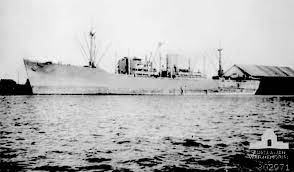
Bantam was built for the KPM by the Rotterdam shipyard of P. Smit Jr and entered service in 1930. She was a steam-powered cargo and passenger vessel of 3,322 gross tons, approximately 98 metres long.[1]
Before the war, Bantam formed part of the extensive KPM network connecting the ports and islands of the Netherlands East Indies. Vessels of this type carried passengers, mail, agricultural produce, machinery and general cargo between communities scattered across the archipelago.
This work gave KPM captains, officers and Indonesian crews considerable experience of tropical seas, difficult coastal approaches and ports with limited facilities. That knowledge became especially valuable when the surviving ships were transferred to the Allied supply system.
Escape to Australia
Following the Japanese invasion of the Netherlands East Indies, Bantam was among the KPM ships that reached Australia. On 26 March 1942 she was included in the group of Dutch vessels made available to the United States Army for employment in the Southwest Pacific Area.[2]
The ships remained Dutch-owned and continued to sail under the Dutch flag with their existing officers and predominantly Indonesian crews. Operationally, however, they were allocated according to Allied military requirements.
Bantam therefore ceased, for the duration of the war, to function as an ordinary commercial inter-island vessel. She became a military transport operating from Australian bases.
Convoy ZK8
One of Bantam’s first major wartime assignments from Australia was participation in Convoy ZK8. The convoy left Sydney on 18 May 1942 carrying 4,735 members of the Australian 14th Brigade and supporting units to Port Moresby.[3]
The troops and their equipment were distributed among four KPM ships: Bantam, Bontekoe, Van Heemskerk and Van Heutsz. The convoy was initially escorted by the Dutch light cruiser Tromp and the Australian destroyer Arunta. On 23 May, escort responsibility passed to the Australian warships Swan, Goulburn and Cessnock.[4]
Convoy ZK8 demonstrated the strategic importance of the KPM fleet. Australia did not possess enough suitable coastal transports to meet all the rapidly increasing demands of the New Guinea campaign. The Dutch ships helped fill this gap at a critical moment.
Supplying the fighting front
As Allied forces advanced along the Papuan coast, the principal supply routes shifted northwards from Australia to Port Moresby, Milne Bay and Oro Bay. Large ocean-going transports could bring supplies to the main bases, but smaller vessels were needed to move men, vehicles, ammunition and provisions closer to the fighting.
Bantam became one of the ships employed in this dangerous coastal supply system. She participated in the preliminary voyages that helped establish the route later organised as Operation Lilliput.[5]
Beginning in December 1942, Operation Lilliput maintained a regular escorted service between Milne Bay and Oro Bay. Nineteen Dutch merchant ships participated. Together with their Australian naval escorts, they delivered approximately 3,802 troops and 60,000 tons of supplies during 39 convoy movements undertaken in 40 separate stages.[6]
The ships frequently had to enter poorly developed anchorages close to Japanese air bases. Port facilities at Oro Bay were rudimentary, while firefighting equipment, salvage pumps and suitable tugboats were either inadequate or unavailable.
The attack at Oro Bay
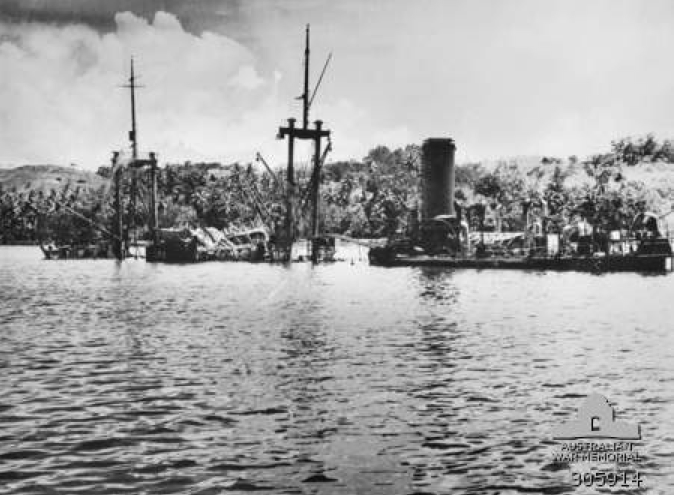
On 28 March 1943 Bantam was alongside the Liberty wharf at Oro Bay, unloading urgently needed supplies. The American ship Masaya was also in the harbour.
Japanese dive-bombers attacked the anchorage. Contemporary reports indicate that seven bombs struck Bantam or fell sufficiently close to cause serious damage. Direct hits were reported forward of the bridge, in No. 3 hold and in the engine-room area. Bombs striking the wharf also damaged the ship around the waterline.[7]
Fire spread through Bantam while steam escaped from the damaged machinery spaces. The wharf itself was burning, and its pontoons began to sink. Members of Bantam’s crew were killed and others wounded, including her captain.
The archival account used by historian Jack Ford records seven crew members killed. The Royal Australian Navy’s published history of HMAS Bowen gives a figure of six. The surviving sources therefore contain a discrepancy of one casualty, but they establish that the earlier DACC claim that the attack caused no casualties is incorrect.[8]
Despite being wounded, Captain Mulleanaux organised the surviving crew’s efforts to fight the fires and remove the ship from the burning wharf. A contemporary KPM account described the crew working “amid the roar of the flames and the escaping steam” to subdue the fire and get the vessel away from the jetty.[9]
Motorboats helped pull Bantam away from the wharf, while the Australian corvette HMAS Bowen went alongside and assisted with firefighting. The badly damaged ship was eventually grounded at the head of Oro Bay to prevent her from sinking in deeper water.[10]
Bantam’s survivors were transferred to Van Outhoorn on 29 March. The wounded were subsequently taken to Sydney, where they received treatment at the Princess Juliana Hospital.[11]
A warning about conditions in New Guinea
Bantam was not the first Dutch merchant vessel lost in the Pacific War. Nor was she the first KPM ship lost during Operation Lilliput: ’s Jacob had been sunk at Oro Bay ten days earlier. Van Heemskerk was destroyed at Milne Bay on 14 April 1943, while several other Dutch vessels suffered casualties and serious damage.[12]
Bantam’s loss became an important element in a Dutch protest over the conditions under which the ships were being employed. After inspecting the situation in New Guinea, KPM maintenance superintendent Hermanus Koning reported that the forward ports possessed little equipment with which to save a damaged ship. He particularly criticised the lack of firefighting appliances, salvage pumps and suitable tugboats.[13]
Koning believed these deficiencies had contributed directly to the loss of Bantam. KPM consequently protested to the Naval Officer-in-Charge at Port Moresby, and Dutch voyages to Oro Bay were temporarily suspended while protection and port support were discussed.[14]
The dispute did not represent a general refusal by the Dutch crews to assist the Allied campaign. It reflected mounting concern that scarce ships and experienced crews were being exposed without adequate protection or emergency support. The supply voyages resumed after the matter was addressed and Allied air cover over the area increased.
Salvage and removal to Sydney
At first Bantam appeared to be a total loss. Nevertheless, the Dutch remained anxious to recover the ship. KPM salvage specialist Captain Noorden inspected the wreck in May 1943 and concluded that it could be raised rather than abandoned or converted into a stationary coal hulk.[15]
Bantam was eventually refloated and towed to Sydney. An assessment found that returning her to operational condition would cost nearly £40,000. The Netherlands East Indies authorities decided that reconstruction was not economically justified and transferred the damaged vessel to the Royal Australian Navy for use as a target hulk.[16]
A disturbing final voyage
Australia had accumulated large quantities of chemical munitions for possible retaliatory use if Japan employed chemical weapons. After Japan’s surrender, the Australian authorities decided to dispose of much of this material at sea.
Bantam was loaded with approximately 27,500 chemical rockets, 8,000 4.2-inch chemical mortar bombs, Royal Australian Air Force chemical stores and conventional high-explosive ammunition.[17]
On 24 September 1946 the hulk was taken into deep water southeast of Sydney. HMAS Condamine sank Bantam with naval gunfire at a recorded position approximately 32 nautical miles from Macquarie Lighthouse.[18]
Thus a ship originally built to carry passengers and cargo among the islands of the Netherlands East Indies ended its life as a container for some of Australia’s most dangerous wartime materials.
Remembering Bantam and her crew
Bantam’s wartime history illustrates the transformation of the KPM fleet after the fall of the Netherlands East Indies. A commercial inter-island vessel became a troopship, military transport and essential component of the Allied supply line to New Guinea.
Her loss also demonstrates that these operations depended upon people as much as ships. Dutch officers and Indonesian seafarers continued to operate Bantam despite enemy aircraft, inadequate port facilities and the constant possibility of death or injury.
The destruction of Bantam at Oro Bay was not the first loss of a Dutch merchant ship in the Pacific War. It was, however, one of the clearest examples of the dangers accepted by KPM crews operating from Australia and of their contribution to the Allied campaign in New Guinea.
Endnotes
[1] Australian War Memorial, “Dutch merchant shipping losses in the Pacific War: Bantam,” recording Bantam as a 3,322-ton KPM vessel; shipbuilding particulars are also recorded in contemporary merchant-shipping registers.
[2] James R. Masterson, U.S. Army Transportation in the Southwest Pacific Area, 1941–1947 (Washington: Transportation Unit, Historical Division, Special Staff, United States Army, 1949), pp. 322–323.
[3] G. Hermon Gill, Royal Australian Navy 1942–1945, Australia in the War of 1939–1945, Series 2, vol. II (Canberra: Australian War Memorial, 1968), account of Convoy ZK8, May 1942.
[4] Gill, Royal Australian Navy 1942–1945, account of Convoy ZK8; Royal Australian Navy operational records for HMA Ships Arunta, Swan, Goulburn and Cessnock.
[5] Jonathan Ford, “The Netherlands Merchant Navy in the Pacific War,” Journal of Australian Naval History, vol. 6, no. 1 (2009), pp. 80–89.
[6] Gill, Royal Australian Navy 1942–1945, pp. 268–283. The terminology used in the records varies: the operation comprised 39 convoys conducted over 40 individual stages.
[7] National Archives of Australia, series MP1587/1, item 476W, cipher message from the Naval Officer-in-Charge, Port Moresby, to the Naval Officer-in-Charge, Townsville, 29 March 1943; NAA, series MP456/4, item 1943/151, Casualty Bantam, Oro Bay.
[8] Ford, “The Netherlands Merchant Navy in the Pacific War,” p. 88; Royal Australian Navy, Sea Power Centre Australia, “HMAS Bowen.” The online RAN history incorrectly gives the year of the attack as 1942; contemporary records establish the date as 28 March 1943.
[9] Koninklijke Paketvaart-Maatschappij, The Koninklijke Paketvaart-Maatschappij Lines and the War in the South West Pacific, p. 3.
[10] HMAS Bowen report, 29 March 1943, NAA, series MP1587/1, item 476W; NAA, series MP456/4, item 1943/151.
[11] Ford, “The Netherlands Merchant Navy in the Pacific War,” p. 88.
[12] Australian War Memorial, “Dutch merchant shipping losses in the Pacific War”; Gill, Royal Australian Navy 1942–1945, pp. 268–283.
[13] KPM maintenance superintendent Hermanus Koning’s report following his inspection of the New Guinea ports, discussed in Ford, “The Netherlands Merchant Navy in the Pacific War,” p. 88.
[14] Ford, “The Netherlands Merchant Navy in the Pacific War,” p. 88.
[15] NAA, series MP456/4, item 1943/151, Casualty Bantam, Oro Bay, including the Bantam Salvage Board report dated 23 May 1943.
[16] Ford, “The Netherlands Merchant Navy in the Pacific War,” p. 88. The estimated repair cost and proposed future use are drawn from the wartime salvage correspondence cited by Ford.
[17] Geoff Plunkett, Chemical Warfare Agent Sea Dumping off Australia, Department of Defence, section on the postwar disposal of chemical munitions off New South Wales.
[18] Royal Australian Navy historical record for 24 September 1946; Plunkett, Chemical Warfare Agent Sea Dumping off Australia. The recorded sinking position was 34°18.8´ south, 151°43.6´ east.