During the Pacific War, ships of the Koninklijke Paketvaart-Maatschappij operated from Australia as part of the Allied transport system. Following Japan’s surrender in August 1945, their role changed again.
KPM vessels carried people and supplies between Australia and the Netherlands East Indies. Their cargoes supported the evacuation of former prisoners and internees, the repatriation of military and civilian personnel and the reconstruction of a devastated archipelago. At the same time, ships were also intended to assist the restoration of Dutch administration and military power.
These competing purposes made Dutch shipping politically contentious. Indonesian seafarers refused to sail on vessels they believed would be used against the newly proclaimed Republic of Indonesia. Australian maritime unions supported them by imposing bans on Dutch ships and cargoes.
Pinkenba, on the Brisbane River, became one of the places where humanitarian relief, repatriation, colonial restoration and Indonesian independence came into direct contact.
From Allied victory to political uncertainty
Japan announced its surrender on 15 August 1945. Two days later, Sukarno and Mohammad Hatta proclaimed the independence of the Republic of Indonesia.[1]
The Dutch expected to resume authority over the Netherlands East Indies, but the situation was vastly different from that which had existed before the Japanese invasion. The colonial administration had been dispersed, much of the infrastructure had been destroyed and hundreds of thousands of people had been displaced.
Dutch and Indo-European civilians emerging from Japanese internment camps were frequently malnourished, ill and traumatised. Former prisoners of war required medical treatment and evacuation. Indonesian communities also faced severe shortages, damaged transport networks and political violence.
No single category adequately describes the cargoes and passengers transported from Australia. Some voyages had clearly humanitarian purposes. Others carried civil administrators, military personnel, vehicles, communications equipment and supplies intended to help restore Dutch authority.
In practice, humanitarian relief, administrative reconstruction and military preparation were often carried aboard the same ships or coordinated through the same organisations.
The Dutch and NEI presence in Brisbane
Brisbane had become an important centre of Netherlands East Indies military, intelligence, civil and logistical activity during the war. Dutch and NEI organisations maintained offices, camps, warehouses, workshops and transport facilities throughout the city.
Camp Columbia at Wacol was initially established as a United States Army camp. From 1944 it was increasingly used by Netherlands East Indies organisations. In 1945 it became an important administrative centre for Dutch and NEI personnel preparing for their return to the archipelago.[2]
It is therefore too broad to describe Camp Columbia as the headquarters of a Netherlands East Indies government-in-exile throughout the war. The wartime administrative structure evolved over time. The Netherlands Indies Government-in-Exile was formally proclaimed late in 1944, and its concentration at Camp Columbia belongs principally to the closing phase of the war and the immediate postwar transition.[3]
Pinkenba complemented this inland administrative presence by providing access to the Brisbane River and Moreton Bay. Warehouses and wharf facilities were used to assemble, store and load material destined for the Netherlands East Indies.
The KPM ships return to Pinkenba
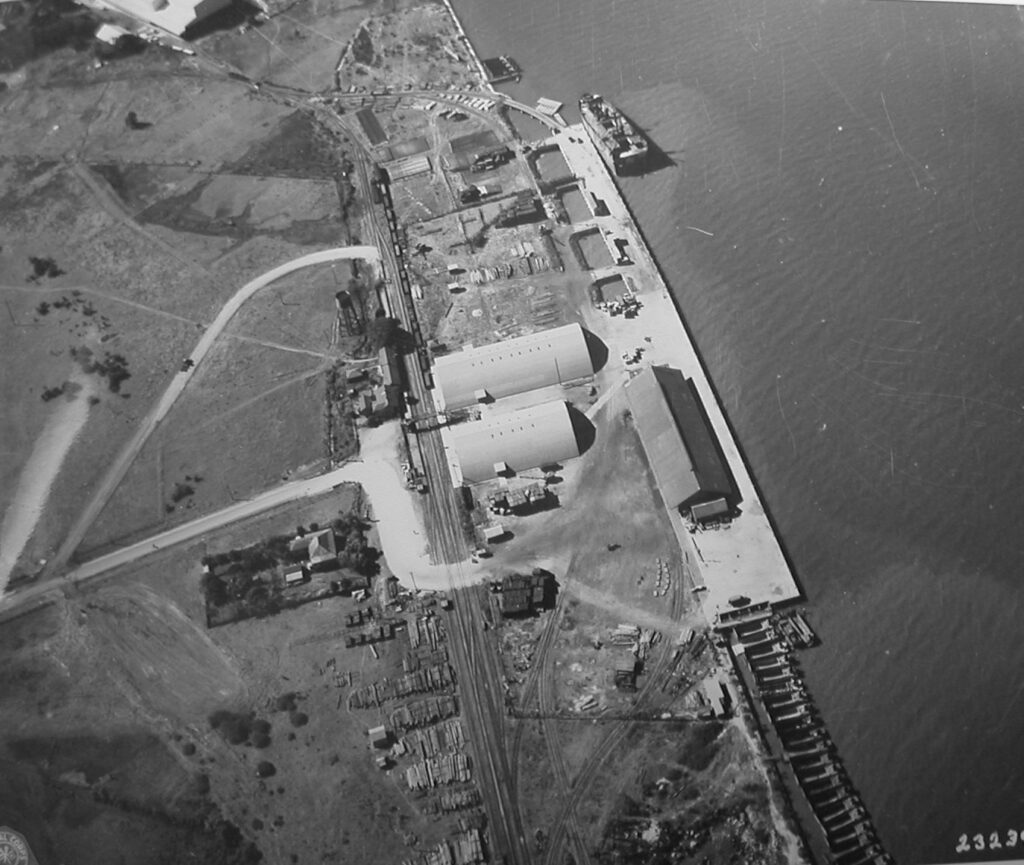
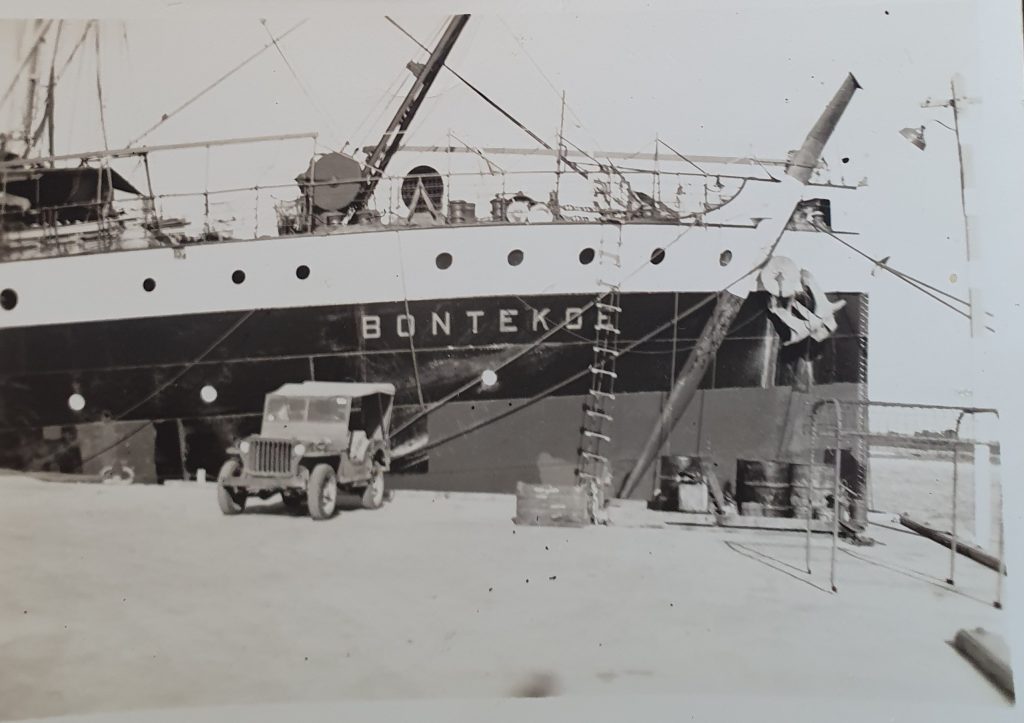
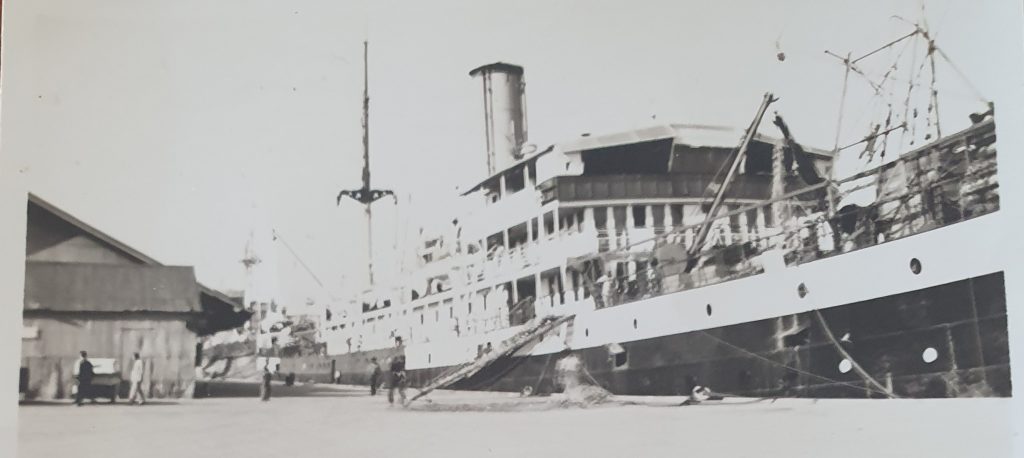
KPM vessels including Bontekoe, Both and Tasman were photographed at the Netherlands East Indies wharf at Pinkenba during 1946.[4]
These were ships with substantial wartime histories. Bontekoe had carried Australian troops in Convoy ZK8 and later participated in the New Guinea supply system and Operation Accountant. Tasman had carried reinforcements to Milne Bay before being converted into a hospital ship. Both had also served the Allied transport network.
Their arrival at Pinkenba represented continuity with the wartime logistics system, but their political setting had changed completely.
During the war, the principal objective had been the defeat of Japan. After the Japanese surrender, the same ships and administrative networks became connected with the disputed effort to restore Dutch authority in Indonesia.
Relief, evacuation and repatriation
The need for shipping after the war was enormous. Former prisoners, civilian internees, military personnel and displaced families had to be moved between Indonesia, Australia, the Netherlands and other destinations.
Australia received evacuees requiring medical treatment, rehabilitation or temporary accommodation. Dutch and Indo-European families who had been separated by the war attempted to reunite. Australian women married to Dutch or NEI personnel also travelled between Australia and the archipelago.[5]
KPM ships carried food, medical supplies, clothing, vehicles, machinery and administrative equipment. Such cargoes could support the restoration of ordinary life and basic services.
These humanitarian and reconstruction functions should not be dismissed merely because the ships operated under Dutch authority. Conditions in Indonesia after more than three years of Japanese occupation were extremely serious, and large numbers of people genuinely depended upon outside assistance.
However, it was often difficult for Indonesian seafarers and Australian maritime workers to determine where humanitarian relief ended and military or colonial restoration began.
Indonesian seafarers take a stand
Indonesian seafarers had played an important role aboard KPM vessels throughout the Pacific War. Many had remained in Australia after escaping from the Japanese conquest or had served aboard Dutch ships operating from Australian ports.
During the war they worked within a colonial maritime hierarchy in which most senior officers were Dutch and much of the lower-deck workforce was Indonesian. They also encountered differences in pay, accommodation and legal treatment.
Japan’s surrender and Indonesia’s proclamation of independence transformed their position. Many Indonesian seafarers no longer regarded themselves as employees of a colonial administration temporarily displaced by war. They saw themselves as citizens of an independent Indonesia.
In September 1945 Indonesian crew members refused to work aboard Dutch vessels they believed were carrying troops, arms or other material intended to suppress the Indonesian Republic.[6]
Their action was not simply an Australian trade-union initiative. Indonesian maritime workers themselves played a central role in starting the boycott and in persuading Australian unions to support their cause.
The Australian maritime boycott
The Waterside Workers’ Federation and other maritime unions supported the Indonesian seafarers. The first embargo on a Dutch ship was proclaimed in Brisbane on 20 September 1945. Similar action spread to Sydney, Melbourne and Fremantle.[7]
On 24 September, the federal executive of the Waterside Workers’ Federation recommended that its branches refuse to work ships carrying munitions or military supplies intended for use against the Indonesian Republic.[8]
In Brisbane, six Dutch vessels were declared “black” by the Disputes Committee of the Trades and Labour Council. On 25 September, approximately 1,400 Brisbane waterside workers endorsed the ban without dissent.[9]
The boycott expanded beyond the refusal to load individual ships. Tug crews, engineers, boilermakers, painters, carpenters, storemen, clerks and other workers could refuse services to blacklisted Dutch vessels and facilities.
The collection of ships and equipment affected by the bans became known as the “Black Armada”. The term did not describe a single fleet at sea. It referred collectively to Dutch ships, smaller craft, aircraft, vehicles and stores prevented or delayed from supporting Dutch operations in Indonesia.[10]
Hospital ships and cargoes accepted as genuinely humanitarian could receive exemptions. Disagreement nevertheless continued over whether particular ships or supplies served humanitarian, civilian or military purposes.
Pinkenba as a contested waterfront
At Pinkenba, the political dispute became visible at wharf level. Dutch and NEI personnel attempted to load ships and dispatch supplies, while union bans restricted access to Australian waterfront labour.
Newspaper reports and photographs record Dutch personnel, Australian workers, Indonesian seafarers, military units and departing passengers at the wharf. They show that Pinkenba was not simply a Dutch military installation or an ordinary commercial terminal. It was a contested logistical space.
Some ships eventually sailed with labour supplied by Dutch or NEI personnel when Australian waterside workers refused to handle them. Contemporary reports described Dutch and local dock workers working side by side on some occasions, while other departures attracted little public attention.[11]
Photographs of Bontekoe and Both at the Pinkenba wharf in 1946 capture this transitional period. The vessels that had once supported a common Allied war effort were now connected with an increasingly divisive political struggle.
The Australian Government’s position
The Australian Government’s position developed over time. It initially had to balance several competing considerations:
- the Netherlands had been an Australian ally during the war;
- Dutch and Indo-European former prisoners required urgent assistance;
- Australia had continuing military and administrative obligations in the region;
- Indonesian independence enjoyed increasing public and union support; and
- prolonged instability threatened Australia’s strategic interests.
The Commonwealth Government did not initiate the waterfront boycott, and industrial action sometimes complicated its diplomatic position. Nevertheless, Australia gradually moved towards supporting negotiations and Indonesian self-government.
Under External Affairs Minister H. V. Evatt, Australia later referred the conflict to the United Nations Security Council and participated in the United Nations Good Offices Committee. Australia’s representative, Justice Richard Kirby, played an important part in mediation between the Netherlands and the Indonesian Republic.[12]
The political relationship created during the war was therefore followed by a serious disagreement over Indonesia’s future.
From wartime partnership to decolonisation
The Pinkenba story marks the end of one phase of KPM history and the beginning of another.
Between 1942 and 1945, KPM vessels operating from Australia helped carry Australian and American troops, supplied the fighting in New Guinea and evacuated Allied casualties. Their work took place within a shared campaign against Japan.
After August 1945, the common enemy disappeared. Dutch authorities saw the surviving ships as essential to relief, reconstruction and the restoration of lawful administration. Indonesian nationalists saw the same vessels as potential instruments for re-establishing colonial control.
Australian maritime workers increasingly sided with the Indonesian claim to independence. The Indonesians who had crewed Dutch ships during the war became active participants in their country’s struggle for political freedom.
Preserving the Pinkenba record
The photographs and newspaper reports attached to the existing DACC article should remain with this revised version. Together they document:
- Bontekoe at the Netherlands East Indies wharf in 1946;
- Both at the Pinkenba wharf;
- Dutch and Australian dock workers;
- NEI troops loading a ship;
- Indonesian personnel departing from Pinkenba;
- guards at Dutch-controlled waterfront facilities;
- Australian wives travelling with Dutch personnel; and
- damage caused when a Dutch ship struck the wharf in 1947.
A complex conclusion to the KPM story
Pinkenba provides an appropriate concluding chapter for the KPM portal because it reveals how quickly the meaning of the ships’ work changed.
The vessels did not cease performing humanitarian or logistical tasks when the Pacific War ended. They carried people home, evacuated former prisoners and moved supplies needed by communities recovering from occupation.
At the same time, their employment was tied to Dutch plans to restore authority over a territory that had proclaimed independence. That placed KPM ships and their crews at the centre of a political and industrial conflict extending from Indonesia to the Brisbane waterfront.
The history should therefore not be reduced to either of two simple interpretations. It was not solely a Dutch humanitarian relief operation, nor was every ship and cargo merely an instrument of colonial warfare. Pinkenba was a place where relief, reconstruction, military power, national independence and the beginnings of decolonisation became inseparably entangled.
Newspaper clippings with thanks to Peter Dunn’s “Australia @ War” at www.ozatwar.com
Endnotes
[1] Sukarno and Mohammad Hatta proclaimed Indonesian independence in Jakarta on 17 August 1945, two days after Japan announced its acceptance of the Allied surrender terms.
[2] National Archives of Australia records concerning Netherlands East Indies organisations at Camp Columbia, Wacol; Peter Dunn, Australia @ War, research on Camp Columbia and the Dutch presence in Brisbane.
[3] The Netherlands Indies Government-in-Exile was formally established in late 1944. Earlier Dutch and NEI administrative authority was divided among the Netherlands Government-in-Exile in London, Lieutenant-Governor-General Hubertus van Mook, the Netherlands Indies Commission for Australia and other military and civil organisations.
[4] Photographs by Wim van Wely reproduced in the DACC Pinkenba collection, showing the KPM vessels Bontekoe and Both at the Netherlands East Indies wharf in 1946.
[5] Contemporary newspaper reports and photographs preserved in the DACC Pinkenba collection concerning evacuees, NEI personnel and Australian wives travelling between Australia and the Netherlands East Indies.
[6] Rupert Lockwood, Black Armada: Australia and the Struggle for Indonesian Independence, 1942–49 (Sydney: Australasian Book Society, 1975); National Archives of Australia and contemporary press records concerning Indonesian seafarers in Australian ports.
[7] Australian National University Archives, “The Black Armada,” Struggle, Solidarity and Unity: 150 Years of Maritime Unions in Australia. The ANU account dates the first Brisbane embargo to 20 September 1945.
[8] “Waterside Boycott of Dutch Ships,” Argus, 25 September 1945, p. 3, accessed through the National Library of Australia’s Trove database.
[9] “Dutch Ships ‘Black’ Over Java Trouble,” Courier-Mail, 25 September 1945. The report states that six Dutch vessels in Brisbane were declared black; contemporary accounts record approximately 1,400 waterside workers endorsing the ban.
[10] Lockwood, Black Armada. Lockwood records that the wider boycott affected numerous merchant vessels, naval craft, barges, aircraft, vehicles and shore-based stores. These totals cover the broader boycott rather than Pinkenba alone.
[11] Contemporary Brisbane newspaper clippings preserved with the existing DACC article, including reports headed “Pinkenba