
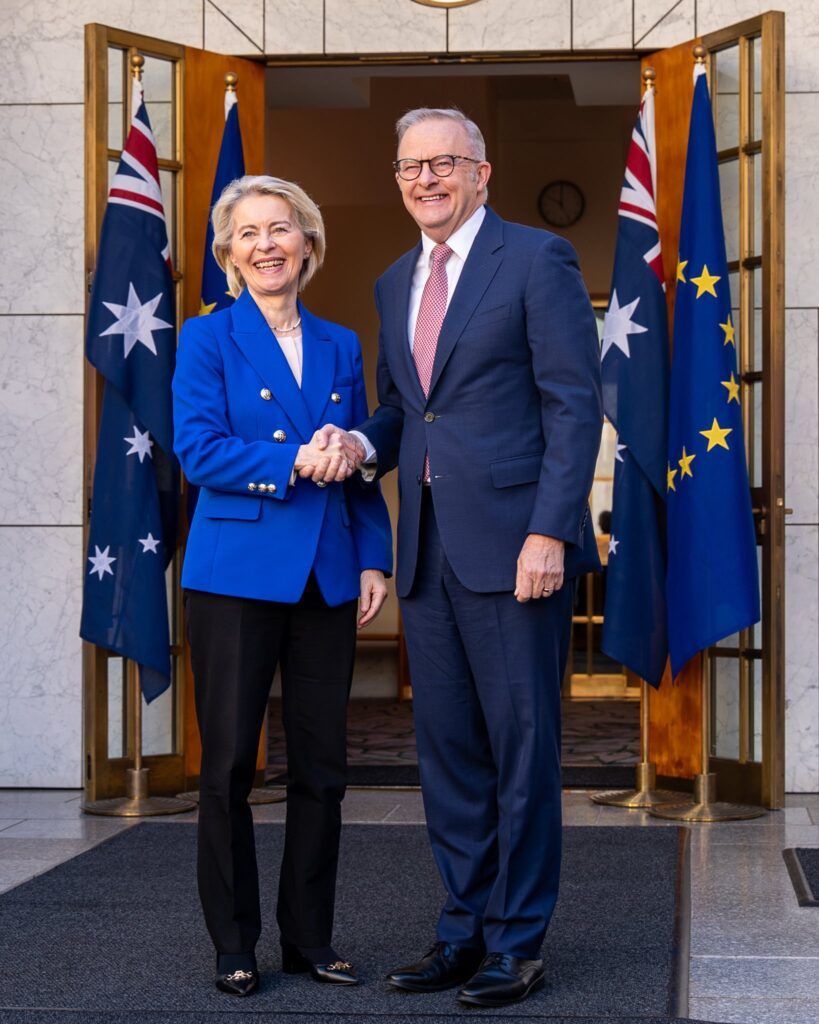
In March 2026 the long awaited EU–Australia agreement was signed, marking a significant shift in the relationship between Europe and Australia. While much public attention has focused on tariff reductions and trade access, the agreement also includes important provisions and parallel initiatives relating to research cooperation, defence collaboration and cyber security.
For Dutch and broader European communities in Australia, these developments could have long-term implications extending well beyond economic activity.
Access to Europe’s Horizon Research Programme
One of the most significant outcomes is the intention for Australia to negotiate association with Horizon Europe, the European Union’s flagship research and innovation programme.
Horizon Europe is one of the world’s largest public research funding frameworks, supporting collaborative projects in areas such as:
- climate transition and sustainability
- digital technologies and artificial intelligence
- energy systems and hydrogen development
- health innovation
- smart cities and infrastructure
Association would allow Australian universities, research institutes and industry partners to participate directly in major European research consortia, strengthening links with European scientific networks and funding streams.
For Dutch researchers and professionals working in Australia, this could significantly expand opportunities for:
- joint research proposals
- technology transfer and commercialisation
- academic mobility and collaborative PhD programmes
- innovation partnerships in sectors where the Netherlands has global strengths
This development also reinforces the long tradition of Dutch engagement in international science and applied engineering — fields that are increasingly important to Australia’s economic transition.
A new Security and Defence Partnership
At the same time as the trade agreement was concluded, Australia and the European Union signed a Security and Defence Partnership, establishing a structured framework for strategic cooperation.
The partnership includes cooperation in areas such as:
- defence industry collaboration and procurement opportunities
- maritime security
- cyber security and economic security
- counter-terrorism and counter-radicalisation
- hybrid threats and foreign interference
- emerging technologies including artificial intelligence and space security
It also aims to increase information sharing and strengthen resilience against complex security threats in both regions.
This reflects a broader geopolitical reality: Europe and Australia increasingly see their security interests as interconnected, particularly in the Indo-Pacific region.
Cyber Security and Strategic Technology Cooperation
Cyber cooperation is a central element of the new partnership. Leaders have emphasised the need to strengthen collaboration on digital resilience, critical infrastructure protection and emerging disruptive technologies.
For Dutch and European technology firms operating in Australia, this could create new opportunities in:
- cyber defence services
- secure communications and data infrastructure
- advanced manufacturing and defence technology
- supply-chain security systems
- digital sovereignty initiatives
Industry groups have already noted that the agreement could support deeper cooperation in cyber capability, advanced technology sectors and defence innovation ecosystems.
Strategic implications for European Communities in Australia
Taken together, the trade agreement, research cooperation and security partnership represent a structural deepening of EU–Australia relations.
For Dutch migrants and organisations, the implications may include:
- stronger institutional links with European universities and research agencies
- new commercial opportunities in defence-related and high-tech industries
- increased European investment in strategic sectors such as energy, maritime infrastructure and critical minerals
- expanded professional mobility for engineers, scientists and consultants
- broader cultural and academic exchange
This development may also reinforce Europe’s long-term strategic engagement in Australia — continuing a relationship shaped historically by migration, trade, maritime connections and shared geopolitical interests.
A new phase in European–Australian Cooperation
While the agreement still requires full ratification processes on both sides before entering into force, the combined trade, research and security initiatives already signal a new phase in Europe’s presence in Australia.
For Dutch communities — historically active in shipping, engineering, science and international commerce — the evolving partnership could open important new avenues for participation in Australia’s economic and technological future.
Prime Minister Anthony Albanese has signed a long-awaited free trade agreement with the President of the European Commission Ursula von der Leyen.
Paul Budde March 2026