Missionary origins and the road to Australia
In the late nineteenth century, there was growing interest among Catholic women in becoming actively involved in overseas missionary work. This development was closely linked to the rapid expansion of European colonial empires and the social conditions that accompanied them. In many colonial territories, women and children had little or no legal status and limited access to education, health care, or economic security. Male missionaries were often restricted in their ability to engage directly with women, creating a clear need for trained female religious congregations able to work across education, nursing, and community welfare.
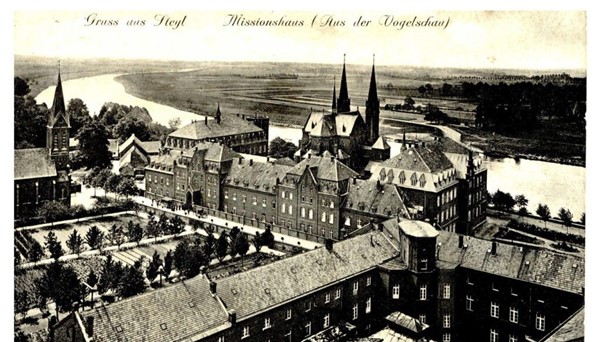
It was within this context that the German priest and scientist Arnold Janssen, together with Helena Stollenwerk and Hendrina Stenmanns, founded the Holy Spirit Missionary Sisters in 1889. Janssen had already established the Divine Word Missionary Priests and Brothers in 1875 in the village of Steyl, in the Dutch province of Limburg. He was unable to do so in Germany itself due to the anti-Catholic policies pursued under Chancellor Otto von Bismarck. The Netherlands, with its tradition of religious tolerance, thus became the organisational base for what would develop into a global missionary network. The congregation’s present head office remains in Uden in the Netherlands.
Initially, Helena Stollenwerk and Hendrina Stenmanns worked as housemaids within the male missionary establishment while Janssen prepared the foundations for a women’s congregation. Once established, the sisters were trained in a wide range of practical and professional skills, enabling them to improve living conditions at multiple levels. Their understanding of missionary work was grounded in a belief in the equal dignity of all people and a commitment to education, health care, and social justice.
Expansion beyond Europe
The congregation expanded rapidly beyond Europe. In 1895 the sisters began their first overseas mission in Argentina, followed by Togo in 1897. In 1899, four sisters travelled to German New Guinea to establish the congregation’s first mission in the Pacific.
German New Guinea comprised the north-eastern part of New Guinea and several surrounding island groups. Established from 1884 onwards, it became Germany’s first colonial possession, later expanded to include the Bismarck Archipelago and the North Solomon Islands. Following Germany’s defeat in the First World War, these territories were transferred to Australia under a League of Nations mandate. All German nationals were deported, and missionaries from Australia, the United States, and other European countries joined the order to continue its work in New Guinea.
War, captivity and loss
The Pacific War marked a decisive turning point. After December 1941, the Australian government evacuated most expatriate women and children from the region. The Holy Spirit Missionary Sisters, however, chose to remain with their communities. They were captured by the invading Japanese forces and suffered catastrophic losses.
In March 1943, missionaries from the East Sepik region were executed aboard the Japanese destroyer Akikaze, including eighteen Holy Spirit Missionary Sisters. In February 1944, a further thirty-seven sisters died when a Japanese transport ship carrying prisoners was attacked by American aircraft. Of the ninety-two Holy Spirit Missionary Sisters stationed in New Guinea, fifty-four lost their lives during the war.
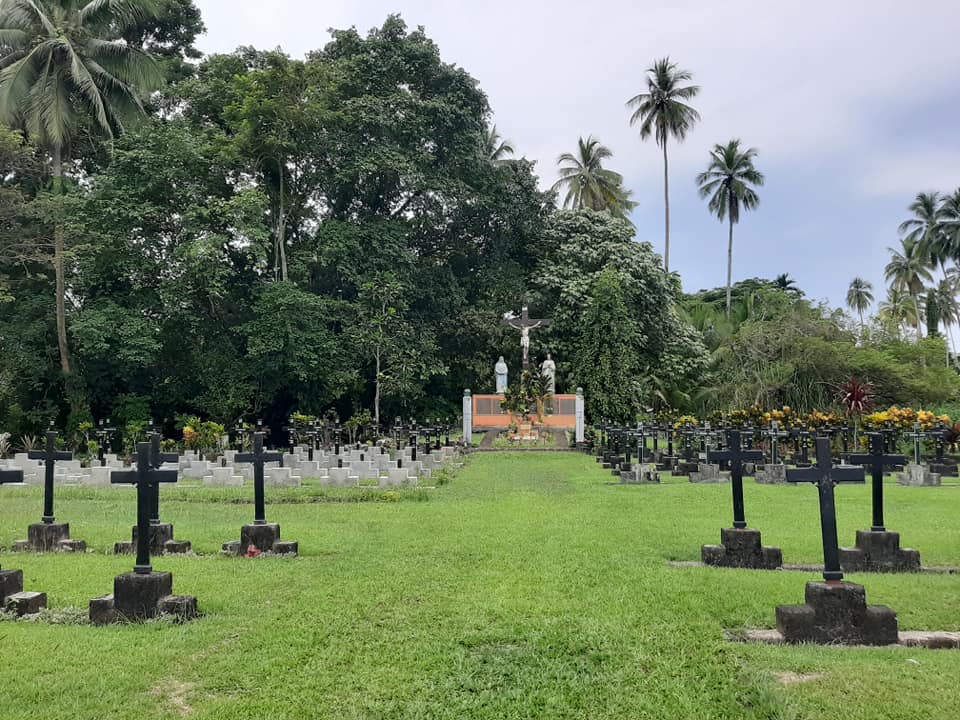
A memorial to all 160 victims, including two bishops, twenty-five priests, thirty-six brothers and fifty-six sisters, was erected at Alexishafen in Papua New Guinea in 2013. Among those commemorated were several Dutch sisters who lost their lives during these atrocities.
Below are the Dutch sisters that were massacred during WWII. A monument for all 160 victims (2 bishops, 25 priests, 36 brothers, 56 sisters) was erected at Alexishafen in Papua New Guinea in 2013.
| KLOOSTERNAAM | DOOPNAAM | FAMILIENAAM | GEBOREN | NAT. | PROF. | MISSIE | †JAAR | †DAG/M | BIJZ. | BEGRAVEN | |
| Machuta | Margaretha | Stijger | 19-03-1895 | Ned. | 1921 | P.N,G. | 1943 | 18-3 | P.N.G. | ||
| Adulpha | Adriana | Ypelaar | 06-03-1891 | Ned. | 1920 | P.N.G. | 1944 | 13-2 | P.N.G. | ||
| Alquirina | Elisabeth | Velzen van | 11-12-1908 | Ned. | 1931 | P.N.G. | 1944 | 6-2 | P.N.G. | ||
| Cunera | Maria Elisabeth | Frericks | 10-09-1899 | Ned. | 1921 | P.N.G. | 1944 | 6-2 | P.N.G. | ||
| Domitiana | Geertrudis | Hendriks | 18-08-1900 | Ned. | 1931 | P N.G. | 1944 | 9-2 | P.N.G. | ||
| Godeberta | Adriana | Beurden van | 06-09-1893 | Ned. | 1923 | P.N.G. | 1944 | 7-4 | P.N.G. |
Evacuation to Australia and wartime Brisbane
Following their liberation at Hollandia in April 1944, the surviving Holy Spirit Missionary Sisters were placed under the care of Major David Schermer of the Netherlands Indies Civil Administration (NICA). After medical treatment the Netherlands Indies Forces Intelligence Service interviewed the missionaries and hey provided valuable intelligence on the attitudes of the natives in their former parishes. The nuns and other missionaries travelled to Australia aboard a Dutch hospital ship Maetsuycker for further medical treatment. Reflecting the continued role of Dutch civil and medical services in managing the aftermath of captivity and displacement from New Guinea.Of the 92 Holy Spirit Missionary Sisters stationed in New Guinea, 54 died during the war.
By this stage, Brisbane had emerged as a major Allied wartime centre. Military installations such as Camp Columbia, together with an expanding network of hospitals, ports and administrative facilities, supported operations across the South-West Pacific. The city also functioned as a reception point for evacuees from the Netherlands East Indies and New Guinea, including civilians, medical personnel and religious workers.
The arrival of the Holy Spirit Missionary Sisters therefore took place within a broader Dutch and Allied wartime presence in Brisbane. While the Sisters had no direct institutional connection with Camp Columbia, their evacuation and reception formed part of the same wartime infrastructure that later underpinned Catholic and Dutch community initiatives in the city.
Eighteen surviving sisters joined five other sisters who had arrived earlier after trekking for months across the mountains and valleys of Papua New Guinea. I would have loved to give tribute to these very special sisters, but I unfortunately was unable to trace their names.
Establishing a lasting presence in Brisbane
Despite the complications faced by German nationals in wartime Australia, Catholic institutions in Brisbane offered the Sisters temporary accommodation. The Catholic Archbishop of Brisbane, James Duhig, invited them to establish a novitiate and offered the Colonel Raff property at Aspley. On 27 March 1945, six surviving sisters founded the first Holy Spirit convent in Australia.
From this foundation flowed a lasting Australian legacy. Garth House on Wickham Terrace became the nucleus of the Holy Spirit Hospital. In 1947, the Archdiocese of Brisbane transferred ‘Garth House’ to the Sisters. In 1950, the hospital was dedicated as the Holy Spirit American, Australian and Allied War Memorial Hospital in honour of the forces that had liberated the sisters at Hollandia. At the time of the dedication, one of the Sisters who had been a prisoner of war of the Japanese was still nursing at the hospital.
Over subsequent decades, the hospital expanded and became the congregation’s principal source of income, supporting extensive charitable and missionary work in Australia and overseas, particularly in health care
Garth House- Wickham Terrace Brisbane
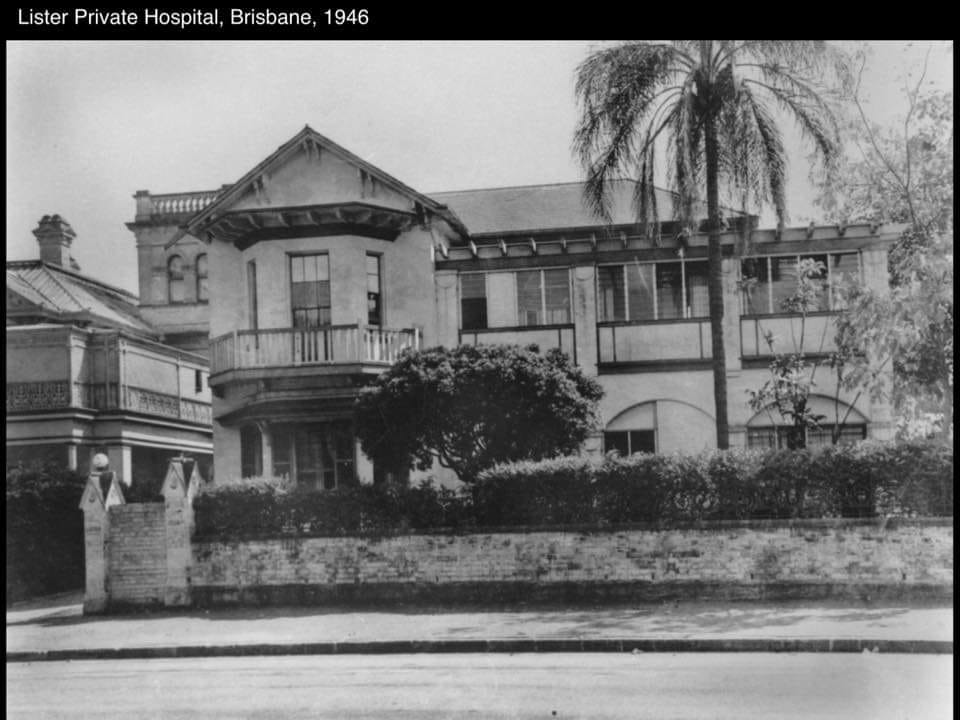
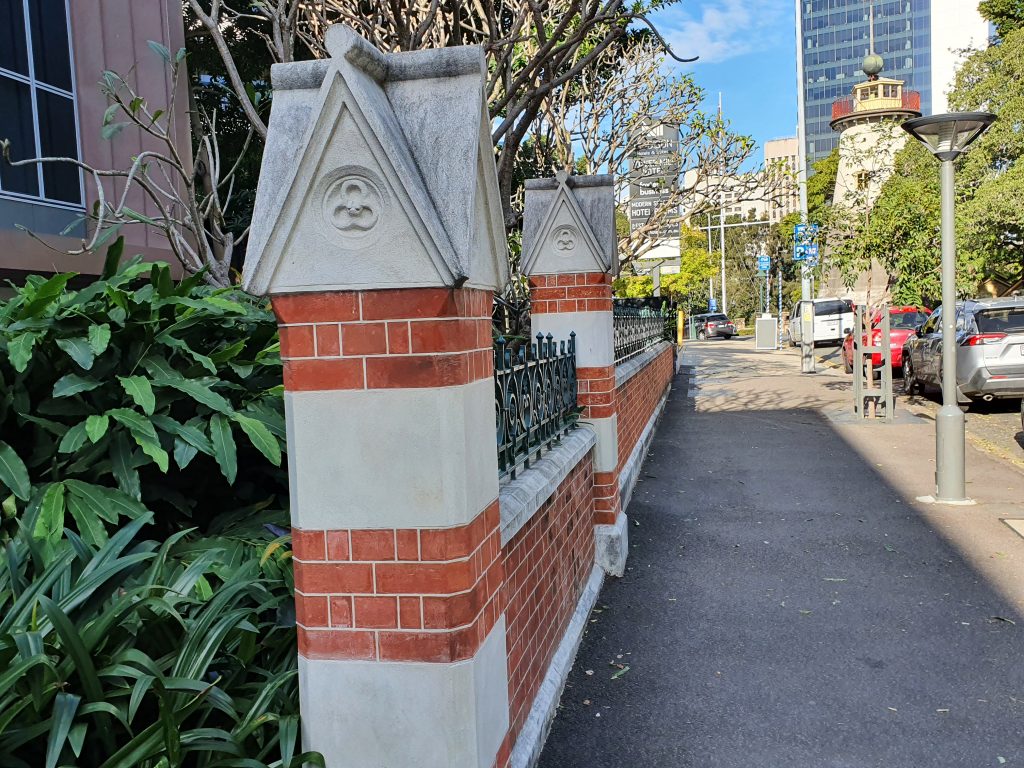
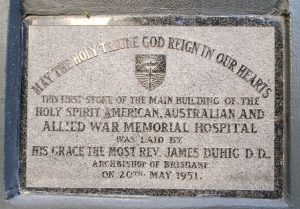
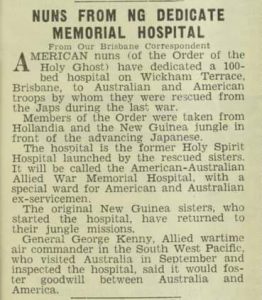
Thus, with two neighbouring nineteenth century residences already altered for multiple occupancies, the sisters converted ‘Garth House” into their Holy Spirit Hospital.
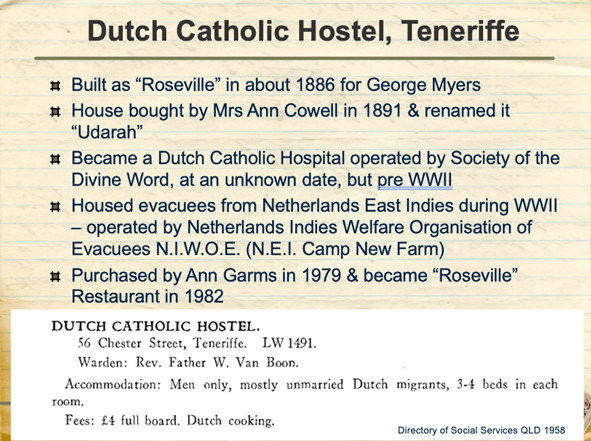
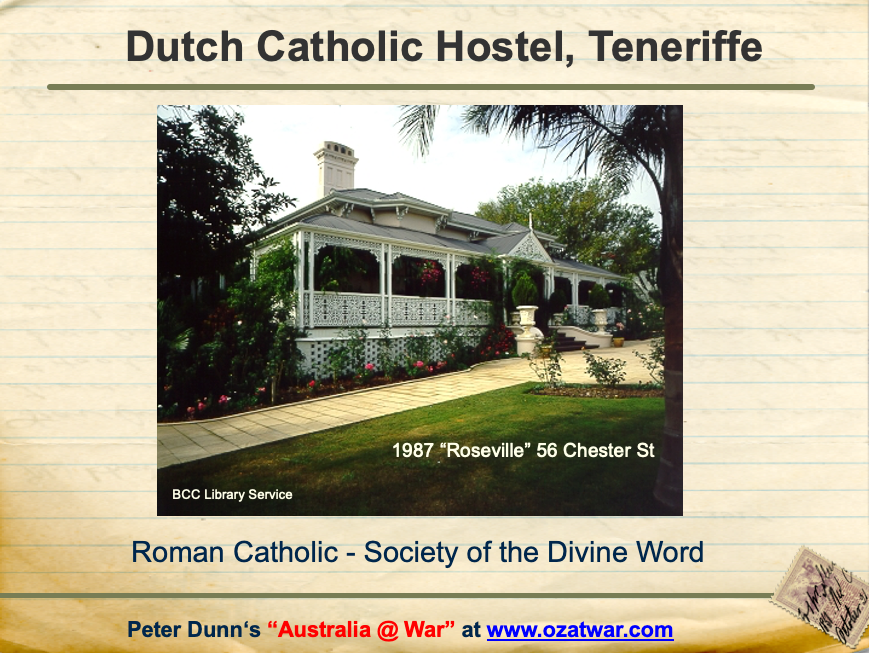
The Dutch Catholic Hostel
Brisbane’s role as a wartime and post-war reception city also led to the establishment of other Catholic initiatives to support displaced Dutch and Netherlands East Indies civilians. Among these was the Dutch Catholic Hostel in Brisbane. While organisationally separate from the Holy Spirit Missionary Sisters, their hostel emerged from the same wartime circumstances and reflected a shared Catholic response to displacement, recovery and post-war migration.
From a Dutch Australian Cultural Centre perspective, the Holy Spirit Missionary Sisters and the Dutch Catholic Hostel represent parallel strands within a broader Dutch, Catholic and humanitarian presence in wartime Brisbane.
See also: Refugees from Netherlands East Indies recuperating in Australia after WWII
Continuity, memory and living testimony
This history is not merely archival. Over the decades following 1945, the Holy Spirit Missionary Sisters became involved in a wide range of ministries across eastern and central Australia, responding to changing social needs while remaining rooted in their original missionary values.
As institutional responsibilities gradually diminished, particularly following the sale of the Wickham Terrace hospital in 2003, the Sisters were able to refocus on their core mission. Freed from the demands of hospital administration, they concentrated increasingly on outreach among marginalised communities, social justice initiatives and pastoral support.
Acknowledgement of Sr Christa Murphy
I am deeply grateful for the assistance of Sr Christa Murphy, who reviewed and edited this text in 2021. At the age of over eighty-eight, she undertook this work entirely by email, bringing both historical insight and personal reflection to the narrative. Her contribution ensured that this account remained faithful not only to documented events, but also to the lived experience and values of the congregation.
The Sisters’ mission today
Sr Christa Murphy offered the following statement, which provides a fitting conclusion and reflects the enduring ethos of the Holy Spirit Missionary Sisters:
Our Mission:
“To witness to the presence of the Spirit of Life and Love as we journey with people, affirming Life, promoting Justice, offering Hope”.
Paul Budde (2021, updated 2026)
Sources:
Missiezusters Dienaressen van de Heilige Geest
Holy Spirit Missionary Sisters
Queensland World War II Historic Places