Following the fall of Singapore in February 1942 and the rapid Japanese advance through Southeast Asia, Western Australia assumed unexpected strategic importance. Fremantle became a critical Allied port, serving as a gateway between the Indian Ocean and the South-West Pacific Area (SWPA). In this period of acute vulnerability, Dutch naval forces in exile played a disproportionate role in the defence of Australia’s western approaches.
Arrival of Dutch warships at Fremantle
On 25 September 1942, the Dutch cruisers Jacob van Heemskerk, Van Galen and Tjerk Hiddes arrived at Fremantle. These ships, crewed by personnel evacuated from the Netherlands East Indies (NEI) and Europe, were integrated into an improvised Allied naval force defending Western Australia. Australian specialists were assigned to the Dutch ships, including radar operator Darcy Keating aboard Van Galen, reflecting the practical cooperation that developed between Allied navies in this period.
Operational command of the combined force fell to Charles Lockwood, the US Navy area commander. Although primarily a submarine officer, Lockwood found himself responsible for a small but strategically significant surface fleet. Dutch cruisers were joined by HMAS Tromp, HMAS Voyager and the light cruiser HMAS Adelaide. Together, these seven warships constituted the principal surface defence of Western Australia at a time when fears of Japanese raiding activity were widespread.
Dutch naval command in exile
The growing Royal Netherlands Navy presence in Fremantle required new organisational arrangements. Frederik Willem Coster, commander of Dutch naval forces in Australia, travelled from Melbourne to Fremantle in September 1942 to inspect the ships and assess local support requirements. During his visit, Coster met with Lockwood and paid particular attention to submarine operations, including a visit to the Dutch submarine K-XII.
Coster was a strong advocate of submarine warfare and had earlier overseen the installation of air-conditioning in Dutch pre-war submarines operating in tropical waters. His inspection underlined the importance of Fremantle not merely as a port of refuge, but as an operational base capable of sustaining prolonged Allied naval activity.
The Dutch Women’s Auxiliary Force in Western Australia
One of the most remarkable outcomes of Coster’s visit was the establishment of a Dutch Women’s Auxiliary Force in Western Australia. Drawn largely from NEI refugees—some of them survivors of the Broome air raid—these women volunteered to support the Dutch naval presence at Fremantle. Many had husbands or family members held as prisoners of war, and their desire to contribute to the Allied war effort was intense.
Lockwood later reflected on the emotional circumstances of these women, noting that few knew the fate of their menfolk. He described their courage and determination under heartbreaking conditions as deeply inspiring. The enthusiasm and commitment of the auxiliary force helped create Royal Netherlands Navy base facilities at Fremantle that, in Lockwood’s words, rivalled those of other Allied navies operating in Australia.
Submarine Port Fremantle and K-XII
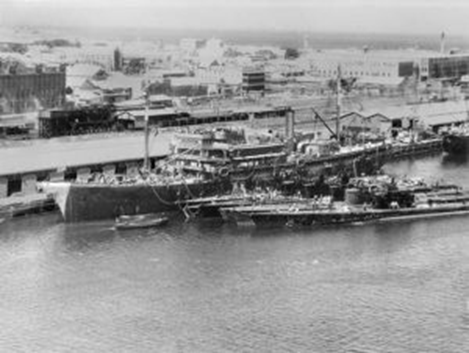
Fremantle also functioned as a submarine port, although Dutch submarine operations there were limited by material constraints. The submarine K-XII was the only Royal Netherlands Navy submarine permanently based at Fremantle during this period. Built in 1924, K-XII was already nearing the end of its service life and suffered frequent mechanical failures. Spare parts were difficult or impossible to obtain, requiring local manufacture and extended dockyard repairs.
Despite these limitations, K-XII conducted four covert patrols in support of the Netherlands East Indies Forces Intelligence Service (NEFIS) between August 1942 and June 1943. NEFIS operated from Camp Columbia in Brisbane, making Fremantle an important western counterpart in the Dutch intelligence network.
On one such patrol in November 1942, K-XII narrowly avoided disaster when USAAF bombers attacked the submarine as it approached Fremantle. The attack missed, but the submarine’s commander, Henry Coumou, lodged a formal protest. The incident was dismissed on the grounds of a “failure to give the correct recognition signal”, a response familiar to Allied naval commanders whose ships had also been subjected to USAAF friendly-fire incidents earlier in the war, including during the Battle of the Coral Sea.
Two Dutch naval theatres: Fremantle and Ceylon
Dutch naval operations in the Indian Ocean were divided between two command areas. While Fremantle fell under SWPA and US command, the Indian Ocean theatre was controlled by South East Asia Command (SEAC) under British leadership. Dutch submarines operating from Ceylon experienced significantly higher levels of combat activity than those based in Australia.
Between July and November 1942, the Dutch submarine O-23, operating from Ceylon under Lieutenant-Commander Valkenburg, sank or damaged multiple enemy vessels in the Malacca Straits, disrupting Japanese shipping entering the SWPA. These operations complemented, rather than duplicated, the intelligence-focused missions undertaken by K-XII from Fremantle.
Strategic significance
The Dutch naval presence at Fremantle in 1942–43 illustrates how exile forces adapted rapidly to new strategic realities. With limited resources, ageing vessels and personnel drawn from across the collapsing NEI, Dutch naval commanders nevertheless contributed meaningfully to the defence of Western Australia. Their efforts spanned surface defence, submarine operations, intelligence support and base logistics, reinforced by the often overlooked contribution of Dutch civilian refugees.
Fremantle’s role as an Allied naval hub was short-lived but critical. In this improvised defensive system, Dutch naval forces—working alongside Australian and American counterparts—helped stabilise Australia’s western flank at a moment when the outcome of the Pacific War was still far from certain.
See also: