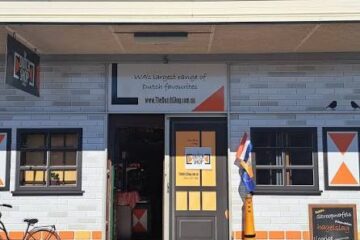
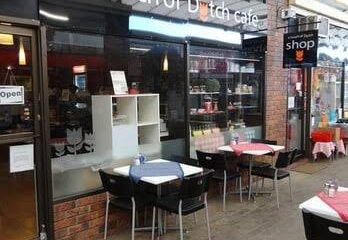
De Hollandse Winkel was a specialist Dutch food retailer operated by Albert Kerkvliet and his wife in Melbourne. Its history illustrates the continuation of Dutch food retailing beyond the heyday of the original Dutch shops and wholesalers of the 1950s, 1960s and 1970s.
The business dates back to 1983 and operated a substantial Dutch supermarket in Vermont South, later relocating to Mitcham. It also established a retail outlet in Brighton, Adelaide.
Establishing a Dutch supermarket
Before opening the supermarket, the proprietors consulted members of the Dutch community, including the Dutch Club in Carnegie and representatives of the Dutch consulate. These discussions indicated that there was sufficient demand for a supermarket specialising in Dutch products.
The business operated from 272–276 Morack Road, Vermont South. According to its historical business profile, its premises covered approximately 836 square metres and accommodated more than 900 different products.
Alongside traditional Dutch groceries, cheese, herring and confectionery, the supermarket stocked ceramics, household goods, clogs, magazines and other products associated with Dutch cultural traditions.
The Adelaide outlet was located at 457 Brighton Road, Brighton. Top Local Places+1
Commercial relationships with Rubsons
De Hollandse Winkel benefited from the established Dutch food wholesale network in Australia.
Paul Rubens, whose family operated the Melbourne-based food wholesaler Rubsons, recalls that De Hollandse Winkel was located approximately ten kilometres from the Rubsons warehouse.
According to Rubens, Albert Kerkvliet and his wife purchased most of their Dutch products from Rubsons. The supermarket also reported maintaining direct relationships with suppliers in the Netherlands.
This commercial relationship illustrates how established Dutch wholesalers supported the development of specialist retailers beyond the principal period of Dutch post-war migration.
Social and cultural significance
De Hollandse Winkel provided more than a retail service. Its business profile recalls occasions when Dutch migrants who had lost contact with one another unexpectedly met again while shopping.
Many older customers sought products and brands they remembered from their childhood in the Netherlands, while younger generations developed their own preferences.
The cultural significance of the supermarket was recognised in the 2011 study Victoria’s post-1940s migration heritage, prepared for the Heritage Council of Victoria. The report identifies De Hollandse Winkel as an example of specialist migrant retailing and its contribution to establishing a sense of home in Australia. Heritage
The Melbourne business subsequently announced its relocation to 13 Thornton Crescent, Mitcham. The later history of the business remains to be documented.
The DACC welcomes further information and photographs relating to the Kerkvliet family and the development of De Hollandse Winkel.
Sources and further reading
- Personal correspondence with Paul Rubens, November 2026.
- De Hollandse Winkel – historical business profile, Vermont South
- De Hollandse Winkel – business history and relocation announcement
- Victoria’s post-1940s migration heritage – Heritage Council of Victoria, 2011 (PDF)
- Rubens Family and Rubsons – Dutch Food Wholesalers in Melbourne
This article forms part of the Dutch Australian Cultural Centre’s Research Portal – Dutch shops and food wholesalers in Australia, documenting the history of Dutch retail and wholesale businesses, their entrepreneurial achievements and their contribution to Australian economic, social and cultural life.