Introduction
In the decades following the Second World War, Canberra became home to a growing number of Dutch migrants. As in other parts of Australia, football (soccer) played an important role in helping these newcomers build social networks, preserve cultural familiarity and gradually integrate into Australian society.
In Canberra, Dutch migrants were involved in several football clubs that reflected different phases of this process. Four clubs in particular — Hollandia / Canberra Austral, Be Quick, Fortuna ’62 and Australiana Capital Territory — together illustrate how Dutch identity, community formation and multicultural integration unfolded through sport in Australia’s national capital.
Hollandia: visibility, success and institutional adaptation
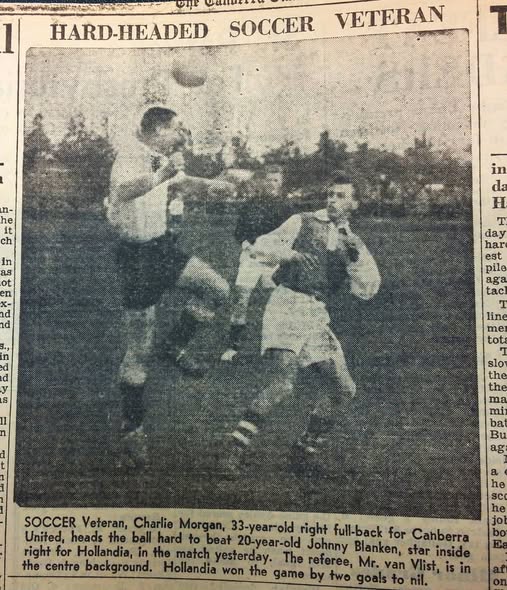
Founded in 1954, Hollandia was the first Dutch football club established in Canberra. Its name and red-and-white colours signalled a strong Dutch identity at a time when ethnic clubs played a central role in migrant community life.
Hollandia was immediately competitive. In 1955 it won the ACT First Division championship and the J.R. Fraser Cup, achievements that gave the club high visibility within Canberra football. These successes demonstrated that a migrant-founded team could compete at the highest local level and helped establish the Dutch community as a confident presence in the city’s sporting landscape.
Despite its Dutch origins, Hollandia was never exclusive. By the late 1950s it fielded players from many national backgrounds, reflecting both Canberra’s changing population and a typically Dutch openness to integration. In 1960, following directives discouraging ethnically identifiable club names, the club adopted the name Canberra Austral.
Although Canberra Austral enjoyed a strong season in 1961, its performance declined in later years. In 1965 it merged with Burns United to form Burns Austral, and through subsequent mergers its lineage became part of what later emerged as the Turner Eagles. Hollandia’s significance lies not only in its trophies, but in its role as a highly visible expression of Dutch migrant confidence in postwar Canberra.
Be Quick: cultural familiarity and community cohesion
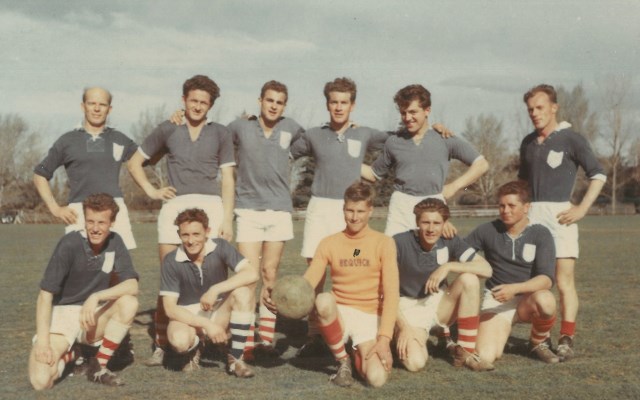
While Hollandia represented ambition and public success, Be Quick reflected the importance of familiarity and community continuity.
The name Be Quick has deep roots in Dutch football culture and would have been immediately recognisable to Dutch migrants. Establishing a club under this name in Canberra was a conscious cultural choice, linking the new Australian setting to football traditions from the Netherlands.
Be Quick operated largely at a grassroots level. Its importance lay less in competitive success and more in its social function. The club provided a regular meeting point where Dutch migrants could maintain language, friendships and shared customs through sport. For many participants, football was as much about belonging as it was about results.
Fortuna ’62: a second generation of Dutch football organisation
By the early 1960s, Dutch football organisation in Canberra entered a new phase with the formation of Fortuna ’62. The club was established in 1962 and its name again reflected a strong Dutch football tradition, drawing on well-known Dutch club naming practices.
Fortuna ’62 attracted players who were active in Canberra’s football scene but sought a renewed Dutch-oriented club environment. The club competed in ACT competitions during the 1960s and, like earlier Dutch-founded teams, combined sporting participation with a strong social dimension.
The establishment of Fortuna ’62 suggests that Dutch identity in Canberra football did not disappear with the renaming or merging of earlier clubs. Instead, it re-emerged in new organisational forms, shaped by changing demographics, generational shifts and evolving relationships with Australian sporting institutions.
Australiana Capital Territory: integration within a multicultural framework
Australiana Capital Territory formed part of the same football environment but differed in character. While Dutch players were involved, the club did not present itself as explicitly Dutch. Instead, it reflected a more integrated, multicultural approach from the outset.
Clubs such as Australiana ACT demonstrate how Dutch migrants increasingly moved beyond ethnic-based organisations and participated comfortably in mixed teams. This pattern aligns with broader observations about Dutch-Australian settlement, where cultural identity was often maintained informally rather than through permanent institutional structures.
From ethnic clubs to a shared football culture
By the mid-1960s, Canberra football reflected national trends. Ethnic clubs were encouraged to adopt neutral identities, while multicultural teams became the norm. Dutch-founded clubs did not vanish abruptly; rather, they merged, rebranded or inspired new initiatives such as Fortuna ’62.
This evolution mirrors the wider Dutch-Australian experience. Dutch migrants tended to integrate pragmatically, retaining cultural traditions where meaningful while contributing actively to mainstream institutions. Football provided a practical and socially accepted pathway for this transition.
Legacy and significance
Together, Hollandia, Be Quick, Fortuna ’62 and Australiana ACT offer a layered picture of Dutch migrant life in Canberra. They show how football functioned as a tool for community formation, cultural continuity and gradual integration, and how Dutch migrants helped shape Canberra’s football culture during its formative postwar decades.
For the Dutch Australian Cultural Centre, these clubs form part of a broader narrative of migration, adaptation and contribution, reminding us that everyday activities such as sport play a vital role in the history of settlement and identity.
Main source: Clogball