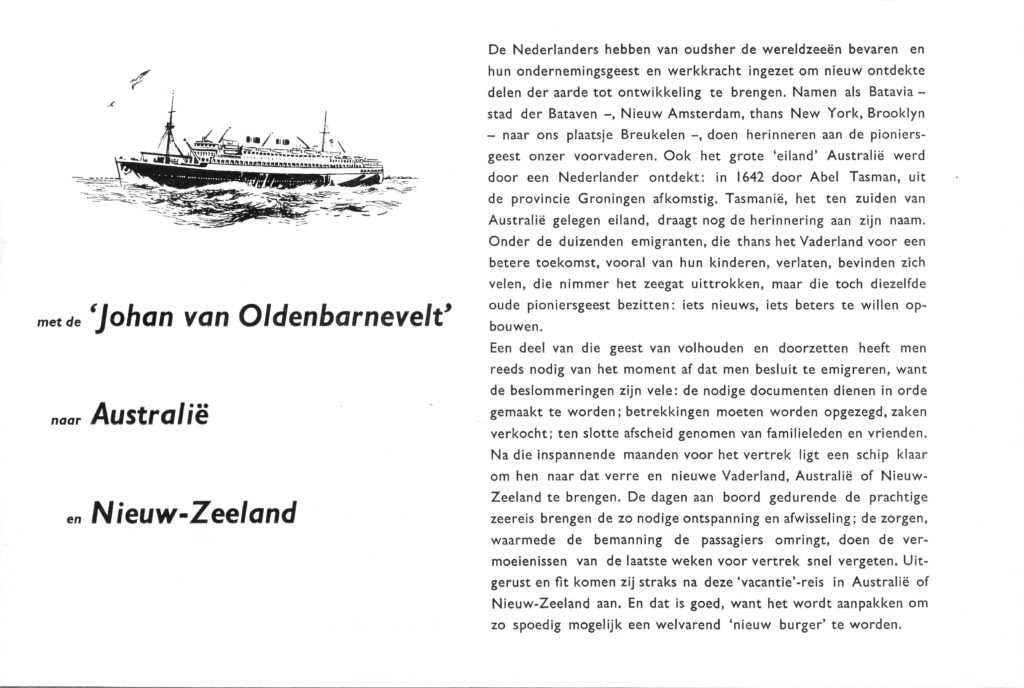
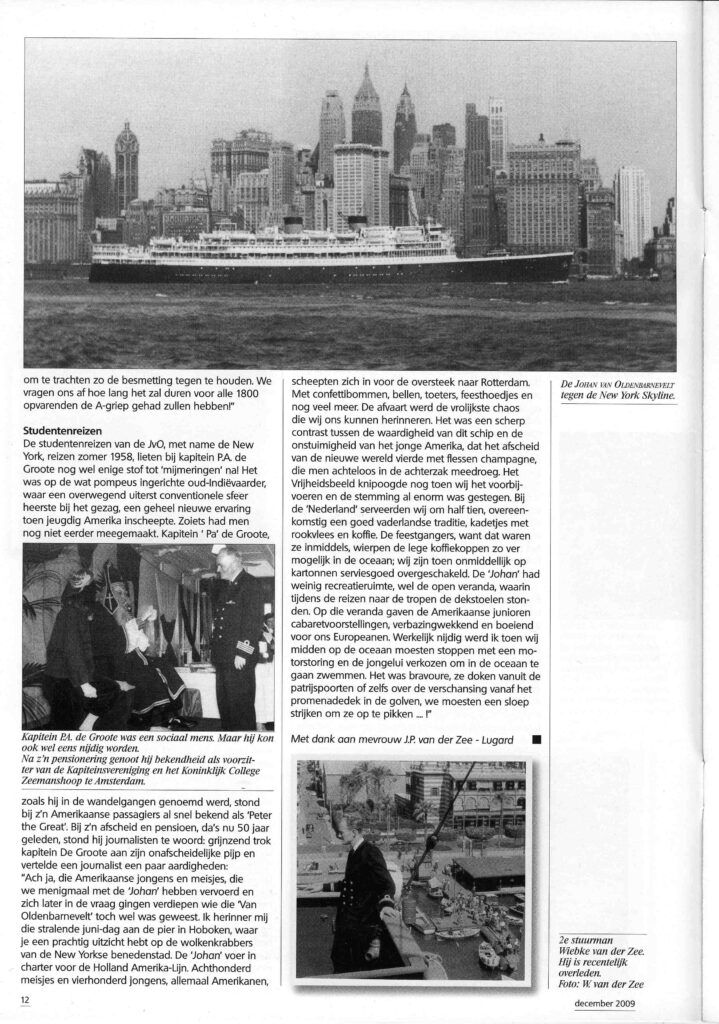
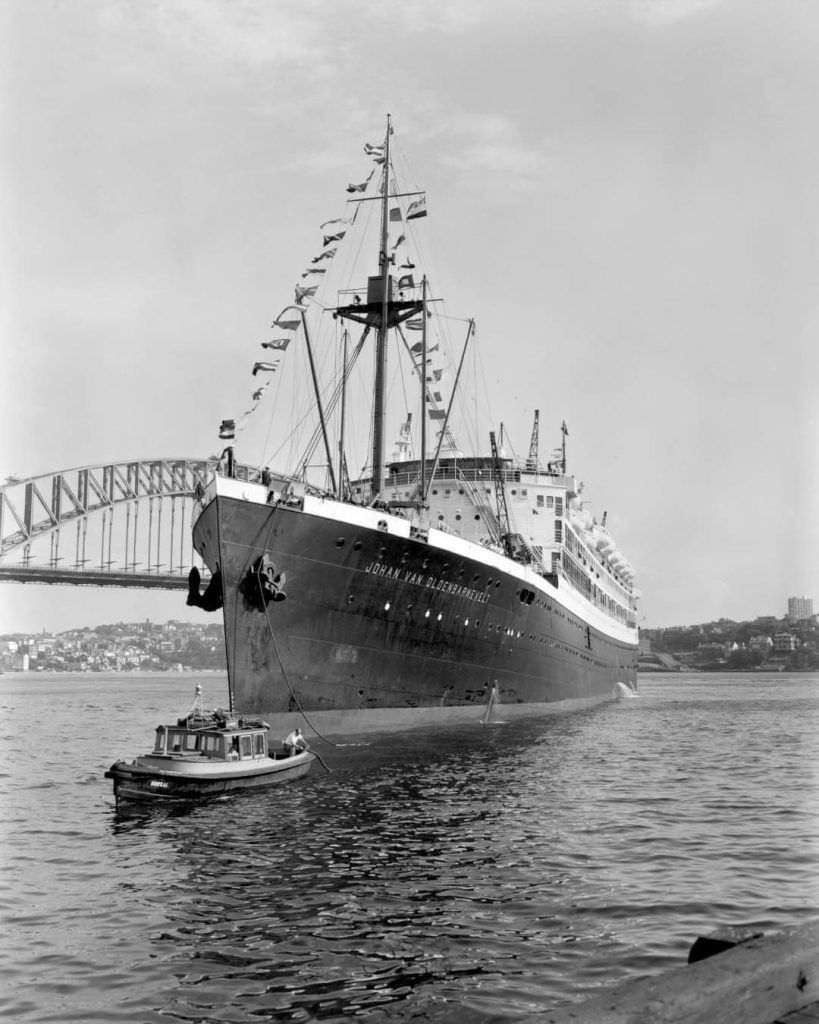
The motor ship Johan van Oldenbarnevelt, widely remembered as the JVO, was one of the most important vessels in the history of post-war Dutch migration to Australia.
Originally built as a prestigious passenger liner for the Netherlands–East Indies service, she subsequently served as an Allied troopship before being converted to carry emigrants. Between 1950 and 1958 she operated under charter in the Australian migrant trade, bringing thousands of Dutch and other European emigrants to Fremantle, Melbourne and Sydney.
After the migrant charter ended, Johan van Oldenbarnevelt continued visiting Australia as a passenger and round-the-world liner until 1963. For the families who travelled aboard her, the ship became closely associated with departure from the Netherlands and the beginning of a new life in Australia.
Built for the Netherlands–East Indies service
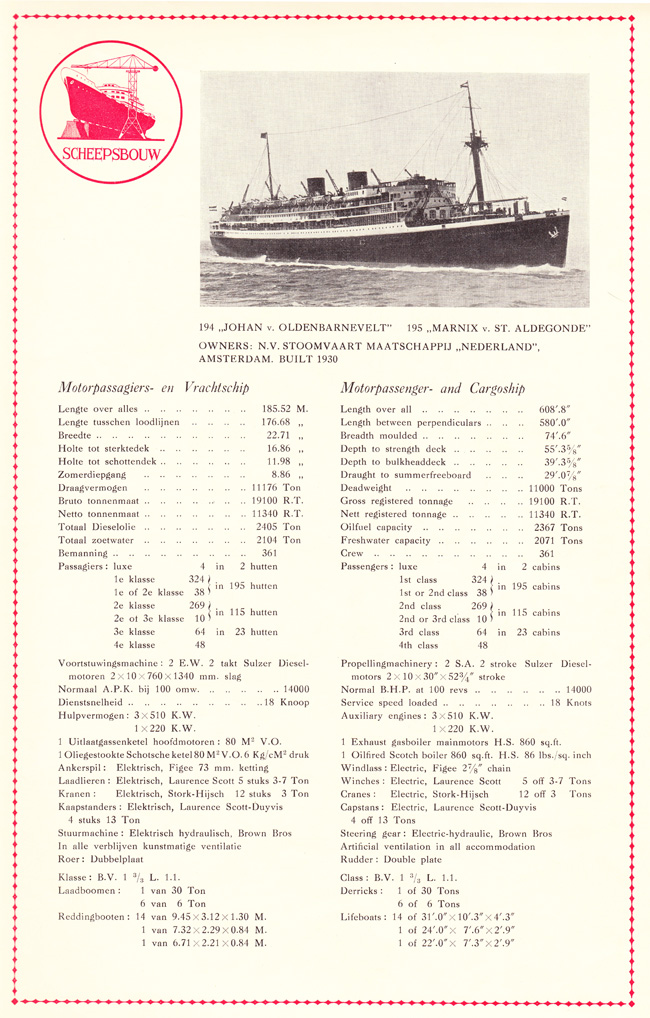
Johan van Oldenbarnevelt was built for the Stoomvaart Maatschappij Nederland, generally known in English as the Netherland Line. The vessel was constructed by the Nederlandsche Scheepsbouw Maatschappij in Amsterdam and launched on 3 August 1929.
When completed in March 1930, she was the largest ship yet built in the Netherlands. She was named after Johan van Oldenbarnevelt, the influential Dutch statesman who played an important role in establishing the Dutch Republic during the late sixteenth and early seventeenth centuries.
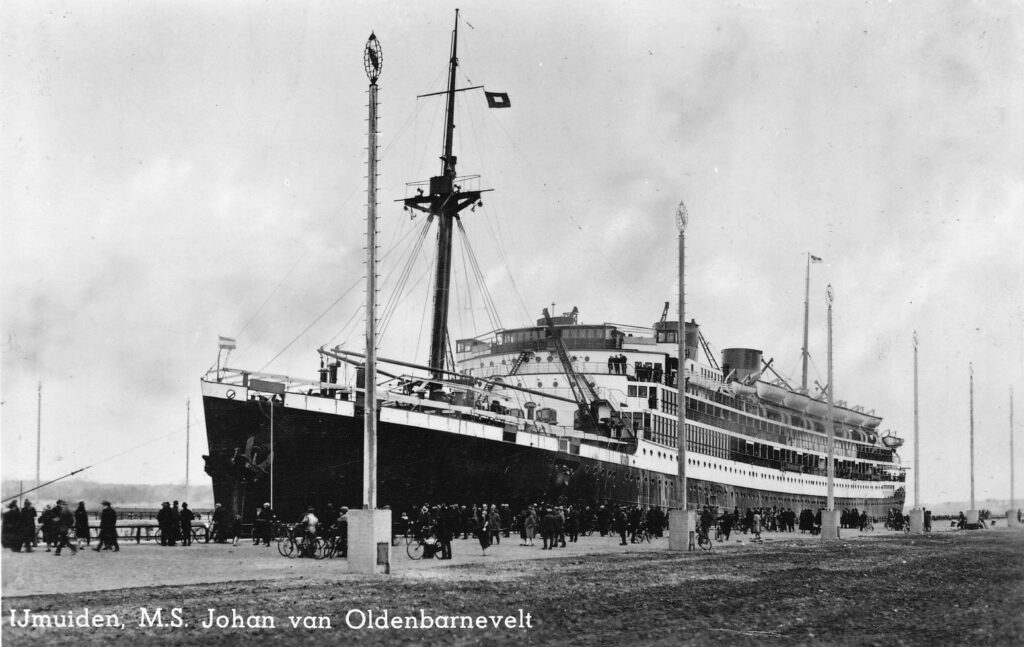
The ship was approximately 185 metres long and powered by two Sulzer diesel engines driving twin propellers. She had a service speed of about 17 knots and could carry approximately 9,000 tons of cargo.
As originally built, the ship accommodated 770 passengers:
- 366 in first class
- 280 in second class
- 64 in third class
- 60 in fourth class
Accommodation was also provided for approximately 360 crew members.
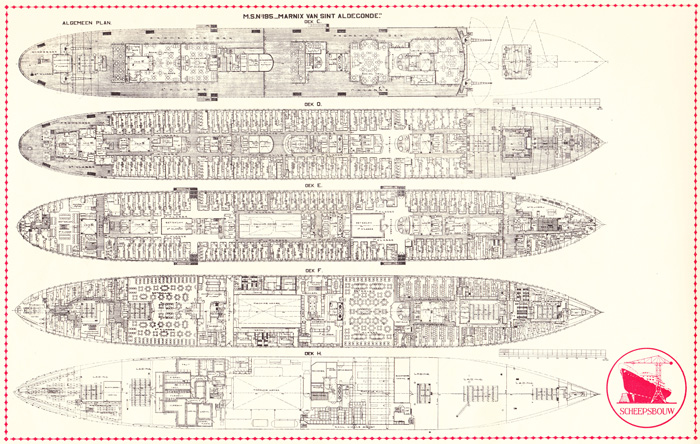
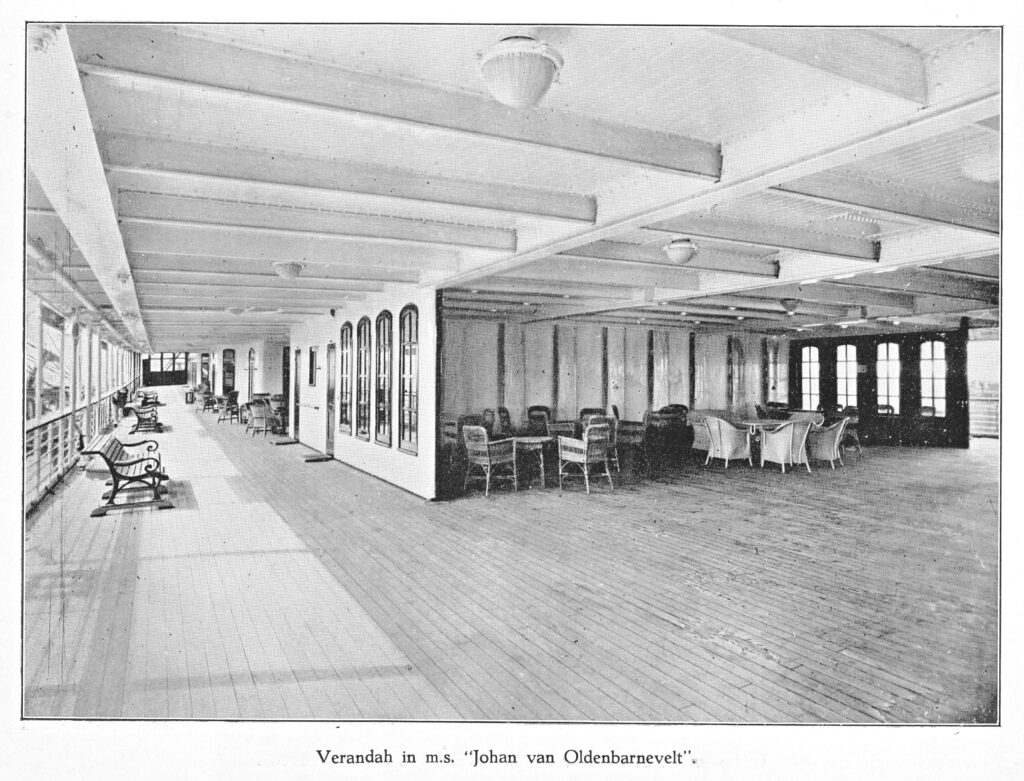
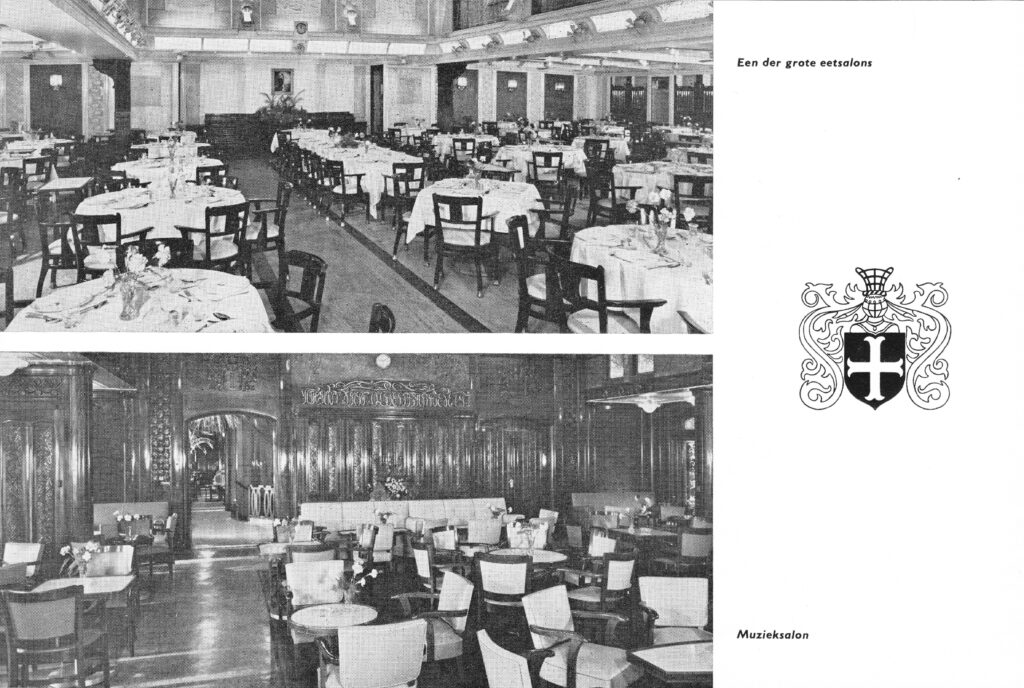
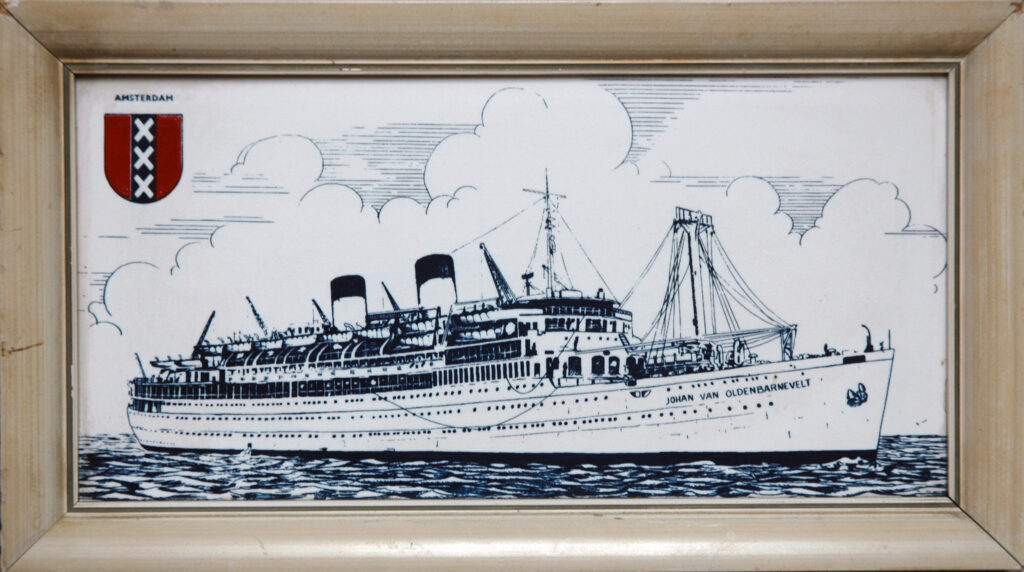
The interiors were decorated by artist Carel Adolph Lion Cachet and sculptor Lambertus Zijl. Teak, marble, mosaics, sculptures, tapestries and chandeliers reflected the status of the vessel as one of the leading Dutch passenger liners of the period. Indonesian artistic influences were incorporated into several public rooms and decorative features.
Her sister ship, Marnix van St Aldegonde, was completed later in 1930 for the same service.
An interrupted maiden voyage
The maiden voyage was scheduled to begin on 6 May 1930. While navigating the North Sea Canal towards IJmuiden, however, Johan van Oldenbarnevelt collided with the freighter Reggestroom.
The damage to the passenger ship’s starboard side was comparatively minor and was repaired quickly. She was able to depart shortly afterwards.
During the 1930s, Johan van Oldenbarnevelt operated on the long-distance route between Amsterdam and the Netherlands East Indies. The service carried passengers, mail and cargo between Europe and ports including Southampton, the Mediterranean, Colombo, Singapore and Batavia.
Allied service during the Second World War
The outbreak of the Second World War fundamentally changed the ship’s role. Initially chartered by the Holland America Line, she was employed as a passenger and cargo vessel between the Netherlands East Indies and New York.
In January 1941, Johan van Oldenbarnevelt was requisitioned for Allied service. She was converted into a troopship capable of carrying approximately 4,000 military personnel and was managed during this period by the British Orient Line.
The ship transported Allied troops over an extensive network of wartime routes. Her voyages took her to ports in Europe, Africa, Asia, Australia and North America.
Her sister ship, Marnix van St Aldegonde, also became an Allied troopship. She was torpedoed by German aircraft off the Algerian coast in November 1943. Although the ship was lost, the troops and crew aboard were rescued.
Johan van Oldenbarnevelt survived the war and returned to Amsterdam on 13 February 1946, almost seven years after the German invasion had made normal Dutch commercial operations impossible.
From colonial liner to emigration ship
Following refurbishment, Johan van Oldenbarnevelt briefly returned to the passenger service between the Netherlands and Indonesia. Indonesian independence and the accompanying decline in passenger traffic, however, undermined the commercial basis of the traditional route.
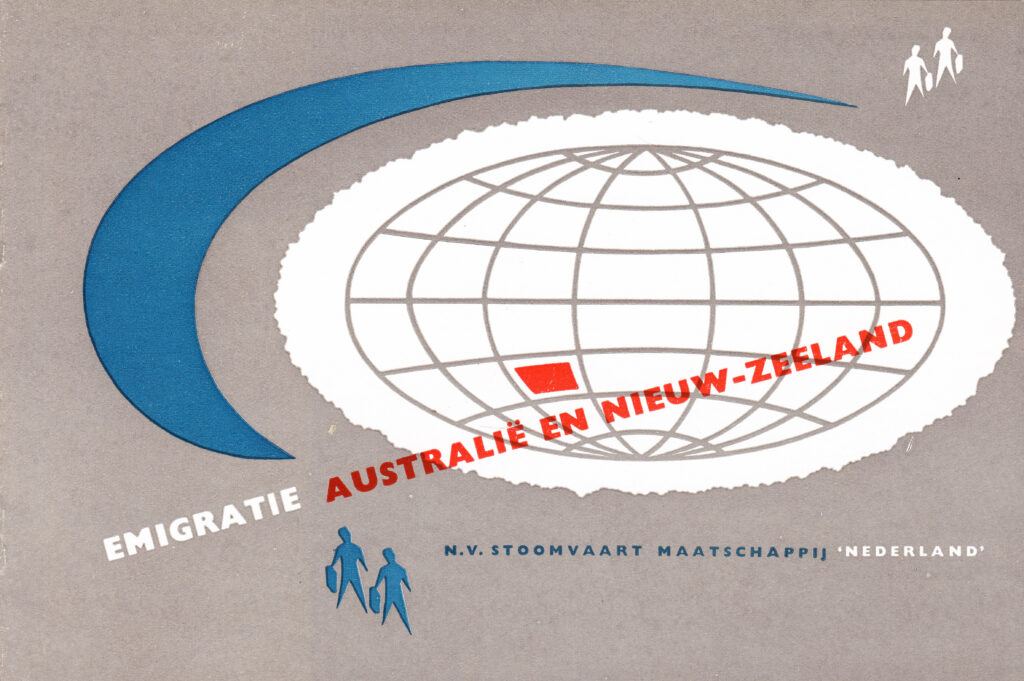
At the same time, Australia was expanding its immigration program. The Dutch Government was encouraging emigration as part of its response to post-war housing shortages, population pressure and limited economic opportunities. Australia required ships capable of carrying large numbers of assisted migrants from Europe.
The Netherland Line therefore made Johan van Oldenbarnevelt available for charter in the Australian migrant trade.
First emigration voyage to Australia
The ship departed Amsterdam on her first Australian emigrant voyage on 5 September 1950 and arrived in Melbourne on 9 October.
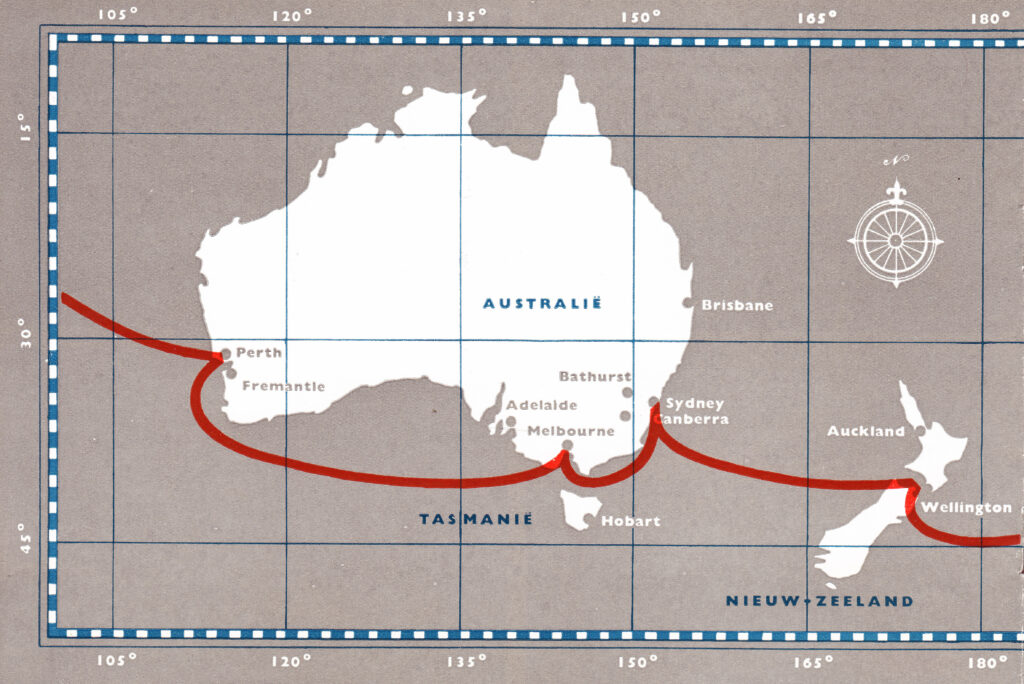
The journey generally took five to six weeks, depending on the route, weather conditions and ports visited. Calls could include Southampton, Port Said, Aden, Colombo, Fremantle, Melbourne and Sydney.
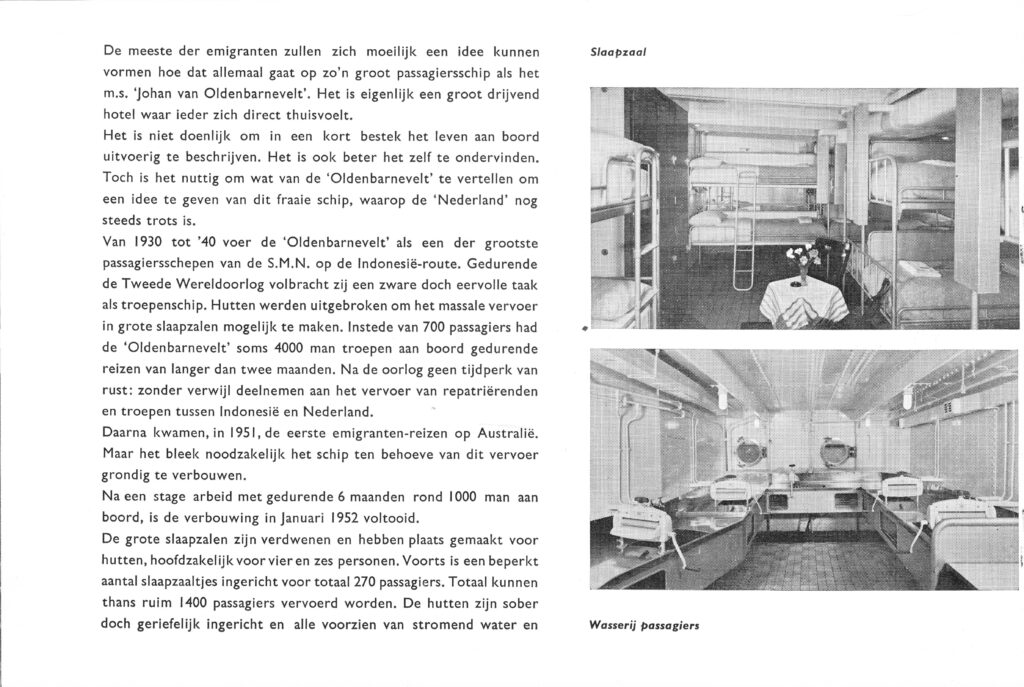
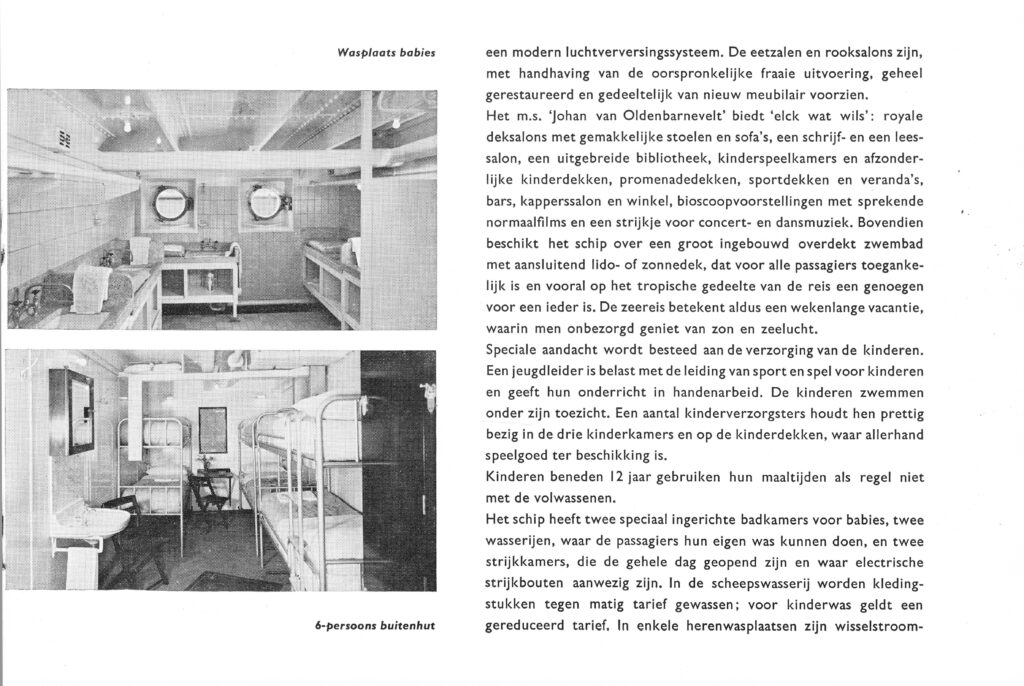
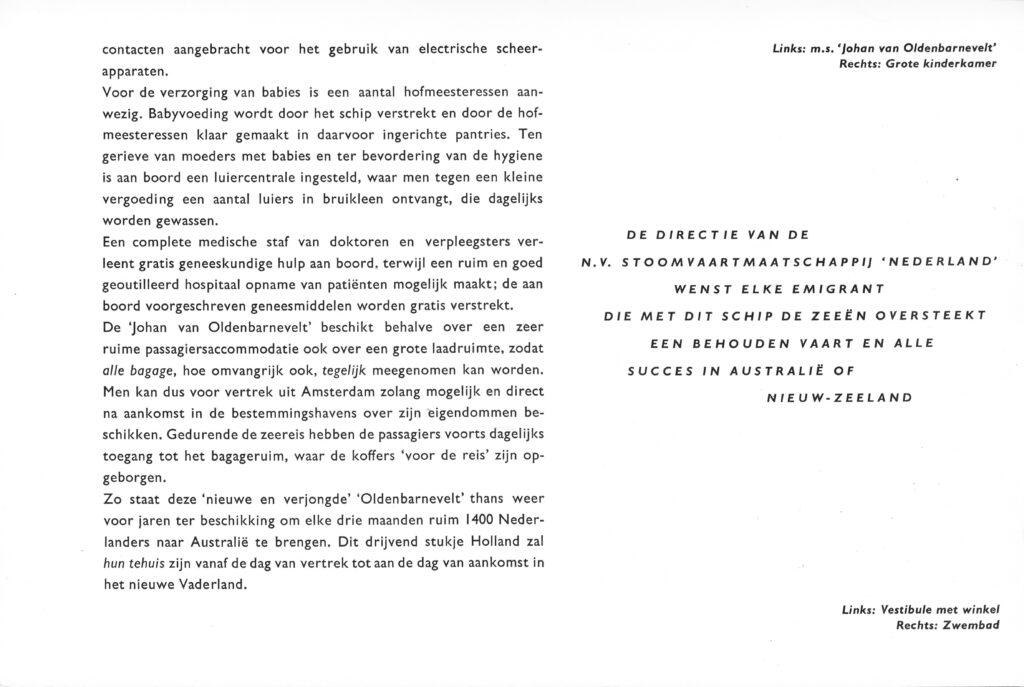
After completing two Australian migrant voyages, Johan van Oldenbarnevelt underwent a major refit specifically for the emigration trade. Her former class-based accommodation was reorganised into single-class migrant accommodation with berths for approximately 1,414 passengers—almost twice her original passenger capacity.
Public rooms were adapted for communal use, while cabins and dormitory-style accommodation housed emigrants travelling under government-assisted passage arrangements.
Life aboard the JVO
The voyage formed an important transitional period between the emigrants’ old and new lives. Passengers had left their homes, employment and extended families in Europe but had not yet encountered the practical realities of settling in Australia.
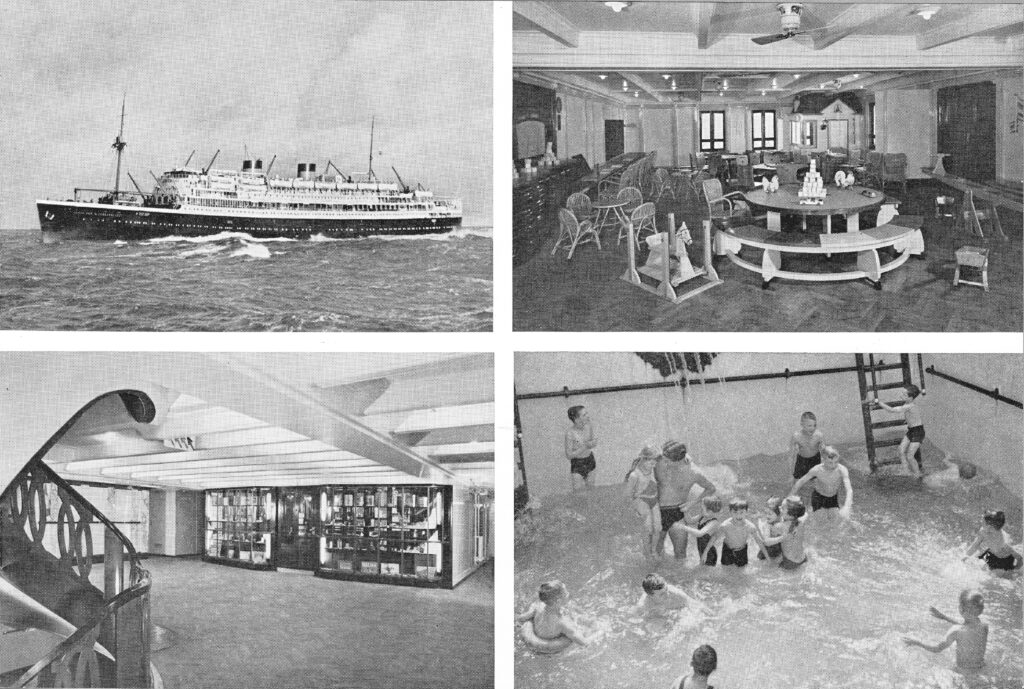
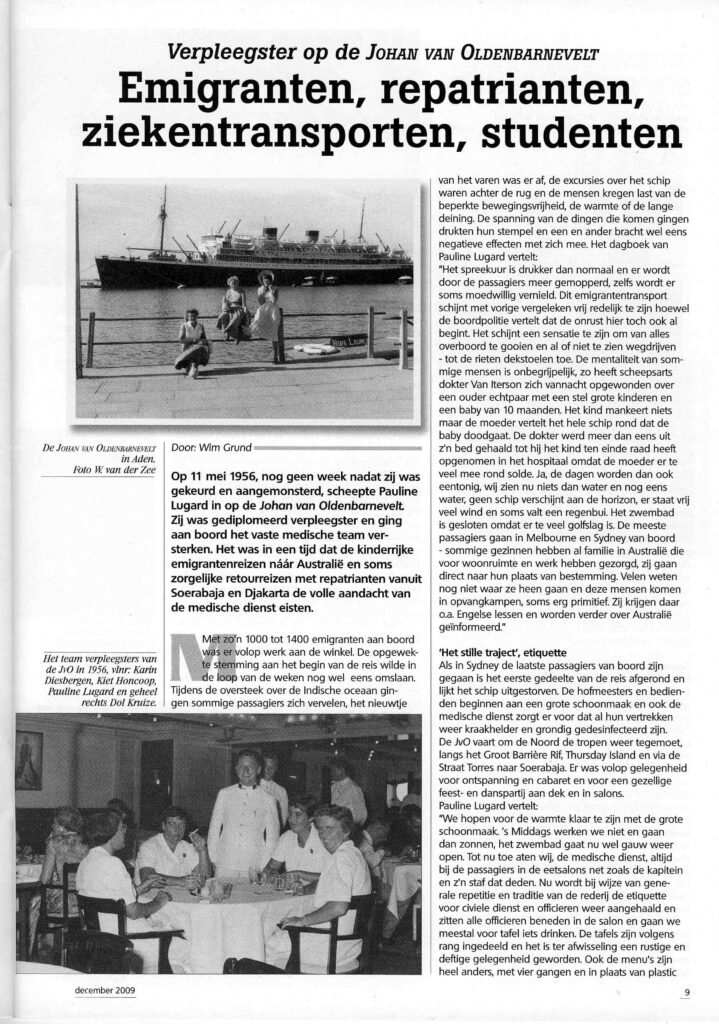
Life aboard was highly organised. Meals were served at fixed times, children participated in supervised activities and passengers attended entertainment, dances, religious services, lectures and information sessions. Concerts and variety evenings were frequently organised with the assistance of passengers.
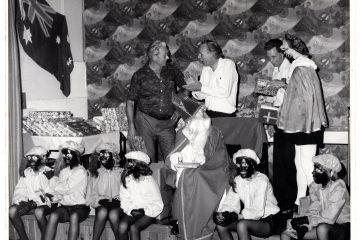
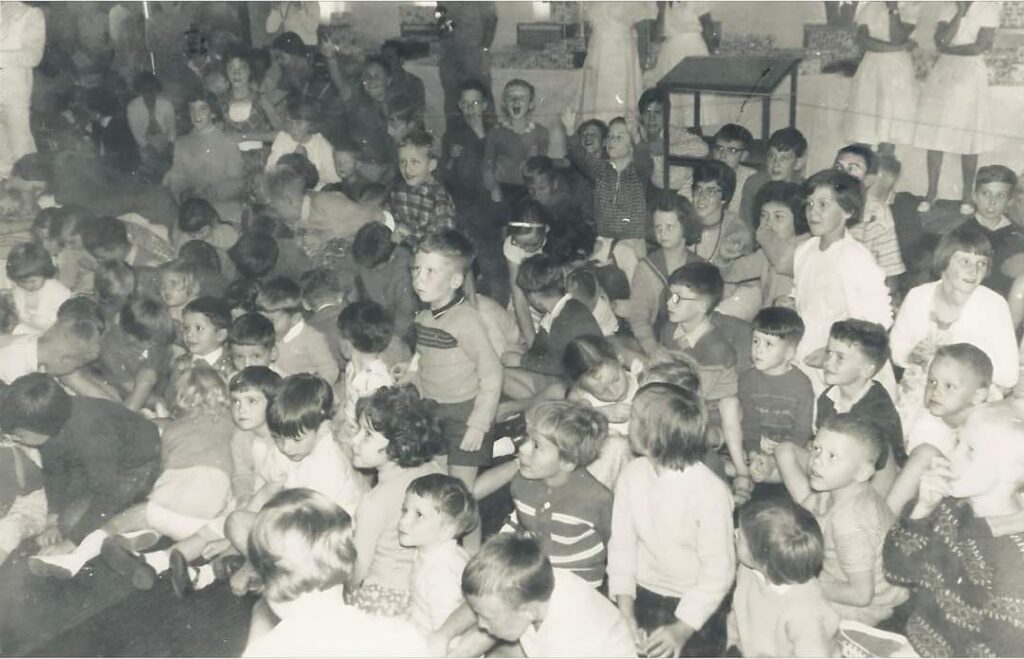
Children’s parties and celebrations helped mark special occasions during the long voyage. Photographs in the DACC collection show Dutch children celebrating St Nicholas Day aboard the ship on 5 December 1961.
For some passengers, the voyage was an enjoyable adventure. Others experienced seasickness, crowded accommodation, illness or anxiety about the future. Conditions varied according to the voyage, the location of a passenger’s berth and the weather encountered along the route.
The ship’s Dutch and Indonesian-influenced interiors made a lasting impression on many passengers. Even after her conversion, traces of the elegant pre-war liner remained visible throughout the vessel.
Arrival in Australia
Johan van Oldenbarnevelt normally called first at Fremantle before continuing to Melbourne and Sydney. Some passengers disembarked in Western Australia, while others continued across the Great Australian Bight.
Melbourne’s Station Pier became one of the principal points of arrival. From there, assisted migrants could be transported by train to migrant reception and accommodation centres such as Bonegilla. Passengers arriving in Sydney might be transferred to centres including Scheyville, while others continued by train to Queensland or South Australia.
For many families, arrival at an Australian port did not therefore mark the end of their journey. It was followed by train travel, temporary accommodation and the challenge of finding employment and establishing a permanent home.
An important place in Dutch-Australian migration
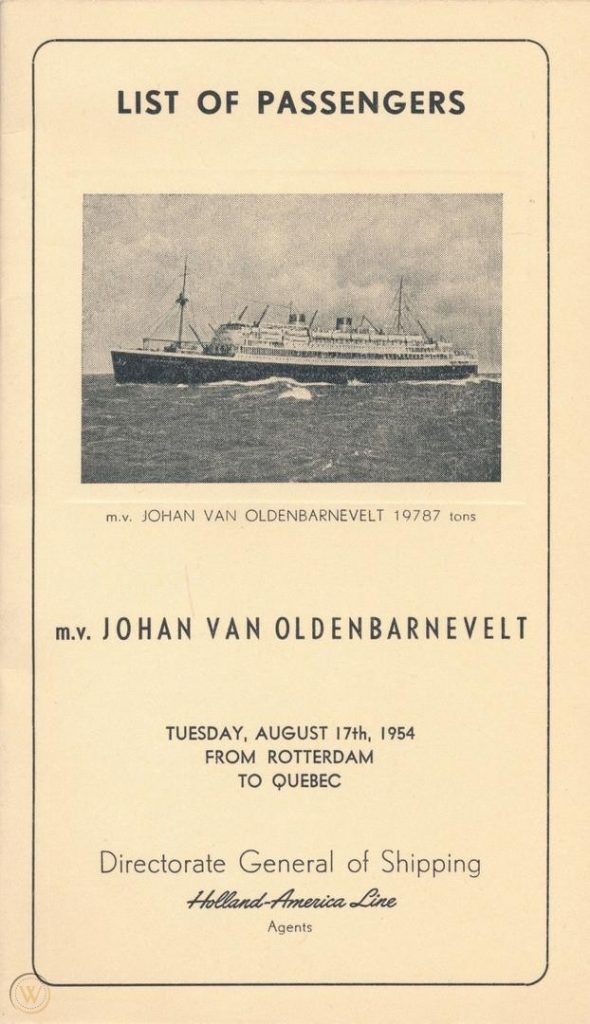
Between 1950 and 1958, Johan van Oldenbarnevelt became one of the best-known ships in the Australian migrant trade. Museums Victoria records that she made 44 voyages to Melbourne.
Although closely associated with Dutch migration, she also carried emigrants from Germany and other European countries. Assisted passage programs enabled many passengers to travel at a reduced cost in return for commitments concerning employment and settlement after arrival.
The ship was known formally as Johan van Oldenbarnevelt, but English-speaking passengers and Australian officials frequently shortened the difficult name to JVO.
Australia’s 100,000th Dutch migrant
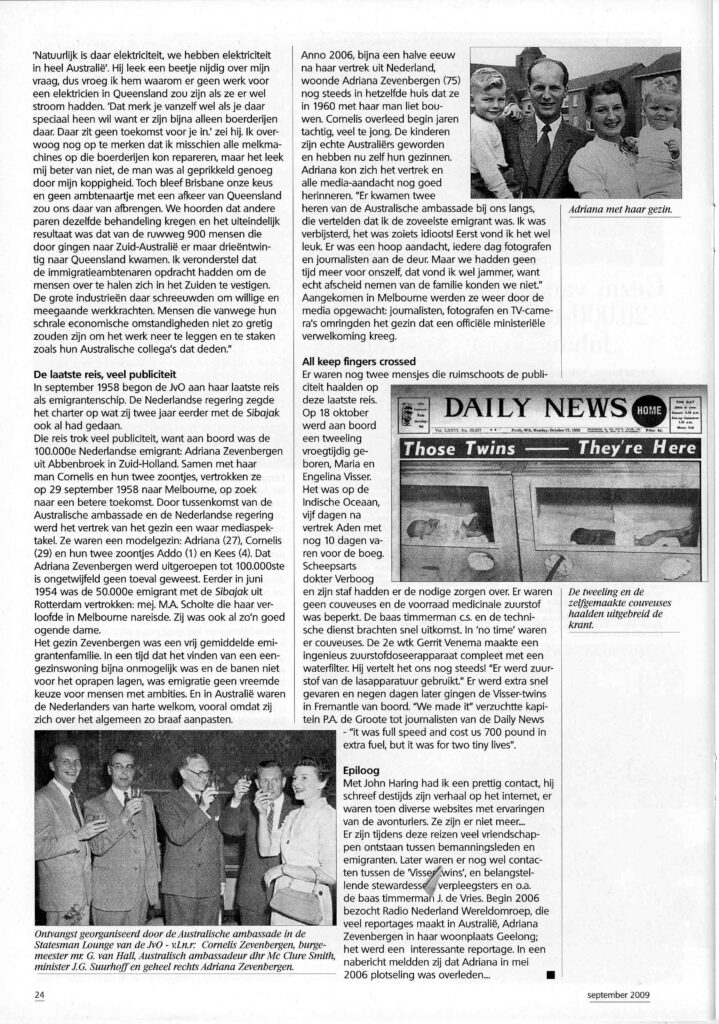
One of the most significant events in the ship’s migration history occurred in August 1958, when Adriana Zevenbergen arrived aboard Johan van Oldenbarnevelt as Australia’s officially recognised 100,000th post-war Dutch migrant.
Her arrival was used to mark the scale of Dutch migration under Australia’s post-war immigration program. It also demonstrated how rapidly the Dutch-Australian community had grown during the decade following the war.
The designation was ceremonial—the counting of migrants can vary according to the dates and categories used—but Adriana Zevenbergen became a public symbol of the Dutch contribution to post-war Australia.
From migrant charter to round-the-world service
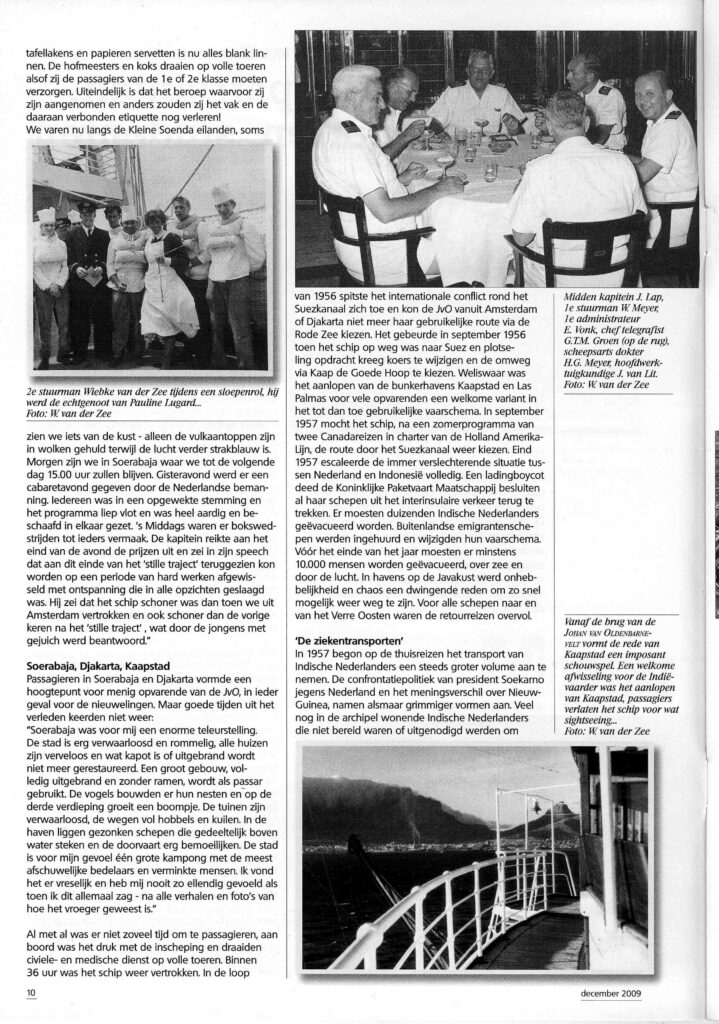
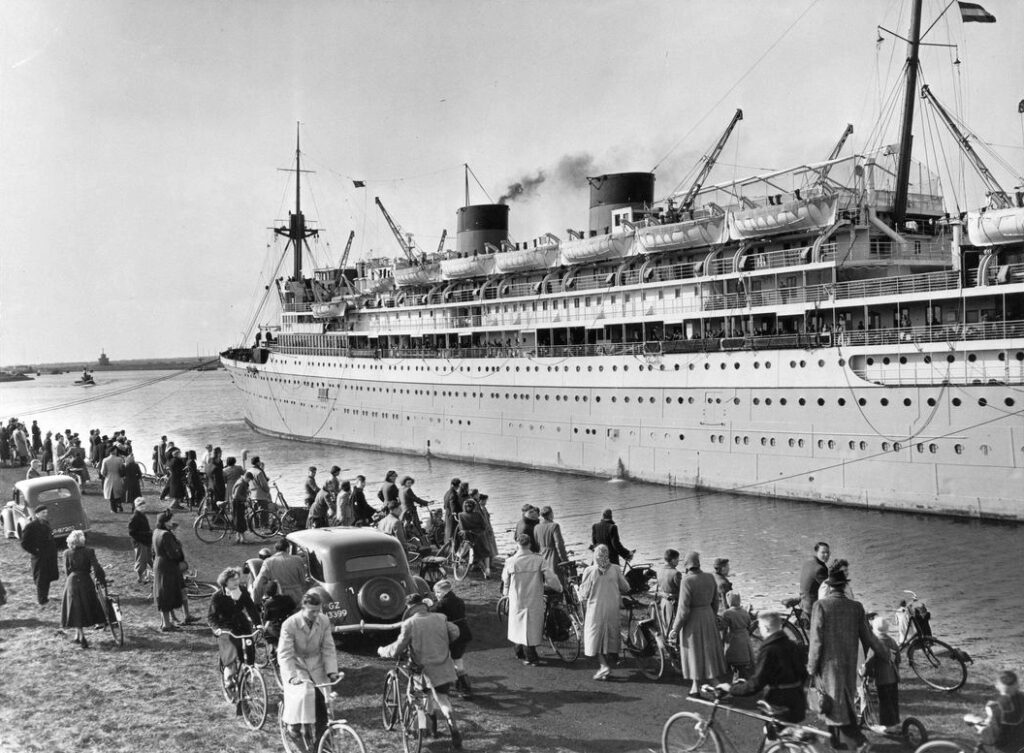
The ship’s dedicated Australian migrant charter ended in August 1958. She was subsequently refitted again, with improved passenger accommodation, for general passenger services and round-the-world voyages.
This did not end her connection with migration or Australia. Johan van Oldenbarnevelt continued carrying a mixture of tourists, returning residents and emigrants. However, she was no longer operating solely as a high-capacity government-chartered migrant ship.
The round-the-world services connected Europe with Australia and New Zealand through the Suez and Panama canals. These voyages formed part of an attempt by Dutch shipping companies to adapt their passenger fleets after the decline of the traditional Netherlands–Indonesia trade.
Final voyage for the Netherland Line
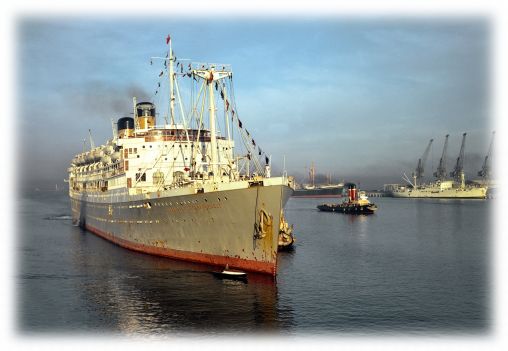
Johan van Oldenbarnevelt departed on her final round-the-world voyage for the Netherland Line on 30 June 1962. She reached Sydney on 3 February 1963, ending a 33-year career with the Dutch company.
After leaving Sydney, she sailed to Genoa through the Indian Ocean and the Suez Canal. She was sold to Greek interests and renamed Lakonia.
The Lakonia disaster
Following extensive refurbishment, Lakonia entered service as a cruise ship.
On 22 December 1963, while undertaking a Christmas cruise in the Atlantic Ocean, a fire broke out aboard the vessel. The flames spread through the passenger accommodation and forced passengers and crew to abandon ship.
The emergency was aggravated by problems with alarms, evacuation procedures and some of the lifeboats. A total of 128 people died as a result of the disaster.
The burned-out ship remained afloat for several days but sank while under tow on 29 December 1963.
The loss occurred less than a year after the ship’s final departure from Sydney and brought a tragic end to a vessel that had survived the Second World War and carried thousands of people across the world.
A ship remembered by generations
The importance of Johan van Oldenbarnevelt lies not only in her size, design or long operational career. Her enduring place in Dutch-Australian history comes from the experiences of the people she carried.
For thousands of emigrants, the ship was the setting for their final memories of Europe and their first encounter with the wider world beyond it. Children celebrated birthdays and St Nicholas Day aboard her. Friendships were formed, marriages began their first weeks at sea, and families waited together to discover what Australia would bring.
The numerous recollections collected by the DACC demonstrate how strongly the voyage remains embedded in family memory. Together, these stories transform the history of the JVO from an account of a ship into the collective story of a generation.
Sources and further reading
- Museums Victoria – Post-World War II migrant ship history: Johan van Oldenbarnevelt, 1950–1963
- National Archives of Australia – Dutch migration stories
- National Archives of Australia – Henk Wolswinkel’s voyage aboard Johan van Oldenbarnevelt
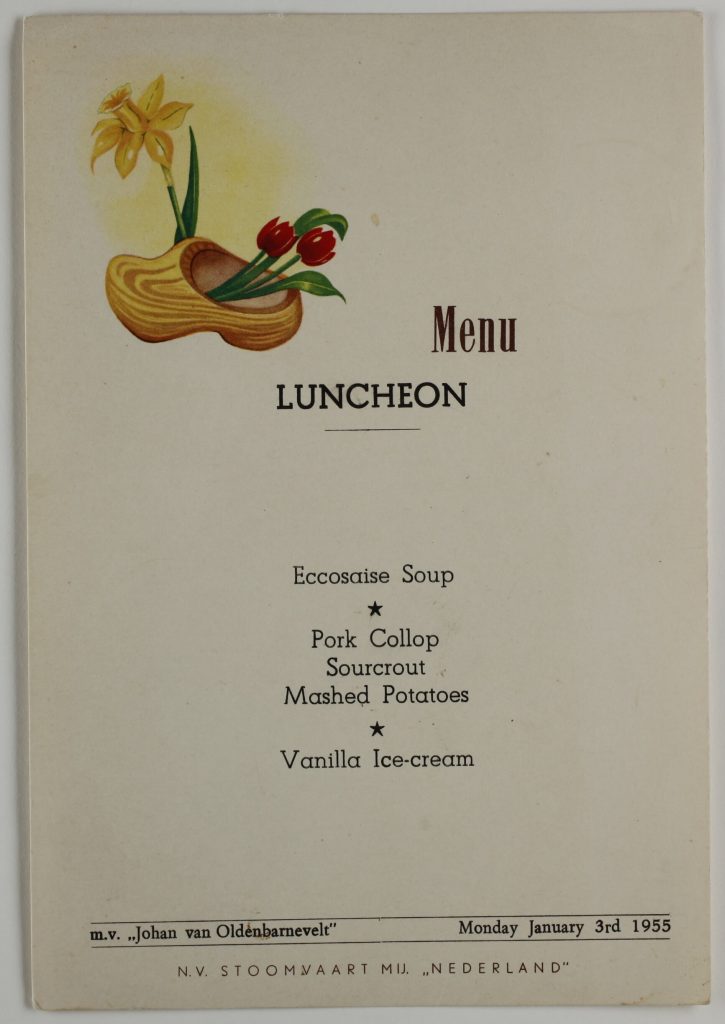
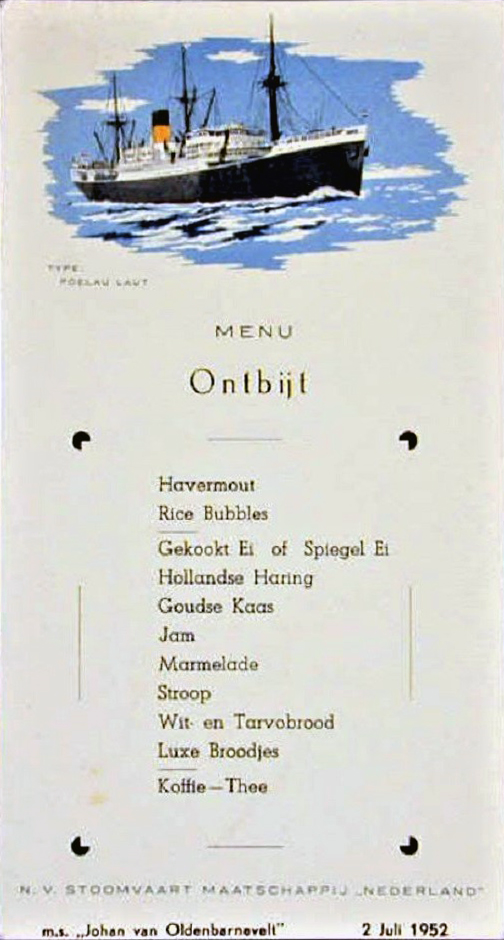
- Museums Victoria – Dinner menu from Johan van Oldenbarnevelt, 9 January 1955
- Museums Victoria – Luncheon menu from Johan van Oldenbarnevelt, 7 January 1955
- Wim Grund and G.J. van der Sluis, Johan van Oldenbarnevelt: een schip met zes levens, 1996.
- Peter Plowman, Emigrant Ships to Luxury Liners, New South Wales University Press, 1992.
- Spencer Baty, Ships That Passed: The Glorious Era of Travel to Australia and New Zealand, Reed Books, 1984.
- SBS Dutch – De JvO: Migrantenverhalen
Related DACC articles
- Dutch emigration ships to Australia – Portal
- MS Willem Ruys – Dutch flagship and emigration ship to Australia
- MS Sibajak – From Netherlands East Indies mail ship to Dutch emigration ship
- Where to find shipping lists and passenger-arrival records
- Dutch immigration to Australia – Statistics and other resources
Photo and Document Gallery
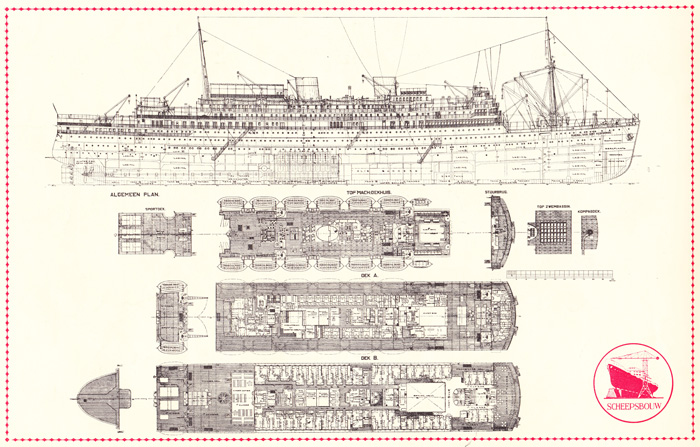
With thanks to the archives of the Dutch Australian Cultural Centre and information received from Ruud van der Sluis, director of Stichting NDSM-Herleeft (Foundation NDSM [dockyards] Lives On).
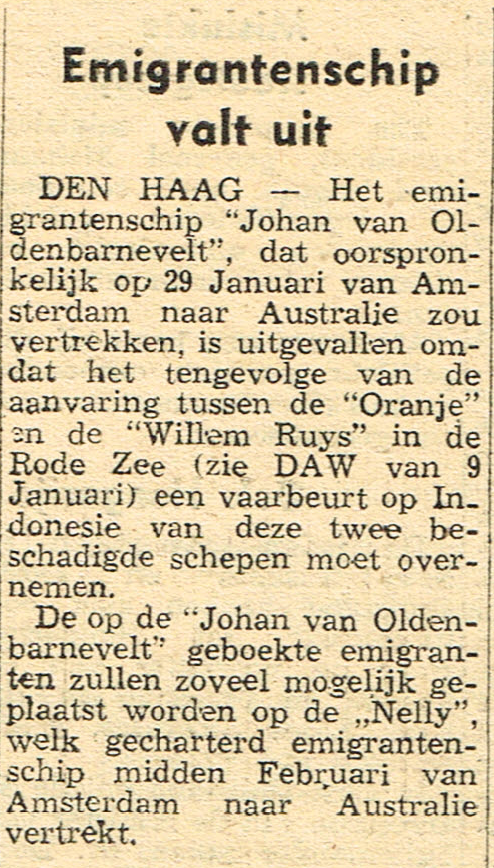
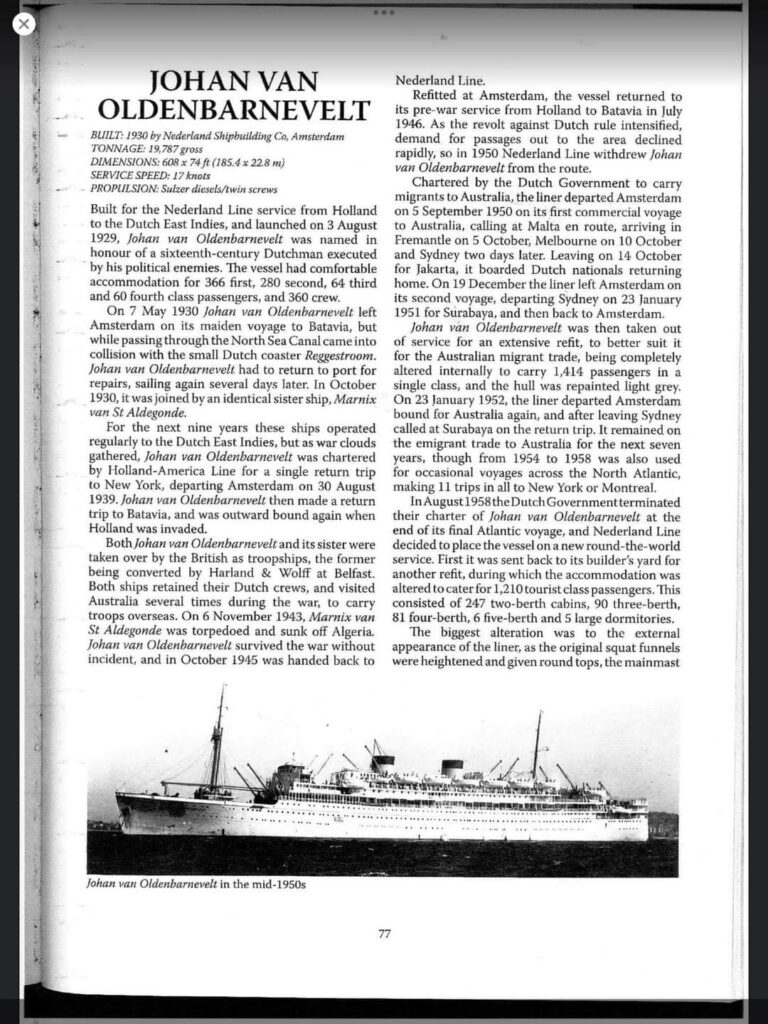
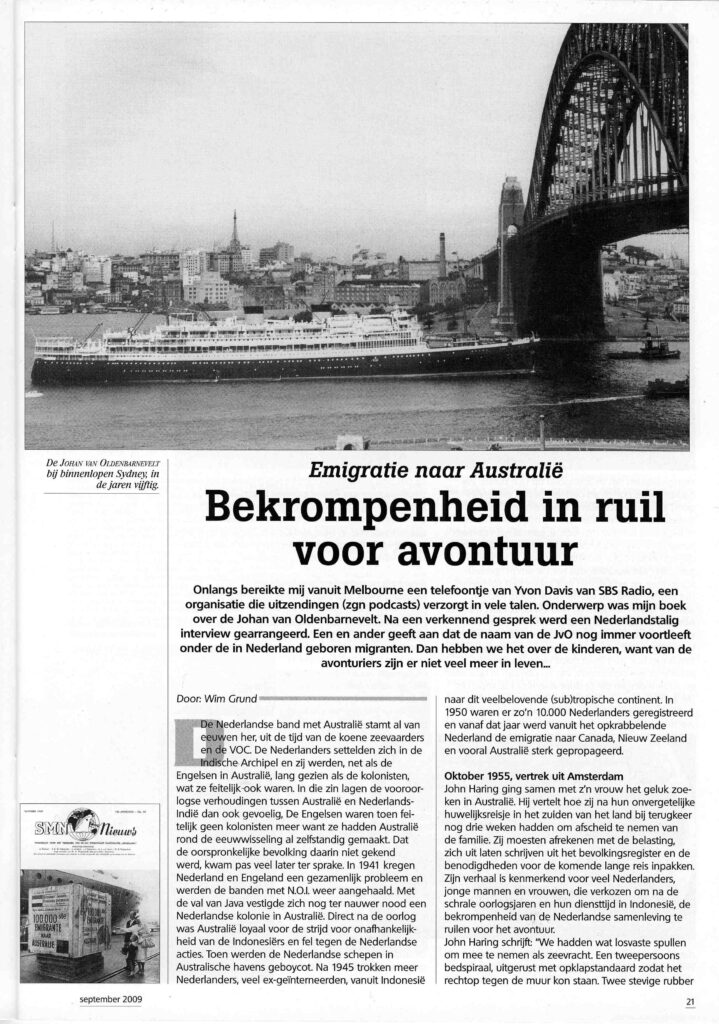
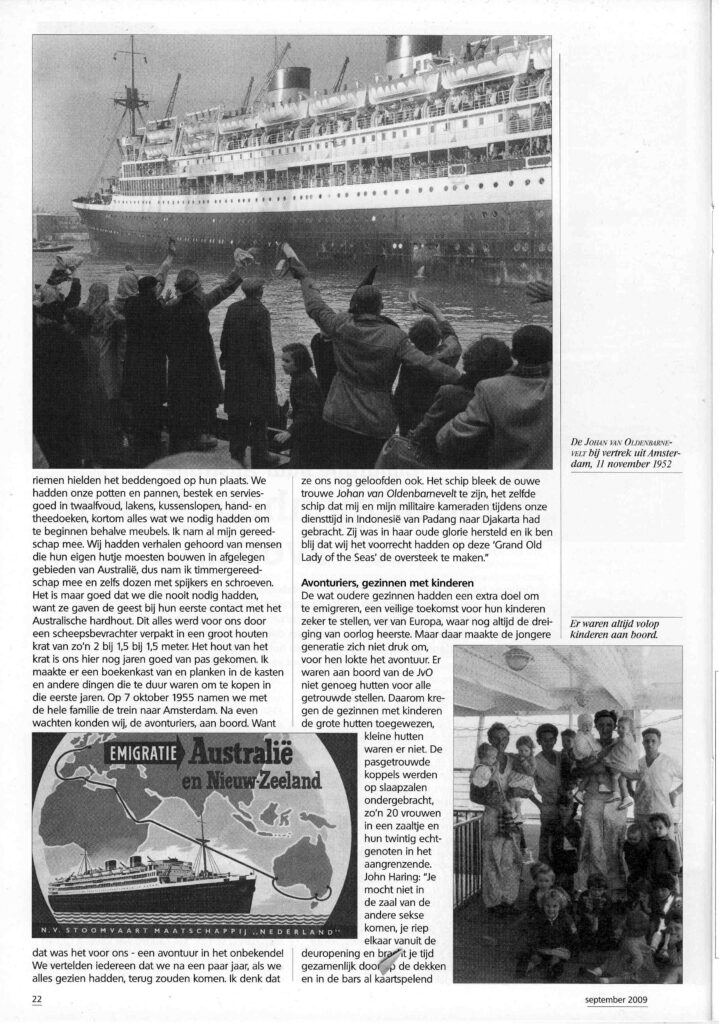
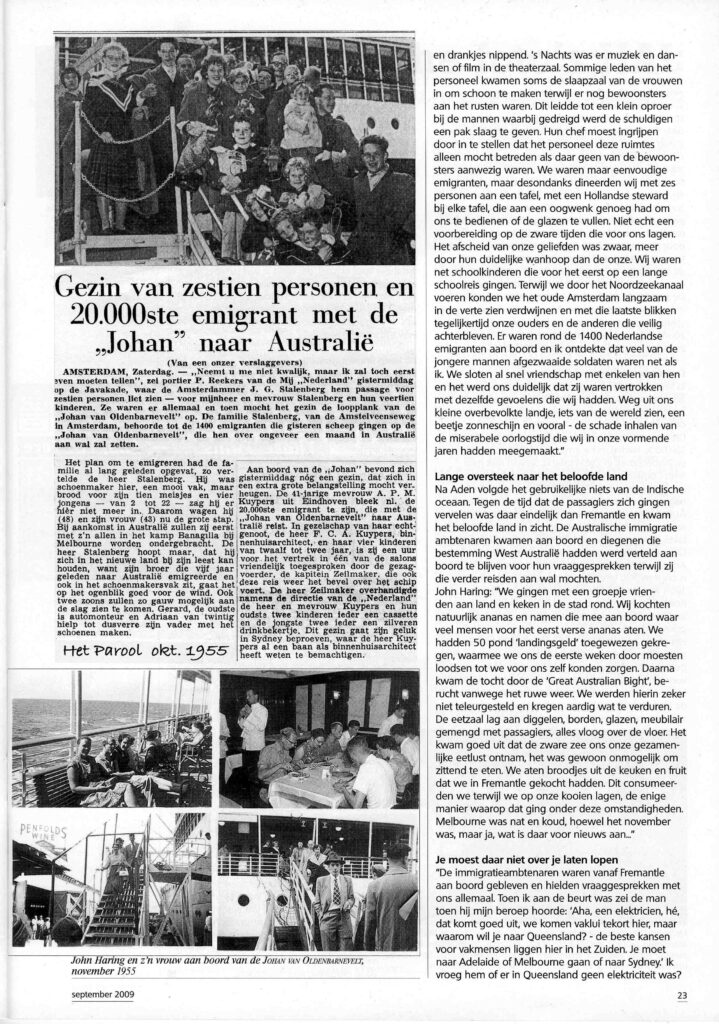
Emigratie naar Australia – Bekrompenheid in ruil voor avontuur
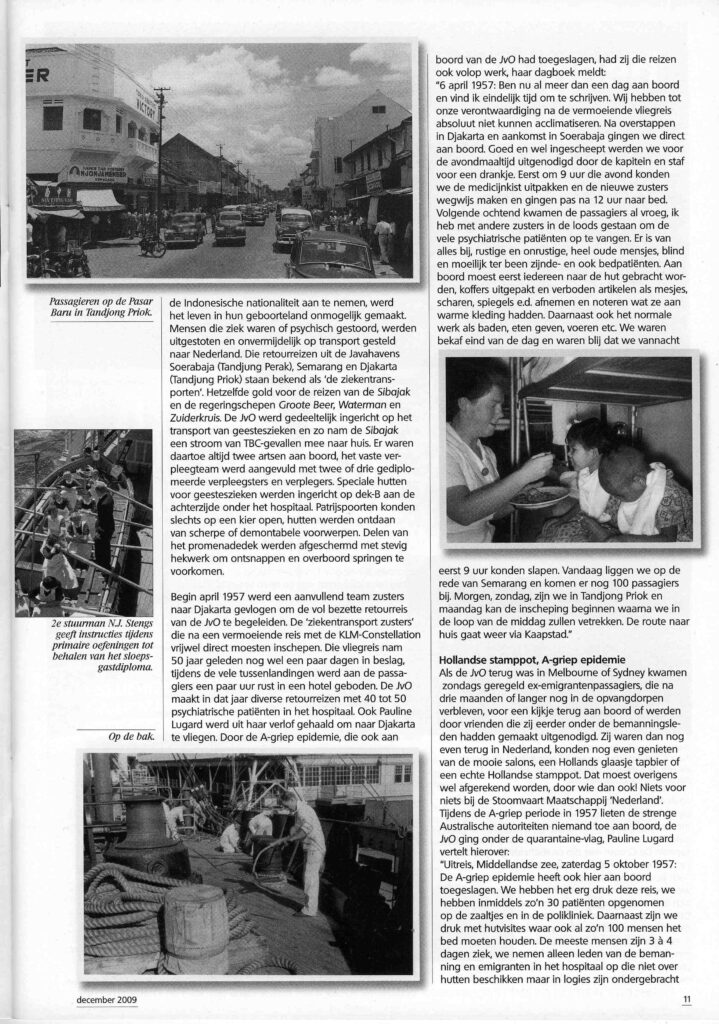
The following is an article written by Wim Grund, one of the foremost experts on the history of the Johan van Oldenbarnevelt.
Gallery
From the DACC archives and the private collection of Ruud van der Sluis.
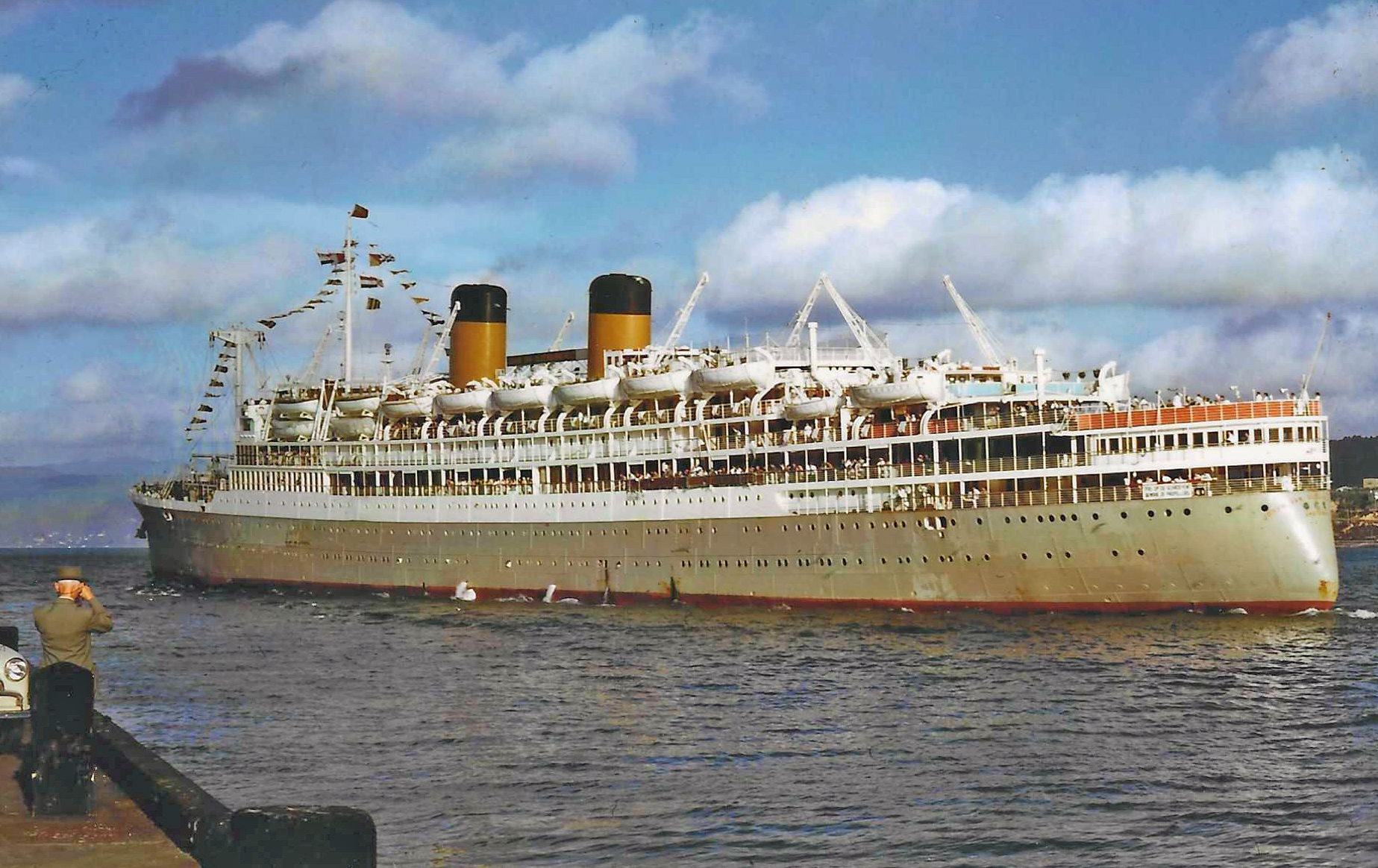
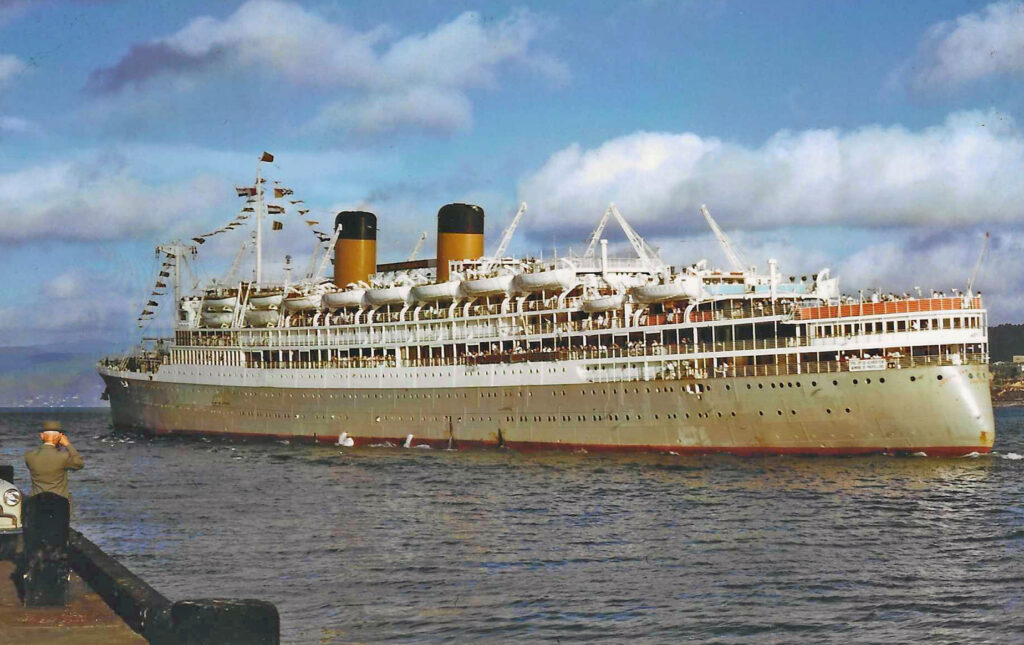
Passenger memories of the Johan van Oldenbarnevelt
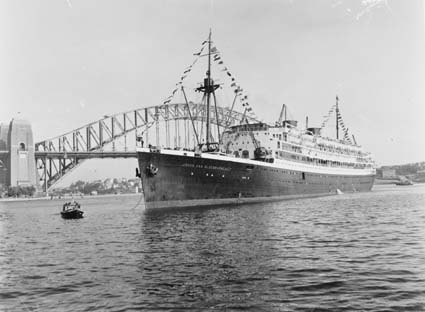
There was a discussion on Dutch Australian Community Facebook site on the Johan van Oldenbarnevelt (JVO) with the above picture of its last visit to Australia, This created a lot of reactions. Al;so other comments have been added since.
Dr. Cor Uidam
The voyage was itself part of Uidam’s new ministry. He served as spiritual adviser aboard the ship, while Emmie assisted Dutch passengers as a migrant welfare officer. After arriving in Sydney in February, the family initially encountered the same uncertainty experienced by many migrants: their expected accommodation was unavailable, their belongings had not arrived and several of the children had to be temporarily billeted elsewhere. See: Cornelis “Cor” Uidam – minister, migrant advocate and Dutch-Australian community leader This article also include passenger documents from the ship/
Christel Shumate
My parents were on the JVO trip that arrived in Melbourne in February 1952!
Dik Visscher
When my family left Amsterdam, we were on that boat in 1956 for 6 wonderful weeks got off at Sydney caught a steam train to Brisbane. when there were bushfires everywhere along the trip
Gonnie Van den Broek-Aspinall
We were on the last trip that ship made arriving in Sydney, And from there arrived at the migrant camp in Scheyville….
Alice Vanderheg
We arrived in 1959, with the JVO, and it was sold to the Greeks, then it sank!
Trish Baart Buckley
My family emigrated on this ship.
Mary Ahling
When we came on the JVO it was part migrant part cruise ship in 1959.We were in contact with English people who had been on holidays to England and went back to Australia. We also had the big storm that took the life of the pianist at Freemantle.
Hanny Malone
My family arrived in Australia on board this ship in February 1954, I was 10 years old and remember the voyage well.
Anna Douglas
My parents arrived in 1954 on the jvo.
Monica Linthorne
This is the ship Oma and Opa arrived in Australia on in 1952.
Naomi Flynn
My Oma and Opa (and Dad) in Feb 1952
Liesbeth van Emmerik
We arrived with this wonderful boat on 8 November in Melbourne. Many special memories.
Susy Wilson
My family and I arrived in Melbourne on the last journey to go to Bonegilla Camp before the ship left for Sydney. It was a long journey for a person suffering from sea sickness
Arrived on 8 November 1955 then spent 5 and half weeks in Daylesford Dutch hostel under the guidance of the Teggelove family whose offspring are now principals in Bendigo!!
Henk Vrolijks
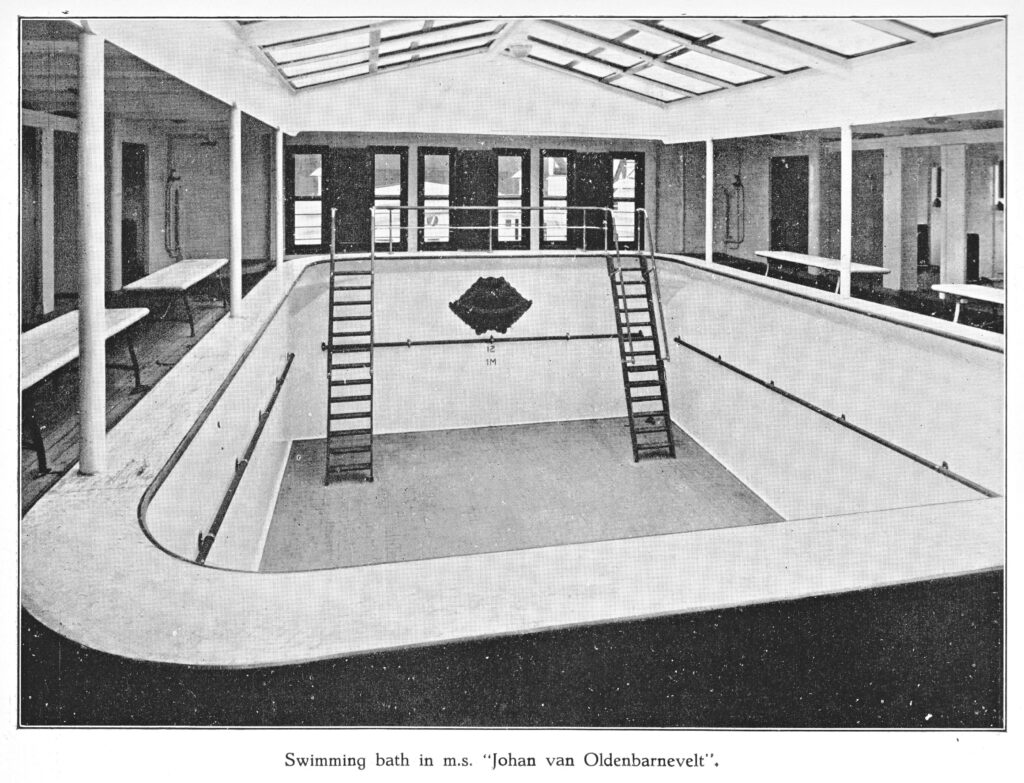
I sealed on her in 1958 and she was not black but white also we had a bad accident and one of my mates drowned in the swimming pool
Anne Lo-Grasso
We arrived in February 1958. Beautiful ship.
John Evert Eykman
We arrived in Melbourne in 1958 great time
Frank Van-Look
Our Cousins the first lot of Van Looks travelled to Australia on that Ship1951. We the second Lot on the Fairsea 1952.
Jennifer Mary Seaton
Frank Van-Look Yes you were with my parents and oldest brother….the van den Elsen’s, 70 years ago!
Patricia Risse
We arrived on that ship. A very long time ago. Got to love these memories
Ali Horvath
I arrived with my family Melbourne 1957.Left Nederland Feb 12 arrived 21March. 23 Adelaide
Miranda van der Keyl
My family and I arrived on this ship in November 1958, disembarking in Melbourne and then taken to Bonagilla Migrant Camp
John Evert Eykman
Miranda van der Keyl I was 5yo when I arrived with the family in Melbourne and also went too Bonagilla
Marie Mawson – Vos
Onboard December 1958 as a baby. May have been November 1958 as mum not sure of the date
Marion Last
Yes… left the Netherlands in November 1950 and arrived in Melbourne January 1951. I think Mum (19) was on ‘D’ deck and Dad (22) on ‘F’ deck. They married on Nov 8th, 1950, so this was their honeymoon. Mum said that they had to ‘book’ the Lifeboats to ‘get together’
Marieanne Visser Van Dyk
The boat Dad arrived in 1952
Sonja Martin
We arrived in October 1955 on this ship.
Bill Adams
What a majestic ship that was. It brought my little family of three from Amsterdam to Fremantle in September 1952. Little did I know of the culture shock awaiting me.
Diny Lee-Schipper
My Uncle came home (Holland) from Indonesia on Johan she was a Troop Ship then. We came to Australia on her but disembarked in Melbourne to continue on the Taroona to Tasmania. 1958
Geera Marshall
I came to Australia with my family on this boat 1953
Arend de Weger
My family (including me as a 4-year-old) migrated to Australia in 1952 on this ship.
Toni Kirkpatrick
We came over on this ship, arrived in March 1957.
Ingrid Rapp
Our family sailed on the JVO twice, once in January 1954 and again in July 1956. A majestic ship with beautiful Indonesian carvings. Our mother kept a day-to-day diary of our journey which we still have in our possession.
Helen Haneveld Jenkins
My parents & I arrived at Fremantle in November 1953 on JVO.
Nancy Lockley
Mum, Dad, my brother & sister came on the JVO in 1952, disembarked in Melbourne, stayed at the Bonegilla migrant hostel & then moved to the Riverland. I was born a year later. (Anja).
Frankie Lindstrom
My parents arrived on this ship in 1956
Joy Pohl
My late fathers family came to Australia on the Oldenbarnevelt in 1954 and disembarked in Melbourne Victoria.
Hans van der Donk
We came to Australia on that ship in 1956
Olga Walters
My good friend and her family were on board! My family travelled on the sister ship de Zuiderkruis.
Corrie Cras
I came to Australia on this boat. I was 5 in 1953
Sue Esra
Bought us to Australia in 1953.
Yvonne Nicholas
My family were on the last voyage !!!!
Marie Mawson – Vos
I came out on this ship at the young age of 10 months with my brother and parents
John Stegehuis
November 1958 my family arrived in Melbourne
Anna Byers
We arrived in Melbourne on that ship in April 1955
Bill Adams
What a beautiful sight. That brings me back to my arrival September 1952.
Toni Swannell
My parents and us 3 kids 1952
Anne Slager
We arrived on that ship on its last voyage
Rene Rem
My parents and I arrived on JVO in 1956.
Barbara van der Horst
My brother-in-law arrived on that ship in that year in Melbourne
Marion Nowell
My father arrived in her at Melbourne in 1949.
John van der Pol
In 1959 van Indonesia naar Holland, want er waren stakingen in Australia om het communisme regering van Indonesië te ondersteunen, ik kwam op dit schip als laatste keer tussen NL en Indonesië, ze was toen al bestemt voor de Holland Amerika lijn.
Ingrid Bower
My Mama and Papa, brother and sister were on the ship, they got off in Melbourne one year before I was born, very nostalgic
Monsoonas Marianne
Teri Pleydell Oma and Opa vanderhorst Corry Haverkort and her three brothers were on this ship I think it was 1955
Dianna Berkholst
My parents boarded JvO 1 April 1954 bound for Sydney but caught the train to Brisbane. My parents never threw anything away and I still have all their paperwork from their trip and one of their trunks.
Desi Lu
Not the last voyage as I came on that ship in 1959.
Garry Lemair
My family came to Melbourne in 1956
Soren-Dane Homme
1954 Oma,Opa und mum arrived on that vessel. De Familie Mensch
Evelyn Guy
My mum was pregnant with me when my parents and siblings came on the JVO in 1950.
John Smolders
Many happy memories on board in 57
Giselle Bakker
Yes travelled on that ship as a child
Ian Cramer
My father also travelled with his family on this vessel, disembarking in Melbourne November 1953.
George Giesberts
My family arrived in August 1952 in Melbourne went from Bonegilla to Hunter Valley to Brisbane in 1954. I had my 13th birthday on board and was allowed to eat with the grown ups, made my day.
Alberta Loch
I had a great time on that ship not so good for my new husband who was badly sea sick all the time.
Johanna Mulholland
My late dad Joop Mul and my oma and opa made the trip in 1956
Mary de Ridder
We left on Friday 13 July 1956 on the “Johan van Oldenbarnevelt and arrived in Melbourne 16 August,left that same night on the most uncomfortable train with wooden seats to Adelaide. Still we survived it and have had a good life here in South Australia.
Memories and photographs from Gerry Rüsing-Molenaar
Gerry shared photographs and her memories of migrating to Australia on the Johan van Oldenbarnevelt with the DACC.
I remember the ship Johan van Oldenbarnevelt very well. I came from Holland to Australia in 1957, I was 7 years old at the time. Had a great time on this ship and also remember the stops in Aden and Port Said.
There is one thing I will never forget.
We had a stop in Melbourne and the crew had a football match, can’t remember against who. My parents and a few other passengers came along in the bus, to cheer them on. After the match the children were taken back to the ship first, because they had to be back in time for their evening meal. Children always had their meals before the grown-ups. After a while, when the ship had already left the harbour of Melbourne, I started looking for my parents but couldn’t find them. When I told one of the crew members, they started to realise that a few other crew members were also missing. When they went to inquire, they found out that the bus driver forgot to go back to pick up the crew and the passengers that came along. So, the bus driver hurried back to pick them up, but as the ship could not go back to the harbour they were brought back by boats and had to climb up a rope ladder to get back on board.
Gerry also shared the following photographs and memories:
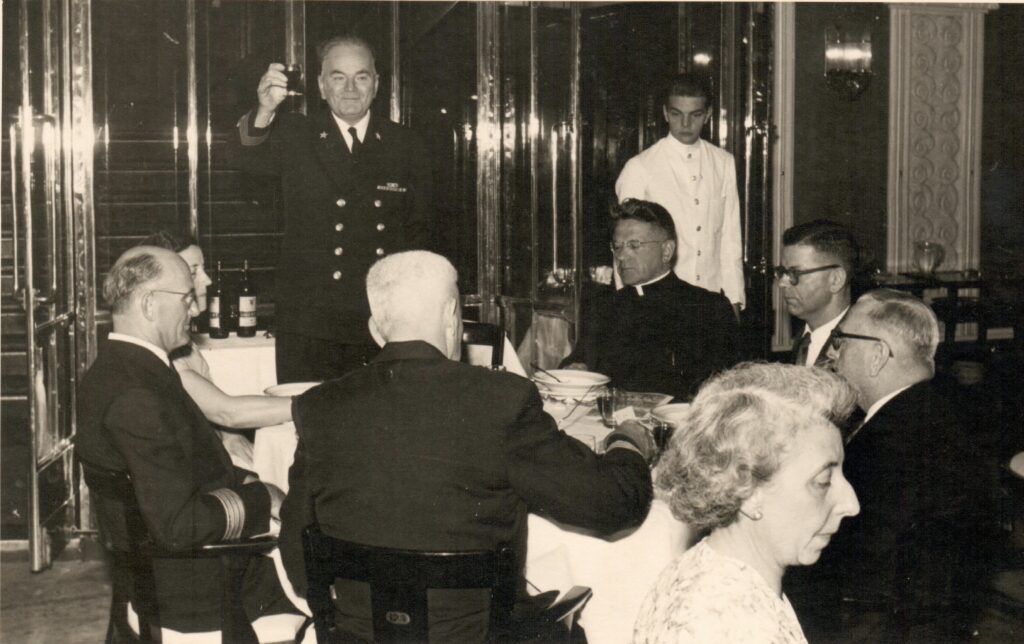
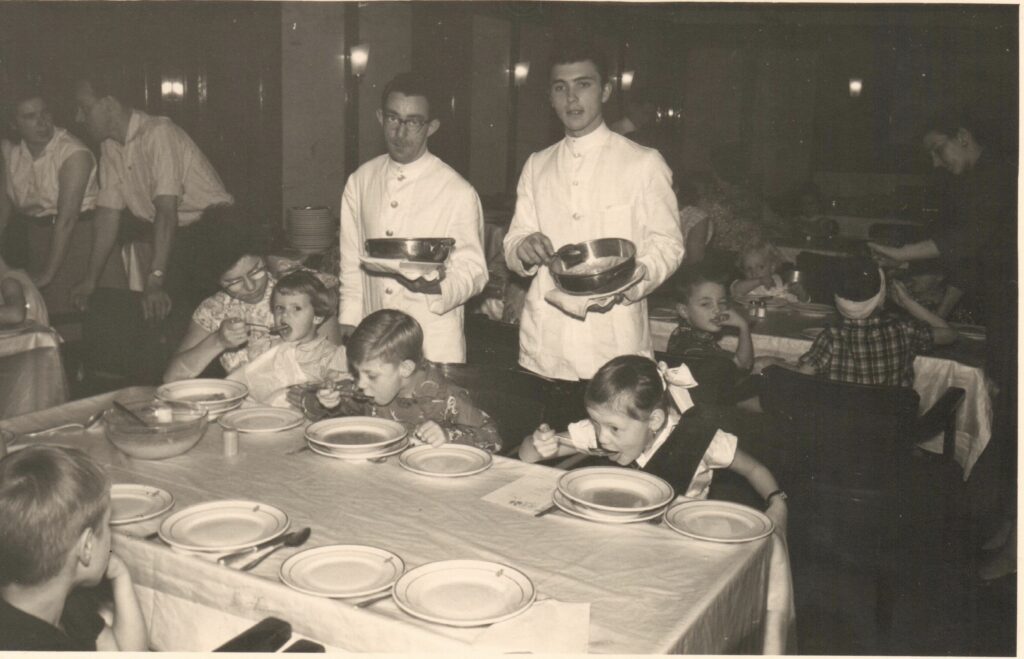
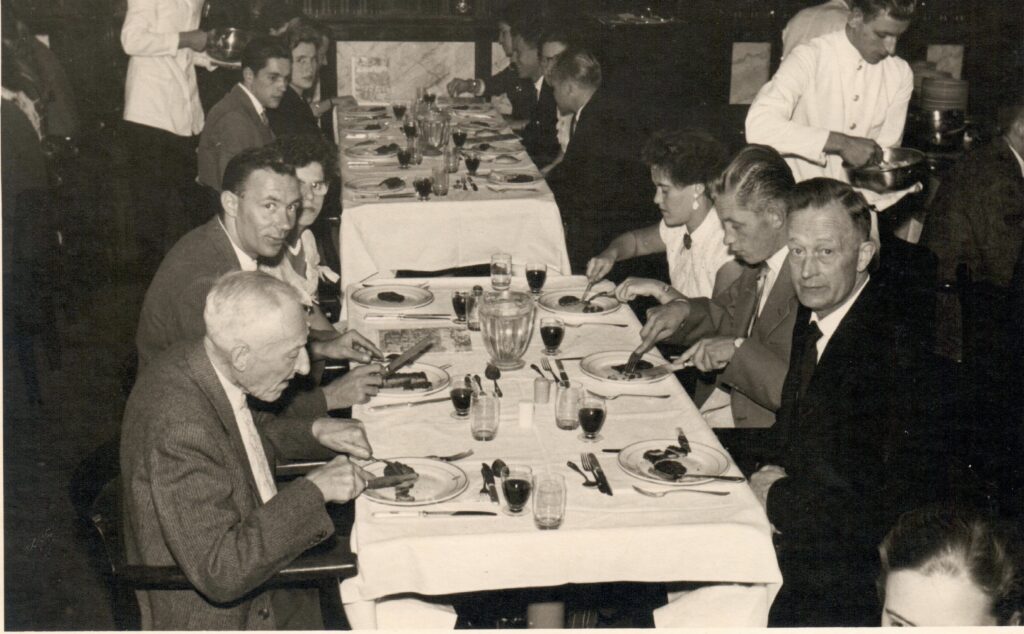
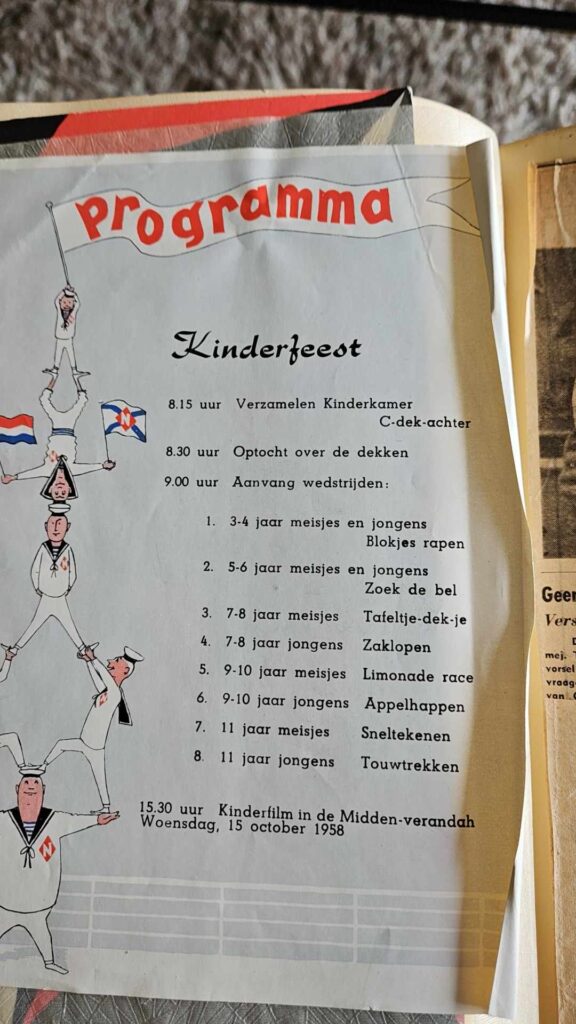
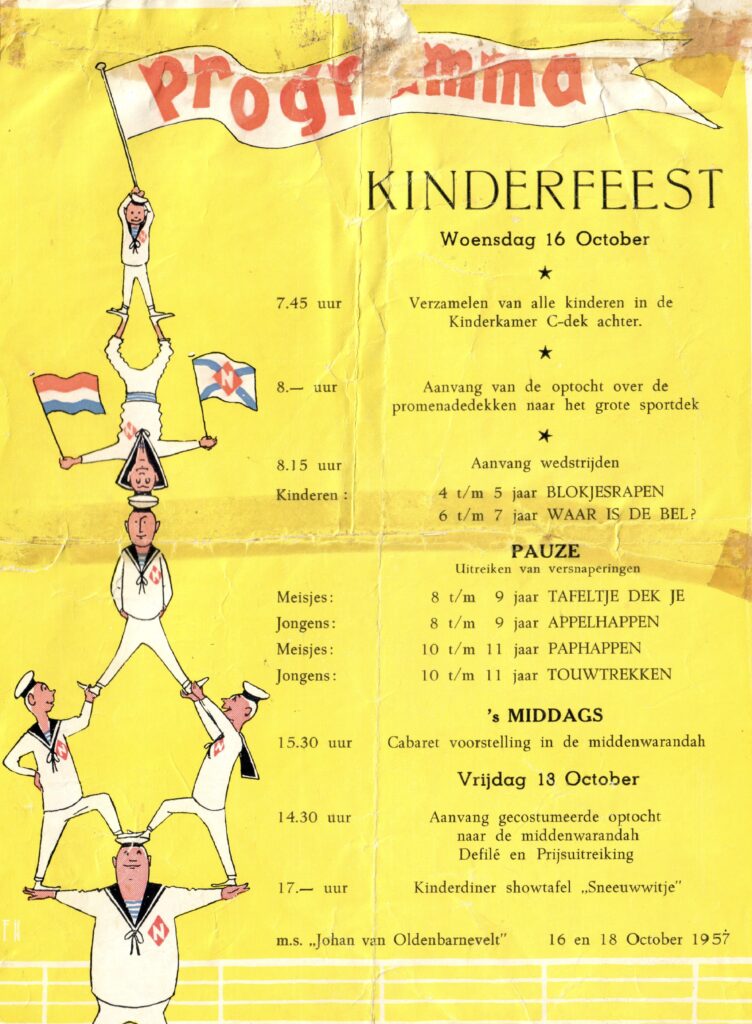
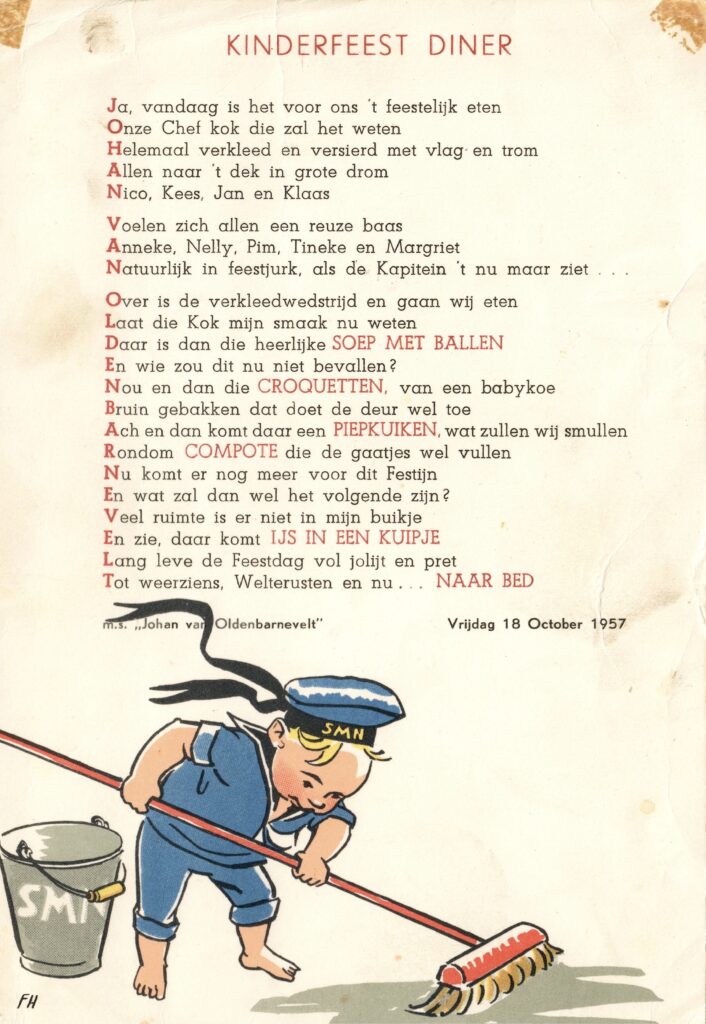
Dinner on the Johan van Oldenbarnevelt. Above, top: Captain’s dinner. Above left: Children having dinner. Above right: Adult passengers having dinner. Below left: Brochure about the kinderfeest or children’s party onboard the ship. Below right: Poem or song about the children’s party dinner. Supplied: Gerry Rüsing-Molenaar.
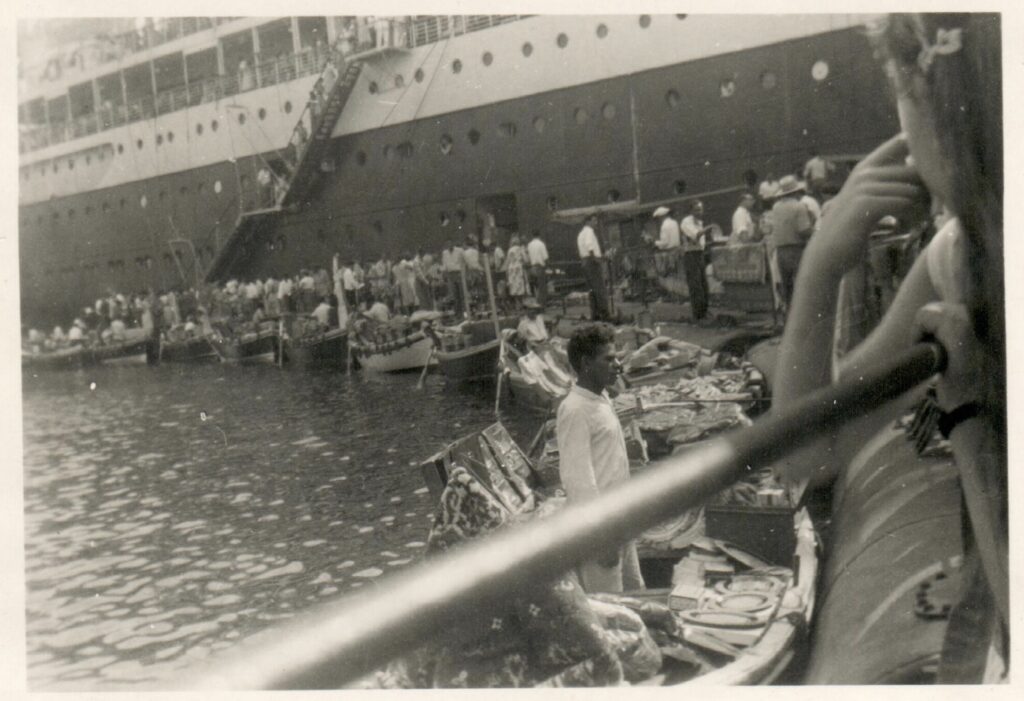
Small boats come alongside the Johan van Oldenbarnevelt in Port Said, Egypt. Supplied: Gerry Rüsing-Molenaar.
Gerry remembers: In Port Said traders came along the side of the boat to try and sell their goods. When you purchased something, they would tow it up in a basket with a rope. But you had to be careful and make sure you had your purchased article first and then pay and put the money in the basket, because if you pay first, you would never get your article, so money gone. There were also crew members on the look-out if any outsiders would sneak on the boat, because they would break in cabins and steal your things.
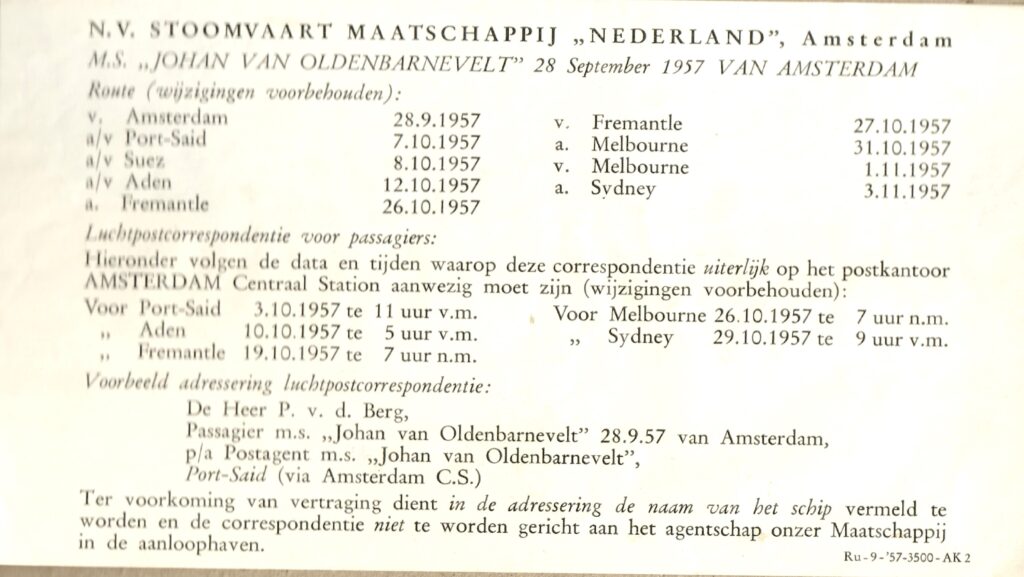
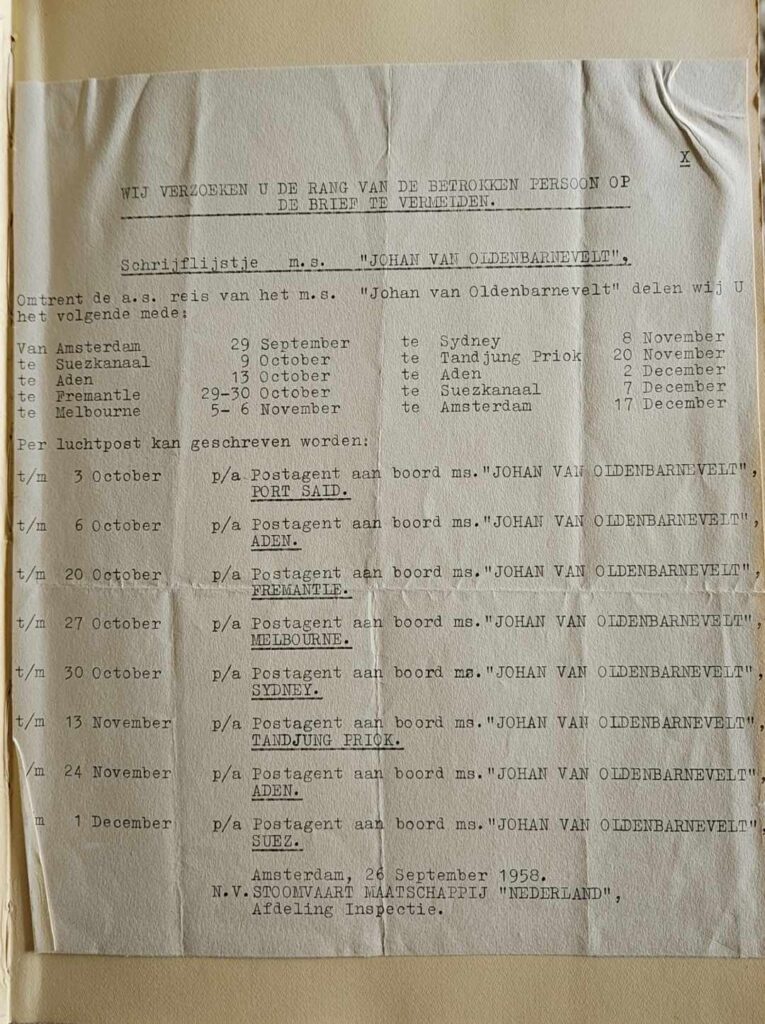
A schedule showing the ship’s route and expected arrival dates in each port. Supplied: Gerry Rüsing-Molenaar.
Gerry remembers: In case family and friends wanted to write you a letter during the trip, they got this schedule, so that they would know how to address and when to post the letter.
The Coenen Family’s Migration Story
In 2026, Patricia Coenen shared her family’s story of migrating to Australia on the Johan van Oldenbarnevelt with DACC.
Patricia’s parents, Maria and Piet Coenen, lived in Leiden and emigrated to Australia onboard the Johan van Oldenbarnevelt, departing from IJmuiden in January 1956. They took their four children, two of whom were from Piet’s first marriage, with them: Anita, Guido (later Guy), Annelies and Marian.
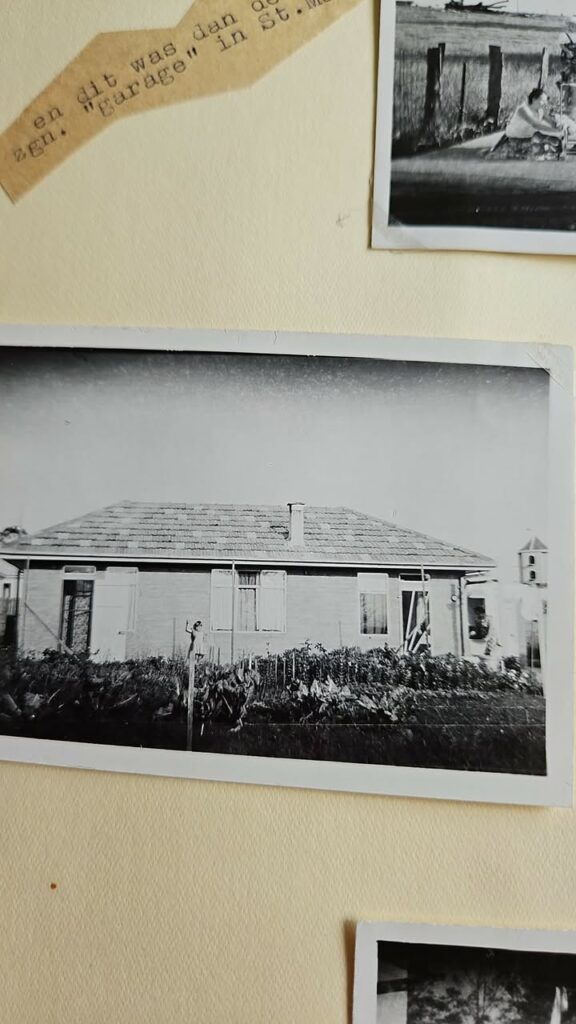
In Australia the family was sent to Scheyville Migration Camp. The family’s fifth child, Margret, was born in the camp. Later, when the family was living in St Mary’s, two more children were born: Yvonne and Patricia. Piet built a house for the family on Carpenter Road, which is still there today.
In September 1958 Maria’s sister, Will, travelled to Australia to visit Maria and her family. Will travelled on the MS Oldenbarnevelt like her sister had two years earlier, and paid for her passage by working in the children’s area. Her work involved looking after passengers’ children and organising games and activities for them. Will made an album about her trip, filled with photos and mementoes of her time in Australia and onboard the Johan van Oldenbarnevelt.
In December 1963, Piet and Maria Coenen returned to the Netherlands. Piet was experiencing health issues and in addition Maria was homesick for her family. The family’s eldest children, Guy and Anita, stayed in Australia while the rest of the family travelled back to the Netherlands.
Several years later, around 1975, Annelies returned to Australia. She lives there still today. Patricia, who lives in the Netherlands and shared her family’s story with us, says she now has quite a lot of family members in Australia today and even in New Zealand!
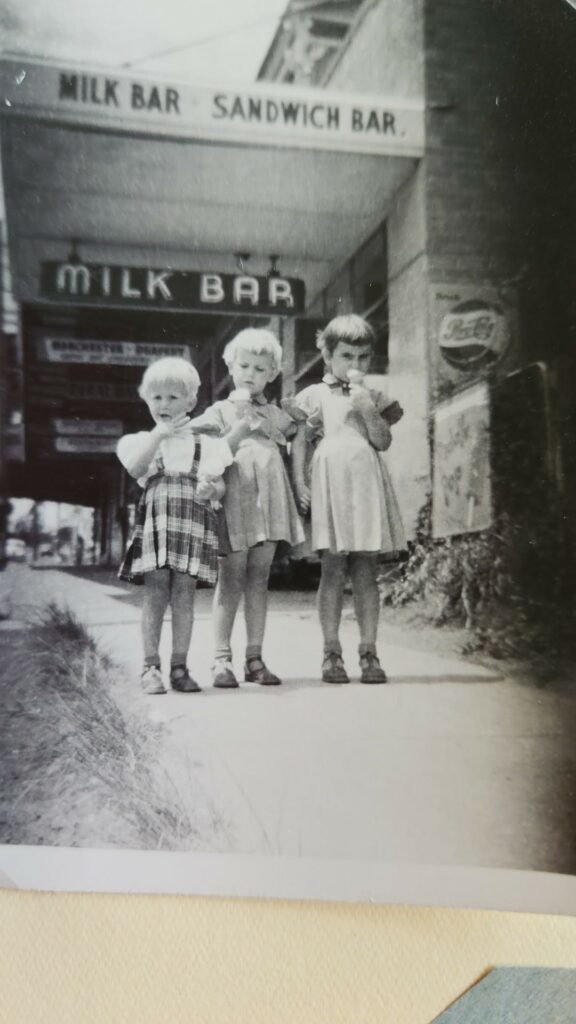
Below a selection of photos and documents from a photo album Will made of her trip to Australia to visit the Coenen family. The house is the home Piet Coenen built in St Mary’s, and the three children are Annelies, Marian and Anita. Photos and documents supplied by Patricia Coenen.