Elva Mary Bennett’s remarkable wartime service took her from South Australia to Camp Columbia and then through India, Burma, Singapore and Java. During the Second World War she served successively with the Australian Women’s Army Service, the Dutch Vrouwenkorps and the British Women’s Auxiliary Service (Burma).
Her story has been reconstructed from personal documents, military records and a surviving transcript of an interview with Elva. These materials were researched, compiled and provided by her son, Russ Morison.
Early life and Australian service
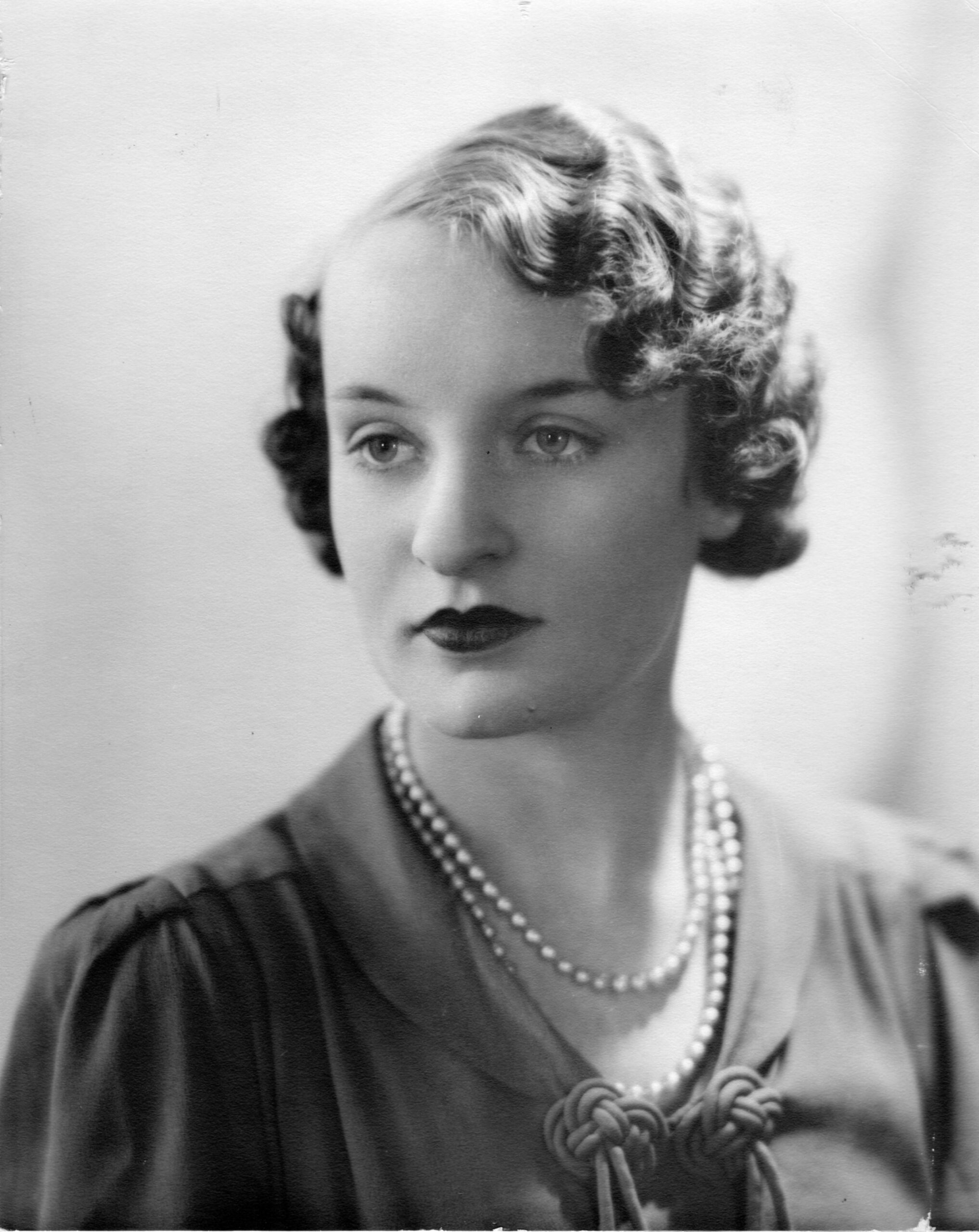
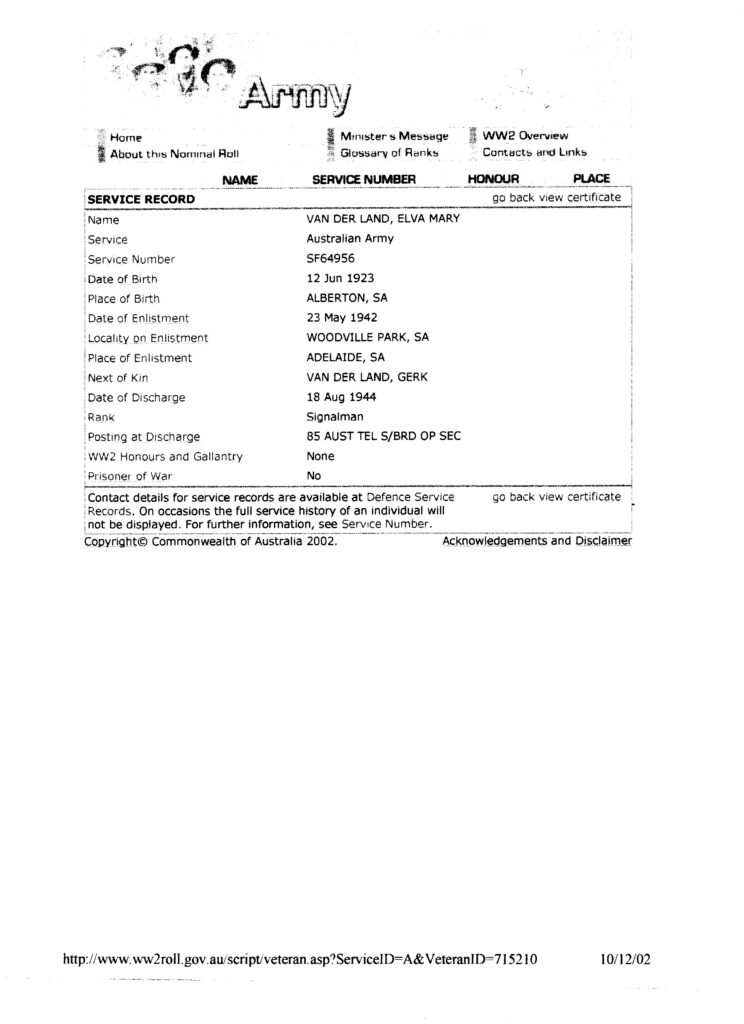
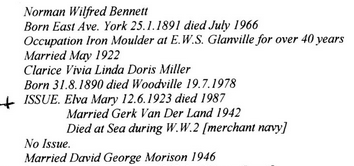
Elva Mary Bennett was born at Alberton, South Australia, on 12 June 1923. After leaving school, she worked from 1939 until 1942 as a typist, switchboard operator and clerk at the Australian Glass Company in Kilkenny.
On 23 May 1942, Elva enlisted in the Australian Women’s Army Service (AWAS). She served with signals units as an operator and was posted to several military camps in South Australia. Her service number was SF64956.
Elva later recalled that she seemed to have been stationed at almost every army camp in the state. The communications experience she acquired during this period would remain important during her subsequent Dutch service.
She was discharged from the Australian Army on 18 August 1944.
Marriage to Gerk van der Land
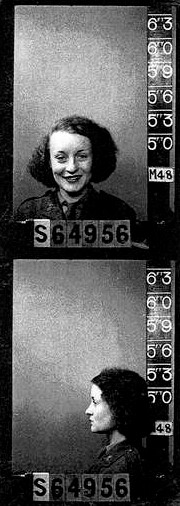
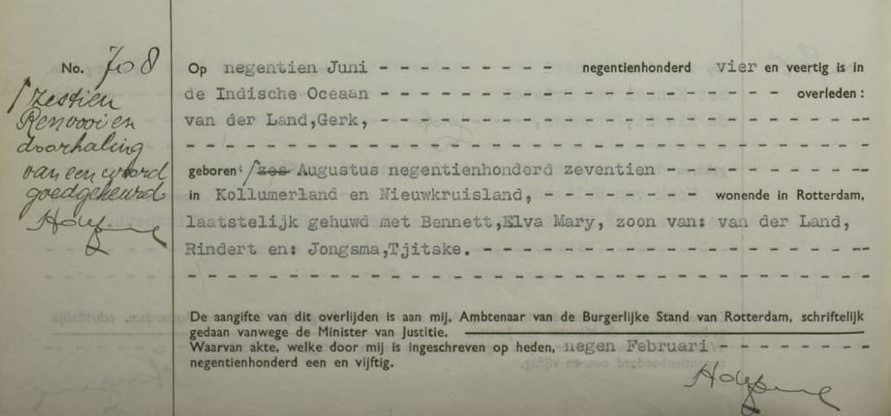
During her Australian service, Elva met Dutch merchant seaman Gerk van der Land. They married in January 1944.
Gerk was born in Kollumerland en Nieuwkruisland, Friesland, on 16 August 1917. He served as an able seaman in the Dutch Merchant Navy.
On 19 June 1944, Gerk was serving aboard the Dutch freighter SS Garoet in the Indian Ocean. At 7.53 pm, approximately 600 miles northeast of Mauritius, the unescorted ship was struck by two torpedoes fired by the German submarine U-181.
The Garoet sank within approximately two minutes. There was no time to transmit a distress signal or launch the lifeboats. All those aboard—46 crew members, 44 lascar seamen and nine gunners—were lost.
Gerk was 26 years old. His death left Elva widowed only a few months after their marriage.
More information about the loss of the ship is recorded in the Uboat.net entry for SS Garoet.
Joining the Dutch Vrouwenkorps
After leaving the AWAS, Elva was offered a position with what she described as the “Dutch Women’s Army”—the Vrouwenkorps or VK. This was the women’s corps established in Australia for service with the Royal Netherlands East Indies Army.
In her surviving interview, Elva explained:
“I joined up and we trained for service in Java, so I went to Brisbane to Camp Columbia.”
Her service involved more than military training. At Camp Columbia she again worked on a switchboard while preparing for possible deployment to the Netherlands East Indies. The operational demands of her communications duties sometimes prevented her from attending the VK’s instructional program.
Elva recalled that she managed to learn spoken Dutch but missed many of the formal grammar classes.
The available family chronology records her VK service as beginning on 1 September 1944. Its exact duration requires further verification. One document gives an ending date in December 1944, but Elva herself recalled remaining at Camp Columbia for approximately twelve months before departing to join the Women’s Auxiliary Service (Burma) in September 1945. Her own account is consistent with a longer period of VK service.
Elva attained the rank of corporal.
Camp Columbia was not only a training camp
When her interviewer asked whether Camp Columbia had simply been a training school, Elva corrected him:
“No. We had to do our ordinary work as well as our training.”
This brief statement provides valuable evidence about the VK-KNIL women at Camp Columbia. They were not merely waiting or undertaking ceremonial military instruction. Women such as Elva performed essential communications and administrative duties while simultaneously preparing for deployment.
Her recollection also shows that women brought skills acquired in Australian service into the Dutch organisation. In Elva’s case, the switchboard and signals experience gained through the AWAS was immediately useful to the Netherlands East Indies authorities.
Joining the “Wasbies”
In 1945, a British recruiting officer visited seeking volunteers for the Women’s Auxiliary Service (Burma), whose members were commonly known as the “Wasbies”.
Elva volunteered and departed for Bombay with fourteen other women. She enlisted in the WAS(B) on 26 September 1945 and served with the British Fourteenth Army.
As her interviewer observed, in little more than a year Elva had served as an Australian, Dutch and British servicewoman. Elva replied:
“From the point of view of service, I certainly was.”
From Bombay, the women travelled to Calcutta. Elva then continued by train to Gauhati, crossed the flooded Brahmaputra River by paddle steamer and travelled by bus into the hills of Assam. There she received her WAS(B) uniform and equipment.
The Women’s Auxiliary Service (Burma) had grown out of a canteen service established in 1942. Its members provided mobile canteens and recreational facilities for troops serving under extremely difficult conditions. They worked close to operational areas and frequently lived in damaged buildings, tents and other improvised accommodation.
Rangoon and Radio Burma
Elva subsequently sailed across the Bay of Bengal to Rangoon, where she worked at a recreation centre and swimming pool serving approximately 2,000 British and Indian troops.
The city had been badly damaged during the war. Elva remembered destroyed buildings, bomb craters and the absence of basic services such as functioning railways and water supplies.
While in Rangoon, she made two radio recordings and sent messages to Australia through Radio Rangoon. The surviving transcript of her interview may derive from a later broadcast made after she returned home, although its precise recording and transmission date still needs to be confirmed.
Singapore and Java
Elva later travelled aboard the pilgrim ship Ismailia to Singapore. There she visited Changi prison and saw evidence of the suffering endured by Allied prisoners of war.
In February 1946 she sailed from Singapore to Surabaya aboard a Dutch hospital ship. The harbour was obstructed by sunken vessels, and a passage had to be cleared before the ship could enter. Elva recalled the devastation caused by the recent fighting and saw bodies in the city’s canals.
She was flown in a Dutch aircraft from Surabaya to Semarang, where she worked with the British 5th Parachute Brigade. Elva and another woman brought boxes of books from Surabaya for troops who had been without reading material for months, carrying the books on stretchers.
Her mobile canteen travelled into the hills to serve soldiers engaged in continuing operations. It supplied tea, coffee, sandwiches and sausage rolls. Any food left over was distributed among local children, many of whom were suffering from dysentery and beriberi.
Elva was deeply affected by the conditions she witnessed. She remembered starving Indonesians collapsing in the streets and British servicemen caring for orphaned children.
Her recollections were recorded from the perspective and in the language of an Australian servicewoman in 1945–46. They offer valuable eyewitness testimony, but they also reflect the attitudes and limited information available to her during the violent opening phase of the Indonesian struggle for independence.
Returning to Australia
Elva travelled across Java to Batavia before returning through Singapore. The need to evacuate wounded personnel prevented her party from flying directly home.
She arrived back in Australia at Derby in Western Australia and continued by sea to Fremantle. From there she travelled across Australia by troop train, accompanied by six suitcases, six smaller cases and a Malayan hat she had carefully guarded throughout the journey.
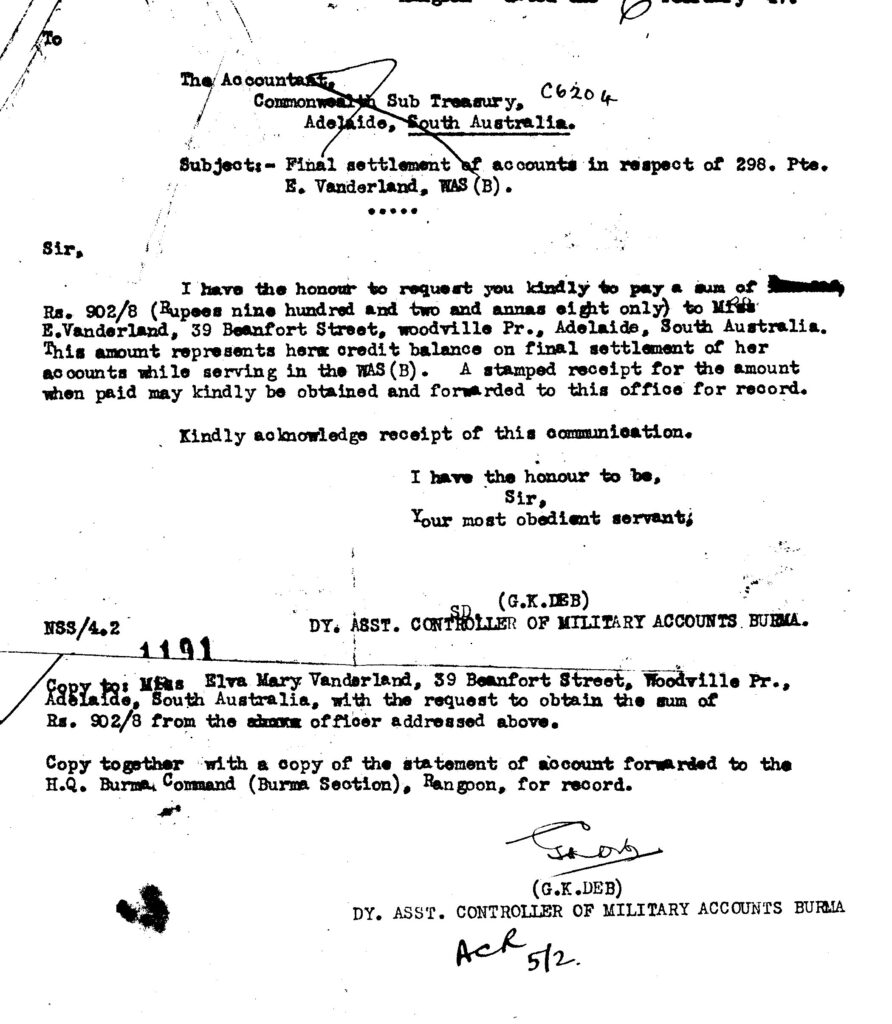
Her WAS(B) service ended in April 1946.
Post-war life
Elva later met British serviceman David George Morison. They married on 8 July 1947.
As the wife of a serving member of the British forces, Elva lived in the Middle East, including Palestine and Egypt. Family documents also record a period at Sarafand. The couple suffered the loss of a stillborn son, Peter, on 8 July 1948.
Elva and David eventually settled permanently in Australia and raised their family. Elva died in 1987.
Her wartime life was extraordinary. Beginning as a South Australian signals operator, she became a member of the VK-KNIL at Camp Columbia and then travelled with the Women’s Auxiliary Service (Burma) through a region emerging from Japanese occupation and entering a new period of political conflict.
Elva’s story also demonstrates how women moved between Allied organisations, carrying their skills and experience from one service to another. Her communications work at Camp Columbia forms a particularly valuable part of the history of the VK-KNIL in Australia.
Family collection and primary sources
This article is based principally on Elva’s service documents, family papers and the transcript of an interview conducted by Reg Neal, preserved and researched by her son, Russ Morison.
The complete family history, documents and interview transcript should remain available with this article as downloadable primary-source material. Some dates recorded in the documents conflict with Elva’s recollections. These discrepancies have been identified rather than silently reconciled and remain subjects for further research.
The poems preserved among Elva’s papers should also remain with the collection. As their authorship has not been established, they should be described as poems found in Elva’s collection rather than as poems written by her.
This article forms part of the VK-KNIL Research Portal – Dutch women in military service from Australia to Indonesia.
Poems found in the collection of Elva – it is not known if she has written them.