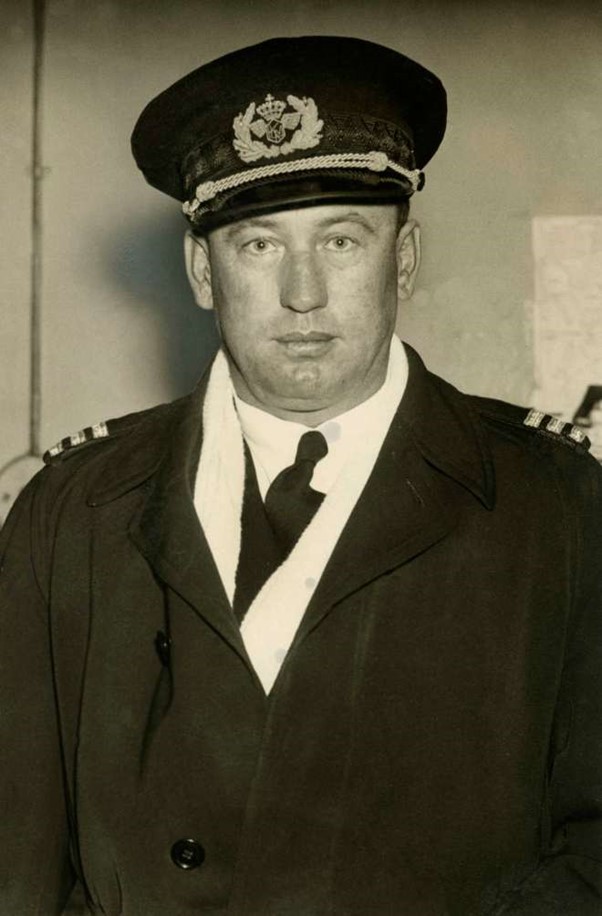
Iwan Wasiliwitsj Smirnoff lived one of the most remarkable lives in early aviation. Born in the Russian Empire, he became a decorated First World War fighter pilot, fled the Russian Revolution and eventually made a new career in the Netherlands.
As a KLM captain, he pioneered long-distance air services between Europe and the Netherlands East Indies. During the Second World War he evacuated civilians from Java, survived a Japanese attack and crash-landing on the Western Australian coast, and later flew with the Allied air transport organisation operating from Australia.
Smirnoff’s story links Russian, Dutch, Indonesian, American and Australian aviation history.
From Russian soldier to fighter pilot
Smirnoff was born near Vladimir in the Russian Empire on 30 January 1895.
Following the outbreak of the First World War, he enlisted in the Imperial Russian Army. After being wounded during ground service, he transferred to military aviation and qualified as a pilot in 1915.
Smirnoff became a highly decorated fighter pilot and was credited with approximately twelve aerial victories. He received all four classes of the Cross of Saint George and several other Russian and Allied decorations.
The Russian Revolution and ensuing civil war destroyed the military and political world in which he had served. After briefly flying for the anti-Bolshevik forces, Smirnoff escaped from Russia and eventually reached Western Europe.
A new aviation career
Smirnoff initially worked in Britain before joining the Belgian airline SNETA in 1920. In 1922 he entered the service of the recently established Royal Dutch Airlines, KLM.
This began an association with KLM that would continue for more than twenty-five years.
His early career included numerous adventures. In October 1923 engine failure forced a KLM Fokker F.III carrying Smirnoff and three passengers to land on the Goodwin Sands in the English Channel. The occupants were rescued before the incoming tide submerged the aircraft.
Smirnoff subsequently became one of KLM’s most experienced long-distance pilots. In 1928 he helped pioneer the air route between the Netherlands and the Netherlands East Indies.
He became a Dutch citizen in 1929 and officially used the name Iwan Wasiliwitsj Smirnoff.
The 1933 Pelikaan flight
Smirnoff’s name became widely known through KLM’s celebrated Christmas mail flight of December 1933.
In early 1944 Smirnoff returned to Europe and resumed flying for KLM on the wartime service between Britain and neutral Portugal.
After the liberation of the Netherlands, he returned to Dutch soil. He subsequently helped KLM assess aircraft and prepare for the restoration of its international services.
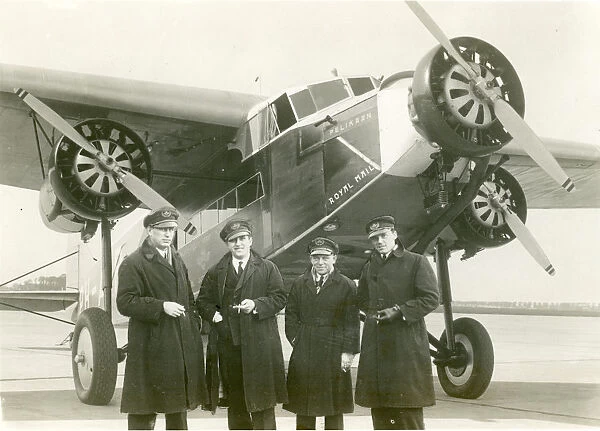
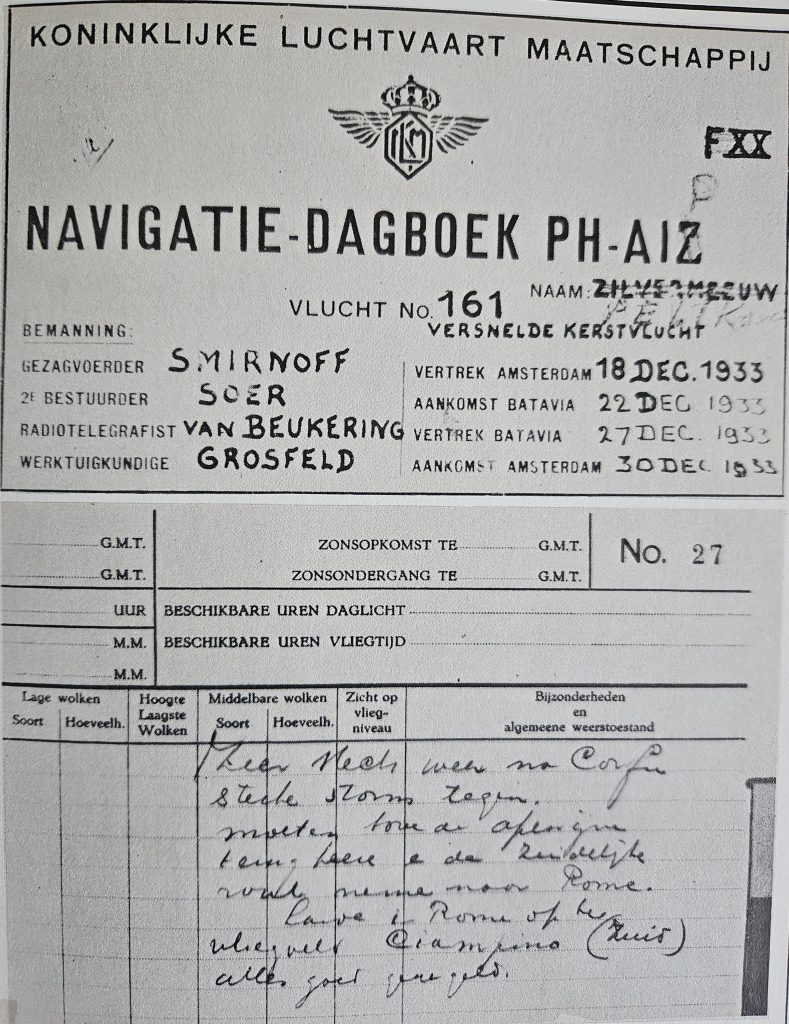
KLM originally intended to operate the flight with its new Fokker F.XX PH-AIZ Zilvermeeuw. When that aircraft developed engine trouble, the crew transferred to the older Fokker F.XVIII PH-AIP Pelikaan.
Smirnoff commanded the aircraft, with Piet Soer as co-pilot, J.M.H. “Sjef” Grosfeld as flight engineer and C.H. “Cor” van Beukering as radio telegraphist.
The Pelikaan departed Amsterdam on 18 December and reached Batavia on 22 December after approximately 100 hours and 35 minutes. The return flight began on 27 December and ended at Schiphol on 30 December, despite difficult weather over Europe.
Thousands gathered at Schiphol to welcome the crew. The flight demonstrated the growing reliability and speed of KLM’s Europe–Asia service and made Smirnoff a national aviation celebrity.
The crew of KLM’s Fokker F.XVIII PH-AIP Pelikaan following the 1933 Christmas mail flight. From left: Captain Iwan Smirnoff, co-pilot Piet Soer, flight engineer Sjef Grosfeld and radio telegraphist Cor van Beukering.
A contemporary KLM profile
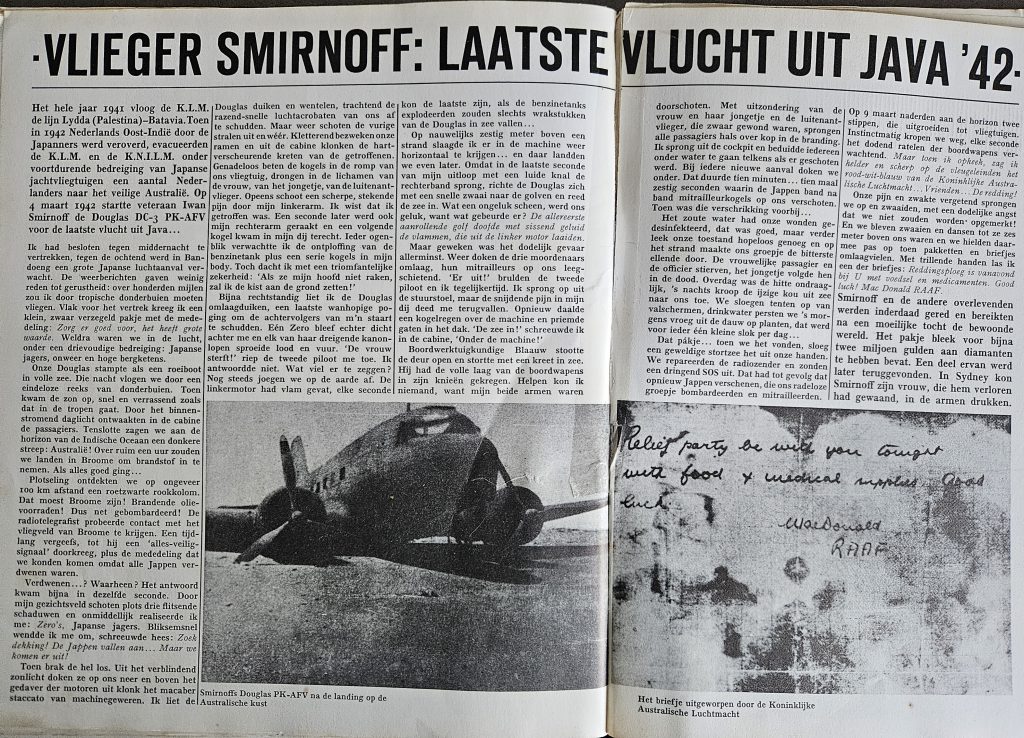
Smirnoff’s international reputation was documented during the war in a Dutch-language KLM publication. The article, written by W.J. van Roosendaal to mark Smirnoff’s fiftieth birthday in January 1945, looked back over his career from the Imperial Russian Army and First World War aviation to his pioneering work for KLM.
The profile records his military decorations, early civil-aviation experiences and service on KLM’s long-distance routes. An editorial note added that Smirnoff had accumulated more than 20,000 flying hours by that time.
The article is valuable because it presents Smirnoff as he was remembered by his KLM contemporaries while he was still actively employed as a pilot.
Two different aircraft called Pelikaan
The aircraft used for the 1933 record flight was the Fokker F.XVIII PH-AIP Pelikaan.
The Douglas DC-3 PK-AFV flown by Smirnoff during his final evacuation flight from Java in March 1942 has also been identified in later publications as Pelikaan. These were not the same aircraft.
To avoid confusing the famous 1933 Fokker with the wartime DC-3, the aircraft involved in the 1942 incident is identified below primarily by its registration, PK-AFV. The surviving contemporary evidence concerning whether the DC-3 officially carried the same name should be treated cautiously.
KLM and KNILM in the Netherlands East Indies
By the beginning of the Second World War, Smirnoff was one of KLM’s senior pilots on the route to the Netherlands East Indies. Following the German invasion of the Netherlands in May 1940, European operations were disrupted and Smirnoff was posted permanently to the Indies.
He continued flying services linking the Netherlands East Indies with destinations in the Middle East and Australia. KLM personnel and aircraft in the region worked increasingly closely with KNILM, the civil airline of the Netherlands East Indies.
Smirnoff’s first wife, the Danish actress Margot Linnet, accompanied him to the region. Their lives were divided between the Netherlands East Indies and Australia as the military threat from Japan increased.
For the wider history, see KNILM and its Australian connection.
Evacuation flights to Australia
The Japanese advance through the Netherlands East Indies transformed the civil airline network into an emergency evacuation service.
Smirnoff flew passengers and officials from Java to Australia while Japanese forces moved rapidly through the archipelago. These flights were conducted under extremely difficult conditions, with limited information, crowded aircraft and the constant threat of Japanese interception.
On 2 March 1942 Smirnoff departed Bandung in Douglas DC-3 PK-AFV. The aircraft carried evacuees and an important consignment of diamonds intended to prevent them falling into Japanese hands.
Japanese attack and crash-landing
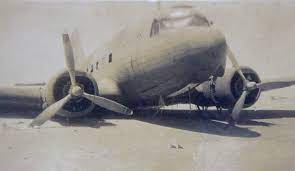
On 3 March, as PK-AFV approached Broome, three Japanese Mitsubishi A6M Zero fighters attacked it.
Smirnoff was wounded several times in his arm and leg, while the aircraft sustained extensive damage. Despite his injuries, he kept the DC-3 under control and brought it down on the beach at Carnot Bay, north of Broome.
Four passengers died from injuries sustained during the attack and crash-landing. The survivors remained on the remote coast until a rescue party reached them.
The aircraft’s consignment of diamonds subsequently disappeared. Some were recovered, but the fate of a substantial part of the shipment has never been conclusively established.
Read the detailed DACC account: Iwan Smirnoff and the aircraft that crash-landed with diamonds aboard.
Allied air transport operations from Australia
After recovering from his injuries, Smirnoff continued flying from Australia.
The surviving KNILM aircraft had been brought under American military control, and experienced Dutch civil aircrew were employed within the Allied transport organisation. Smirnoff served with the United States Army Air Forces’ Air Transport Command and operated transport flights between Australian bases and New Guinea.
His experience of long-distance and tropical flying was especially valuable to American units newly arrived in the Southwest Pacific.
Smirnoff was also associated with the Netherlands East Indies Transport Section at Archerfield. A photograph taken at Archerfield in approximately August 1943 shows him with Lieutenant A. Reyers, Adjutant J.W. Hoogland and another member of the Dutch transport organisation.
The work of these crews included the movement of personnel and supplies, the evacuation of wounded servicemen and the demanding courier service connecting General Douglas MacArthur’s headquarters in Brisbane with New Guinea.
Read more: Netherlands East Indies military air transport services in Australia, 1942–1947.
Smirnoff’s account of his wartime service
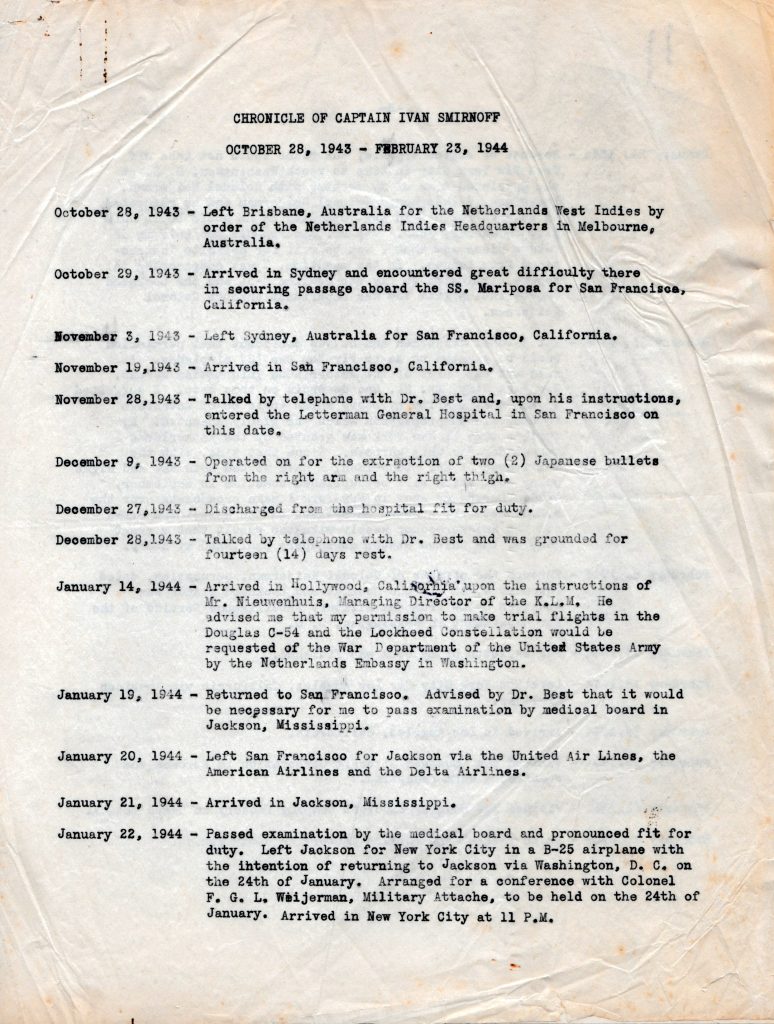
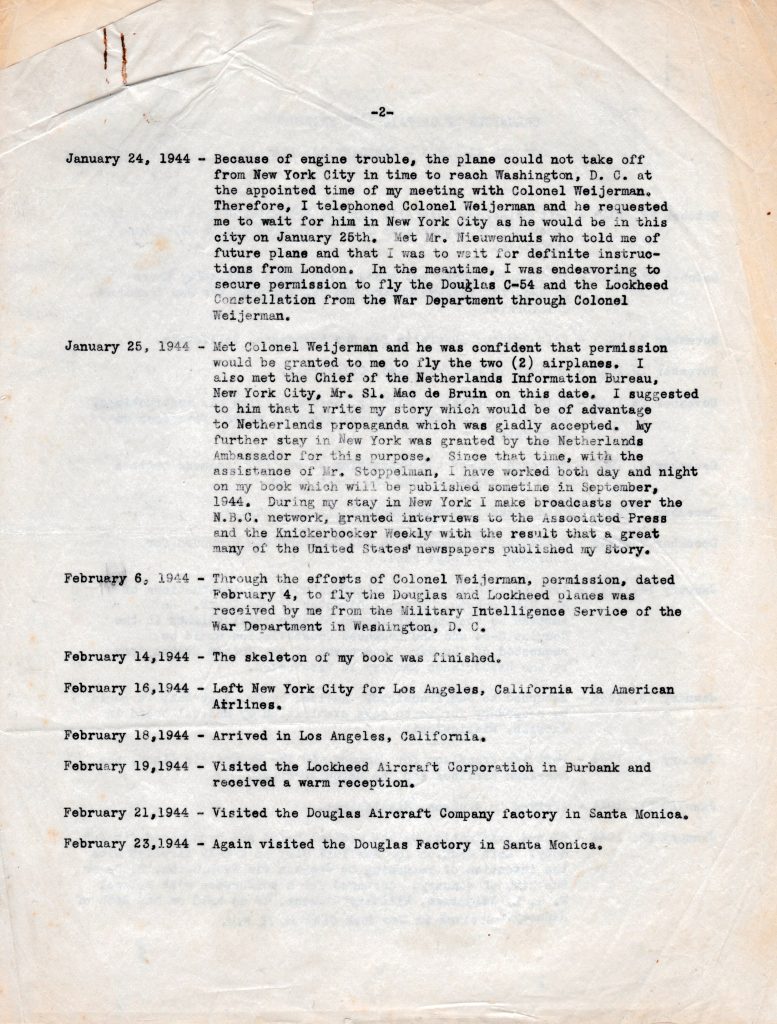
The following surviving document was prepared by Smirnoff and records his experiences between 28 October 1943 and 23 February 1944. It provides first-hand evidence of his wartime aviation service during the period in which he was operating within the Allied transport system.
Pages from Iwan Smirnoff’s account of his wartime service between 28 October 1943 and 23 February 1944. Source: Aviodrome Historical Aviation Archive.
Return to Europe
Smirnoff became a KLM inspector in 1947. His wife Margot died that year after a long illness. In 1948 he married Mina “Niki” Redwood.
Having accumulated more than 30,000 flying hours, Smirnoff retired from KLM in 1949.
Death and remembrance
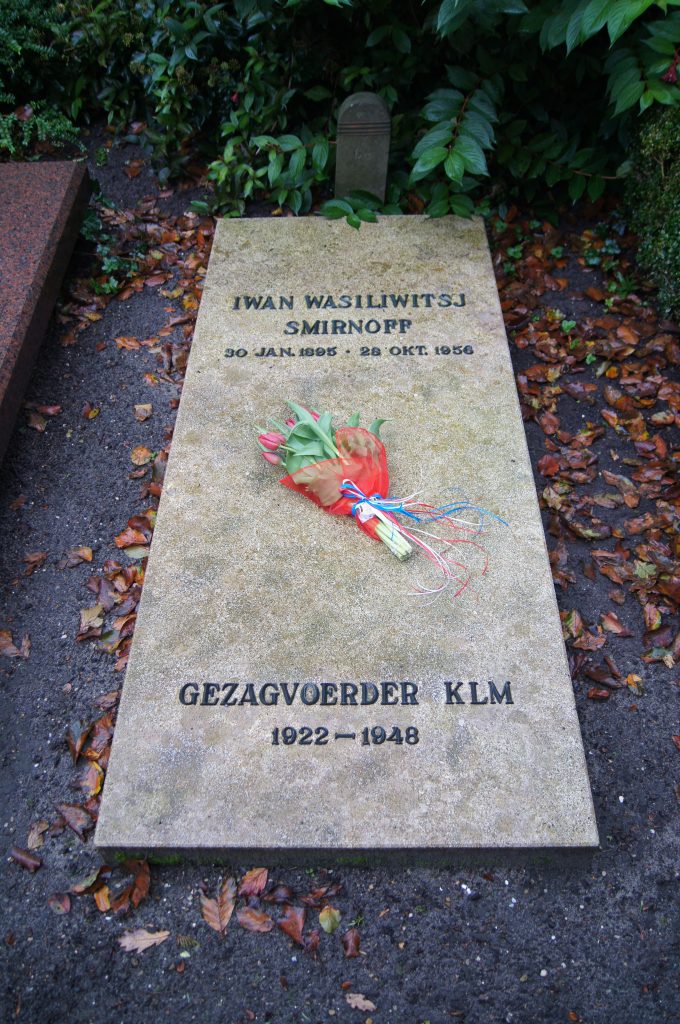
Iwan Smirnoff died on Mallorca on 28 October 1956. He was buried at Heemstede in the Netherlands.
Smirnoff remained closely associated with the history of KLM’s pioneering long-distance routes and the wartime evacuation of the Netherlands East Indies.
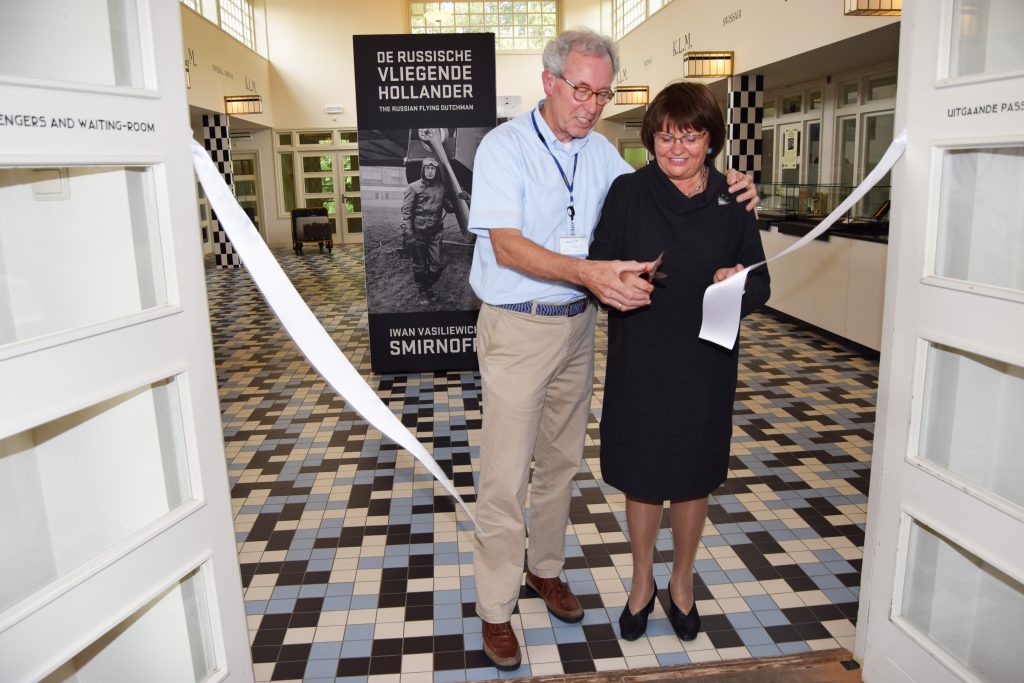
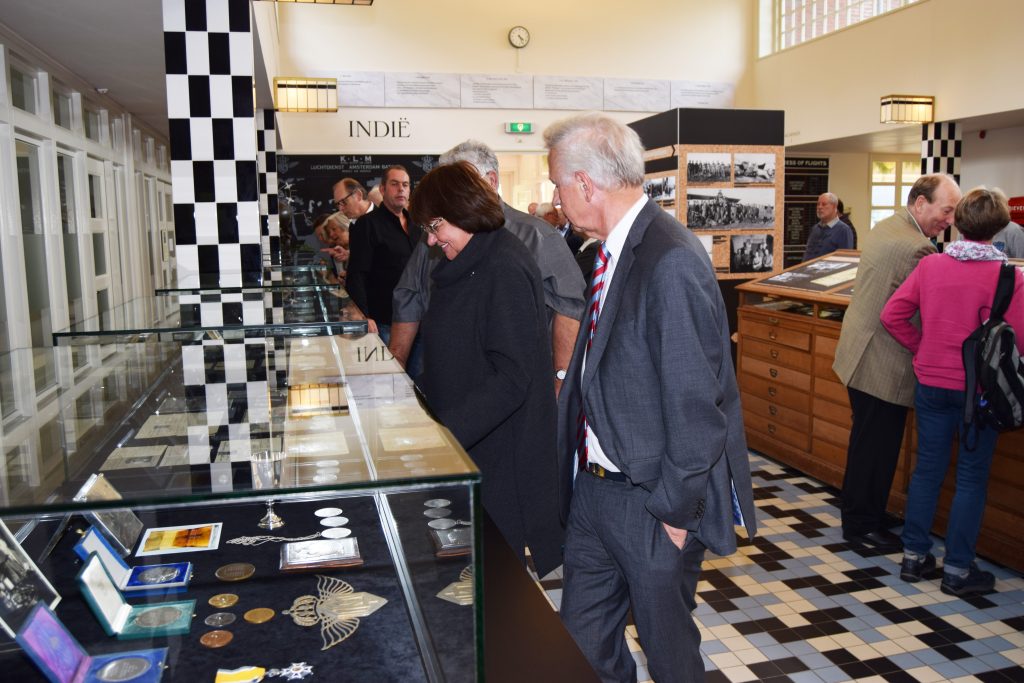
In 2021 the Aviodrome aviation museum at Lelystad received a bronze bust of Smirnoff created by Russian artist Victoria Tishchenko. The bust was presented by the Vladimir-Suzdal Museum, which had included Smirnoff in an exhibition about people from the Vladimir region who left Russia during the revolutionary era.
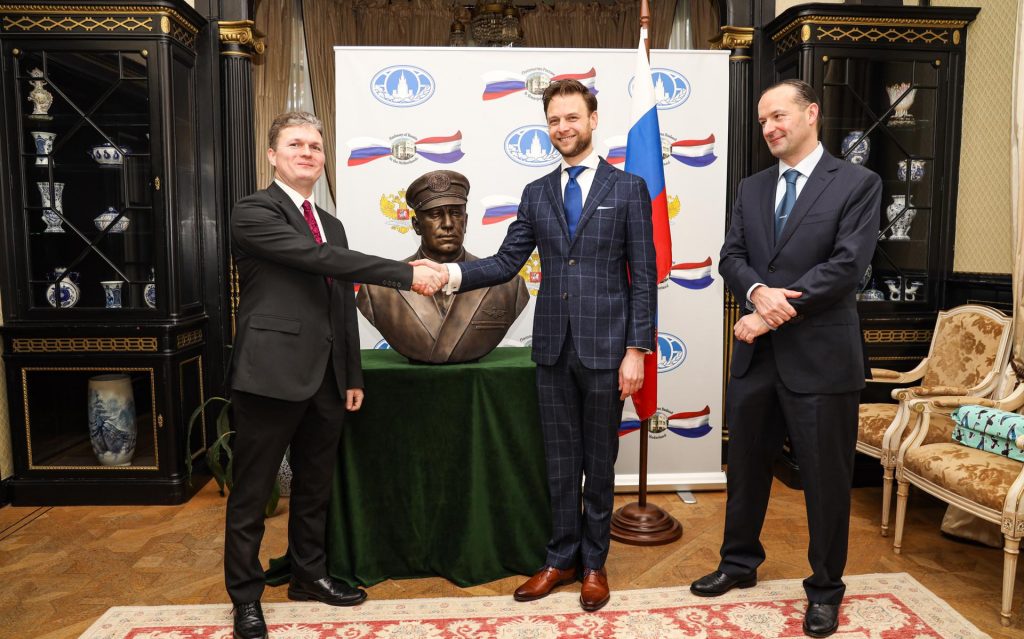
Artist Victoria Tishchenko immortalized him in bronze last year for an exhibition in the Vladimir-Suzdal Museum about residents of Vladimir who left the country between the revolution and the Second World War; Smirnoff was one of them.
The pictures below are of the exhibition of Iwan Smirnoff in the Aviodrome museum.
Smirnoff’s career spanned several distinct eras of aviation:
- the pioneering years of First World War military flying;
- the Russian Revolution and exile;
- the development of European civil aviation;
- KLM’s long-distance service to the Netherlands East Indies;
- the emergency evacuation of Java;
- Allied air transport operations from Australia; and
- the rebuilding of KLM after the war.
For Australian history, his crash-landing at Carnot Bay and his subsequent service from Australian bases provide a direct connection with the Dutch wartime presence in Australia.
Related DACC articles
- DACC Air Force Research Portal
- KNILM and its Australian connection
- Netherlands East Indies military air transport services in Australia, 1942–1947
- The Dutch at Archerfield Airport, Brisbane
- Iwan Smirnoff and the aircraft that crash-landed with diamonds aboard
- The Java–Broome evacuation route, February and March 1942
Sources and further reading
- Anne Robertson Coupar, Iwan Smirnoff: Een leven vol avontuur
- Piet Soer, “Luchtvaartpionier Iwan Smirnoff”
- Aviodrome Historical Aviation Archive.
- KLM historical publications and photographic collections.