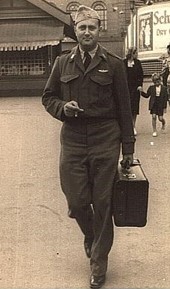
Johannes “Joop” Gijzemijter was a Dutch aircraft engineer and flight engineer who escaped from Java to Australia with KNILM personnel and aircraft in February 1942. After serving with Allied transport units, including the USAAF’s 39th Troop Carrier Squadron, he became Technical Superintendent of the Netherlands East Indies transport organisation at Archerfield.
This personal account was written by his son, John Gyzemyter. It records not only Gijzemijter’s wartime career but also the practical difficulties faced by the Dutch transport service in Australia—including shortages of trained personnel, aircraft parts and workshop equipment. It complements the broader DACC histories of the Netherlands East Indies transport squadrons and Archerfield Airport.
Johannes (Joop) Gijzemijter
Born: 24 February 1915, Rotterdam, the Netherlands
Died: 30 April 1999, Brisbane, Australia
From KLM to KNILM
Gijzemijter began his aviation career with KLM on 3 March 1930 as an apprentice aircraft maintenance engineer. After qualifying, he trained as a flight engineer and worked on several types of KLM aircraft.
In 1937, he was among the KLM engineers who reassembled the newly delivered Douglas DC-3 PH-ALW Wielewaal at Waalhaven after the aircraft arrived by ship from the United States. That aircraft later became KNILM’s PK-ALW and escaped from Java in March 1942 carrying Lieutenant Governor-General Hubertus van Mook.
In 1938, Gijzemijter joined KNILM in the Netherlands East Indies. As a flight engineer, he worked on the airline’s expanding regional and Australian services. On 22 December 1941, he served as flight engineer aboard the KNILM aircraft commanded by Captain Gerson van Messel on what was reported as the airline’s 250th service to Sydney.
During the Japanese invasion, Gijzemijter escaped to Australia with the surviving KNILM personnel and aircraft. On 14 May 1942, he was flight engineer aboard the Douglas DC-5 PK-ADC Wakago, flown by Captain Dirk Rab, when it joined two other former KNILM aircraft in passing beneath the Sydney Harbour Bridge.
These experiences placed Gijzemijter among the civil aviation specialists who subsequently became essential to the Netherlands East Indies military transport organisation in Australia.
“What did you do during the war Daddy?”
Written by his son John Gyzemyter.
As children Dad often told us stories about his career in aviation which started on the 3 March 1930 as an apprentice aircraft maintenance engineer with KLM Royal Dutch Airlines in the Netherlands. After qualifying as an aircraft engineer he trained as a Flight Engineer on various aircraft.
In 1938 he was offered a job as a Flight Engineer for KNILM in what was then Netherlands East Indies. He flew from 1938 until the Japanese invasion. During the invasion, as a member of the civilian aircrew, he evacuated from Java to Australia together with 10 KNILM aircraft in February 1942. After having been seconded to various military units around Australia, my Dad found himself attached to the 39th Troop Carrier Squadron of the United States Army Air Force based at Archerfield as a flight engineer and co-pilot in early 1943.
On 1 September 1944, Dutch personnel from the existing transport sections were brought together in No. 1 Netherlands East Indies Transport Squadron, based at Archerfield. Joop, a fully qualified aircraft maintenance engineer, was appointed Technical Superintendent of the new Dutch unit.
My Dad continues the story,
” We were allocated a hangar which could accommodate a Douglas DC 3. There was, of course, an enormous shortage of manpower but through the labour exchange, we were allocated 20 civilians of which only one, an Irishman named Danny McLaughlin, had any aircraft experience. The others were a mixture of farmers, carpenters, miners, and one meat worker. Apart from Danny none had been close to an aircraft before and were totally bewildered. However, they were very willing and in time became an efficient and productive team”.
Danny was a good engineer and a fantastic storyteller; but what was more important, he was the biggest scrounger that I’ve ever come across. He was able to procure almost any part or piece of equipment needed. For the supply of spare parts, we were dependent on USAAF supply depots. So being at the end of the chain it was only natural that we were sometimes given the run-around when we needed something that was in short supply. This is where Danny became our greatest asset. Having worked for ANA and Qantas he knew everybody worth knowing; and because both companies were also engaged in repair work, they had the parts. Danny would casually walk into their hangar, seek out the person he wanted, and with a ‘Hey, did you hear this one?’ start to spin one of his yarns. He would have them in stitches for the next 10 minutes and he would always have the goods when he came back.
We only had one set of wing jacks and badly needed a second pair, but we had no hope of getting a set through normal channels. Danny had discovered a shed full of RAAF equipment and at least two dozen wing jacks just sitting there.
There were two guards in a little office who were extremely bored with having nothing to do. Danny made it his business to visit them regularly and tell them a few jokes. After a while, they really looked forward to his visits and even made him cups of tea to prolong his stay. This was all part of Danny’s plan, for he had shown four of our fellows how they could wheel two jacks out of the shed without being seen, while he would keep the guards occupied roaring with laughter. So, this is how it happened one day, while in our own hangar some fellows stood by with paint and brushes. Before Danny left the guards, the jacks had been repainted and converted to Dutch Air Force property.”
“All is fair in Love and War.”
Maintaining the Dutch transport fleet
Gijzemijter’s account illustrates how the Netherlands East Indies transport organisation depended upon Australian civilian workers and informal cooperation with neighbouring Allied and commercial aviation organisations.
As Technical Superintendent, he was responsible for maintaining aircraft that operated long-distance supply, courier and personnel services between Australia and New Guinea. His small team had to overcome shortages of experienced workers, spare parts, tools and workshop equipment.
The twenty civilian workers supplied through the labour exchange came from widely varied occupations. Under the guidance of Gijzemijter and the few experienced engineers—including Danny McLaughlin—they developed into an effective aircraft-maintenance team.
Their work supported the transport operations upon which the Netherlands East Indies Government-in-Exile, NICA, NEFIS and the Dutch combat squadrons depended.
Postwar career
After the war, Gijzemijter returned to Jakarta as a Technical Superintendent with KNILM and KLM. He subsequently remained with KLM as a maintenance manager at several overseas stations.
In November 1963, Joop and his family migrated to Sydney. He joined Qantas and helped establish its apprentice training college at Rosebery, where aircraft engineers were prepared for the introduction of the Boeing 747.
He retired in July 1975 and later moved to Brisbane. Joop Gijzemijter died there on 30 April 1999.
His career connected several major chapters in Dutch–Australian aviation history: prewar KLM and KNILM services, the evacuation from Java, Allied transport operations at Archerfield, the rebuilding of aviation in the postwar Netherlands East Indies and the development of Australia’s international airline industry.
Related DACC articles
- Netherlands East Indies military air transport services in Australia, 1942–1947
- The Dutch at Archerfield Airport, Brisbane, 1934–1947
- Archerfield Memories—including the Netherlands East Indies Transport Service
- KNILM and its Australian connection
- From Wielewaal to VH-ANR: a Dutch DC-3 preserved in Queensland
- From Java to Charleville: the wartime journey of the DC-5 Wakago
- Dutch aircraft flew under the Sydney Harbour Bridge
- DACC Air Force Research Portal