Julius Tahija (13 July 1916 – 30 July 2002) was an Ambonese soldier, intelligence operative, politician and businessman whose remarkable wartime career linked the Netherlands East Indies, Australia and the Allied intelligence war against Japan.
Serving with the Royal Netherlands East Indies Army (KNIL), he distinguished himself during the Japanese invasion of the Netherlands East Indies and was awarded the Military Order of William, the Netherlands’ highest military decoration. Later in the war, operating from Australia, he became involved in intelligence activities directed towards the Japanese-occupied archipelago and in 1945 led the NEFIS III intelligence mission Operation FIRETREE.
From Surabaya to the KNIL
Tahija was born in Surabaya on 13 July 1916 into an Ambonese family. His father ensured that he received a Dutch education, and Tahija attended a Handels School with the initial intention of pursuing a career in business.
Instead, in 1937 he joined the Royal Netherlands East Indies Army (KNIL). He initially trained as a pilot but was subsequently transferred to the infantry. Before the Pacific War he served in Aceh.
After the outbreak of war with Japan, Tahija was sent to Australia while escorting a group of Japanese civilians who were to be interned there. His wartime career soon took a very different direction.
Saumlaki and the Military Order of William
During the Japanese invasion of the Netherlands East Indies, Tahija, then a sergeant, volunteered to lead a small group of Indonesian KNIL soldiers to Saumlaki in the Tanimbar Islands.
According to Tahija’s later account, his party discovered evidence that Japanese forces were preparing to land on the island. Working with local officials, the group prepared defensive positions and engaged the Japanese landing force.
After the fighting, Tahija and the surviving members of his party withdrew into the jungle. They eventually obtained a schooner and escaped to Bathurst Island in northern Australia, together with local officials and civilians.
For his leadership and actions at Saumlaki, Tahija was appointed Knight 4th Class of the Military Order of William in August 1942. His surviving comrades also received decorations.
The award was an exceptional distinction for an Indonesian KNIL soldier and established Tahija as one of the most highly decorated Netherlands Indies servicemen of the Pacific War.
Intelligence work from Australia
Tahija was subsequently promoted to lieutenant and became involved in intelligence and special operations directed towards Japanese-occupied areas of the Netherlands East Indies.
Australia had become the principal base from which the Dutch and Netherlands Indies authorities rebuilt their military and intelligence organisations following the Japanese conquest of the archipelago. By 1943 these clandestine activities were increasingly concentrated within NEFIS III – Special Intelligence and Special Operations, part of the Netherlands Forces Intelligence Service.
Indonesian personnel such as Tahija were particularly valuable to these operations. Their knowledge of local languages, geography, communities and conditions within the archipelago could not readily be replicated by Allied personnel unfamiliar with the Netherlands East Indies.
Operation FIRETREE
In February 1945, First Lieutenant Julius Tahija commanded Party FIRETREE, a five-man NEFIS III intelligence party intended to operate in the Moluccas.
Its assignment was to collect military and general intelligence, including information about Japanese shipping and aircraft movements, local conditions and weather.
The party departed Darwin aboard the Royal Netherlands Navy submarine K XV on 2 February 1945. Its principal destination was Mangoli in the Sula Islands.
Several attempts were made to find a safe landing place. On 8 February, a reconnaissance party went ashore on Mangoli but returned with information indicating that some members of FIRETREE were wanted by the Japanese. The proposed landing there was therefore abandoned.
A further reconnaissance landing was made on Saparua on 12 February. The men returned the following day after local inhabitants, fearing Japanese reprisals, declined to cooperate. As a result, the complete FIRETREE party was never permanently landed and K XV returned to Darwin on 17 February 1945.
Although the mission did not establish an intelligence party ashore, it demonstrates the extreme difficulty of clandestine operations in Japanese-occupied territory. Safe landings depended upon local cooperation, secrecy and reliable intelligence, while residents faced severe consequences if Japanese forces discovered that they had assisted Allied agents.
Tahija’s leadership of FIRETREE also illustrates the important role played by Indonesian personnel within the Dutch intelligence effort. These operations depended heavily upon people with knowledge of local languages, geography and communities.
For the broader history of FIRETREE and other clandestine intelligence missions, see NEFIS III: Dutch and Indonesian Special Operations from Australia during WWII.
Camp Columbia
By 1945 the headquarters of NEFIS had moved from Melbourne to Camp Columbia at Wacol, Brisbane, which had become an important centre for Dutch and Netherlands Indies government, military and intelligence organisations.
A surviving photograph from 1945 shows Tahija at Camp Columbia together with Lieutenant Lou Bierens de Haan and four members of the Women’s KNIL Corps.
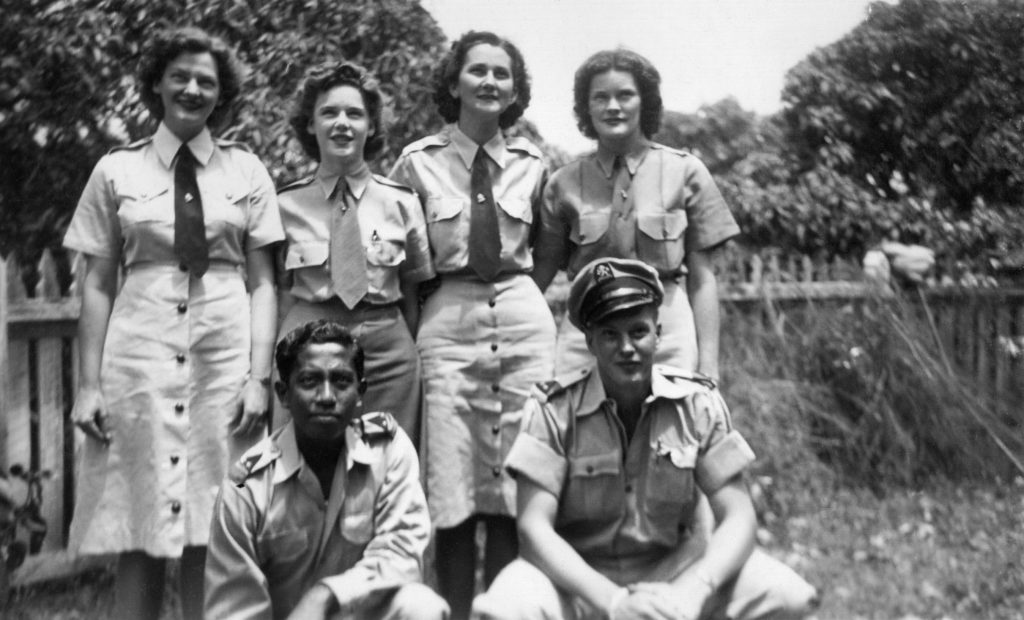
Julius Tahija (left) with Lieutenant Lou Bierens de Haan at Camp Columbia, Brisbane, during the Dutch occupation of the camp. Source: Bierens de Haan family archives/Pieter Lommerse.
The photograph provides a valuable visual connection between Tahija’s intelligence activities and the much larger Dutch and Netherlands Indies wartime presence in Australia.
A personal Australian connection
Tahija’s years in Australia also had an important personal consequence. He met Jean Walters, an Australian dentist from Victoria. They married in 1946.
His Australian wartime experience therefore became part not only of his military career but also of his personal life.
From soldier to businessman and politician
After the war Tahija returned to Indonesia during a period of profound political change.
During the Indonesian National Revolution he briefly held ministerial positions in the State of East Indonesia in 1947. He subsequently moved increasingly into business.
Tahija became associated with the development of the Indrapura Group, which grew into a major Indonesian business conglomerate. His postwar career eventually made him one of Indonesia’s prominent business figures.
His life consequently spanned several very different periods of Indonesian history: Dutch colonial rule, the Japanese occupation, service with the KNIL and Allied intelligence organisations, the struggle surrounding Indonesian independence, and the economic development of independent Indonesia.
He died on 30 July 2002.
An Indonesian participant in the Allied secret war
Julius Tahija’s story is particularly significant because it challenges an overly simple description of wartime intelligence from Australia as exclusively Dutch or Australian.
He was Ambonese and served in a Dutch colonial army, fought the Japanese, was decorated by the Netherlands, operated from Australia and participated in intelligence missions directed towards his occupied homeland. After the war, he built his future in independent Indonesia.
His career therefore reflects the complicated identities and loyalties of many people from the Netherlands East Indies whose wartime experiences cannot be understood solely through national labels.
Tahija’s story is also an important reminder that Indonesian personnel were not peripheral to Dutch intelligence operations from Australia. Their languages, local knowledge, military experience and personal networks were integral to the Allied intelligence effort in the Netherlands East Indies.
Sources and acknowledgements
This story was originally researched by Pieter Lommerse, who kindly gave permission for his research and photographic material to be used by the DACC.
Photographic material courtesy of the Bierens de Haan family archives and the Cavalry Museum, Amersfoort, the Netherlands.
Further information on Operation FIRETREE is contained in the surviving records of the Netherlands Forces Intelligence Service (NEFIS) held by the Nationaal Archief, The Hague, including material concerning intelligence parties prepared and dispatched during 1945.
Further research: Explore related articles, personal stories and archival sources in the DACC Research Portal – Dutch and Indonesian Intelligence and Special Operations from Australia during WWII.