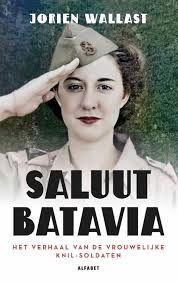
n October 2024, Dutch journalist Jorien Wallast published Saluut Batavia: Het verhaal van de vrouwelijke KNIL-soldaten (Salute Batavia: The Story of the Female KNIL Soldiers). The book recovers the experiences of five young women who served in the Vrouwenkorps of the Royal Netherlands East Indies Army during the turbulent transition from Japanese occupation to the Indonesian struggle for independence.
By concentrating on the women themselves—their backgrounds, expectations, relationships and eventual disillusionment—Wallast brings an important human dimension to the history of the VK-KNIL.
The first women arriving in Java
Japan capitulated in August 1945, but the surrender did not produce an orderly restoration of Dutch authority in the Netherlands East Indies. Indonesian nationalists proclaimed independence on 17 August, while Allied forces faced the complex tasks of disarming Japanese troops, releasing prisoners and internees and attempting to maintain order.
On 17 September 1945, an initial Dutch contingent of approximately one hundred people landed in Java. Alongside militarised medical personnel were a small number of VK-KNIL women.
These young women entered an environment very different from the one for which they believed they had volunteered. They were largely unarmed and confronted violence, political upheaval and uncertainty about the role they were expected to perform.
Five women, five different motivations
Wallast reconstructs the experiences of five VK-KNIL members: the Curaçaoan sisters Mimi and Tilly, the Leiden friends Claar and Betty, and Tjits.
They did not all join for the same reason. Mimi and Tilly dreamed of helping to liberate the Netherlands East Indies. Claar hoped to find her sisters, while Betty wanted to return to the country where she had been born. Tjits was searching for her brother Piet, who had lived on Sumatra before the war and from whom the family had received no news.
Their different backgrounds reflect the geographical reach of the former Dutch empire and the disruptive effects of war on families spread across Europe, the Caribbean and Asia.
Through their experiences, Saluut Batavia explores not only military service but also separation, uncertainty, youthful idealism and the desire to find missing relatives.
Unarmed women in a colonial conflict
The VK-KNIL women were military personnel, but they were generally not trained or equipped as combatants. They undertook medical, clerical, communications, welfare and administrative duties.
Their deployment nevertheless placed them within a colonial military organisation attempting to restore Dutch authority after Indonesia had declared its independence. What some of the women initially understood as a mission of liberation and reconstruction increasingly became part of a violent decolonisation conflict.
Wallast examines the moral uncertainty this created. The women encountered Indonesian independence fighters, British and Gurkha troops, Dutch military personnel and people emerging from Japanese internment. They had to reconcile their original motivations with the political and military reality developing around them.
From family history to historical research
Wallast’s interest in the VK-KNIL began with the story of her grandmother, Mies van Bekkum.
Mies joined the corps after the war and served in the former Netherlands East Indies. For approximately seventy years, she said little about this period of her life. Wallast’s conversations with her grandmother became the foundation for the five-part NPO Radio 1 podcast Mijn oma de soldaat (My Grandmother the Soldier).
The podcast led Wallast into a much wider investigation of the VK-KNIL. Her subsequent book draws upon archival records, personal correspondence, family collections and oral histories.
This combination allows the women’s own voices and memories to remain central while placing their experiences within the wider history of the Indonesian independence war.
Women missing from military history
The history of the KNIL has generally been told through its male commanders, soldiers and military operations. The women of the VK-KNIL received much less attention.
Although they were formally enlisted military personnel, their work was often characterised as secondary or supportive. Contemporary publicity sometimes presented them as symbols of Dutch recovery rather than as individuals performing demanding work under uncertain and dangerous conditions.
Wallast challenges this marginalisation. Her account includes fear, boredom, friendship, courage, romance, trauma and disillusionment. It also asks difficult questions about how much the women understood about the conflict and how they later interpreted their participation in the Dutch attempt to re-establish colonial rule.
The Australian connection
The Australian history of the VK-KNIL began before the events described in Saluut Batavia. The corps was established in Melbourne on 5 March 1944, while the Netherlands East Indies government and armed forces were operating in exile.
Women were recruited, trained and employed in Australia, including at Yeronga Park and Camp Columbia in Brisbane. Some subsequently travelled from Australia to the Netherlands East Indies.
Saluut Batavia principally examines the women’s experiences in Indonesia rather than their earlier Australian organisation and training. It therefore complements the Australian stories assembled in this research portal. Taken together, the book and the Australian records reveal a connected history extending from wartime Australia into the violence and uncertainty of post-war Indonesia.
Recovering individual names and stories
An important result of Wallast’s research is the recovery of the women as individuals rather than as an anonymous auxiliary corps. The membership register associated with her research contains approximately 1,300 names and provides an important starting point for families and researchers.
Many individual histories remain incomplete. Personal papers, photographs, service records and family recollections in Australia and the Netherlands may still contain information capable of identifying women, explaining their work and tracing their post-war lives.
Saluut Batavia demonstrates what can be achieved when those scattered records are combined. It restores women to a history in which they were present but for too long remained largely invisible.
Sources and further information
Jorien Wallast, Saluut Batavia: Het verhaal van de vrouwelijke KNIL-soldaten, Alfabet Uitgevers, Utrecht, 2024. Book information from Alfabet Uitgevers
The five-part podcast Mijn oma de soldaat can be heard through NPO Radio 1.
Further background on the podcast and Wallast’s research is available from the Indisch Herinneringscentrum.
This article forms part of the VK-KNIL Research Portal – Dutch women in military service from Australia to Indonesia.