Two cemeteries on one historic site
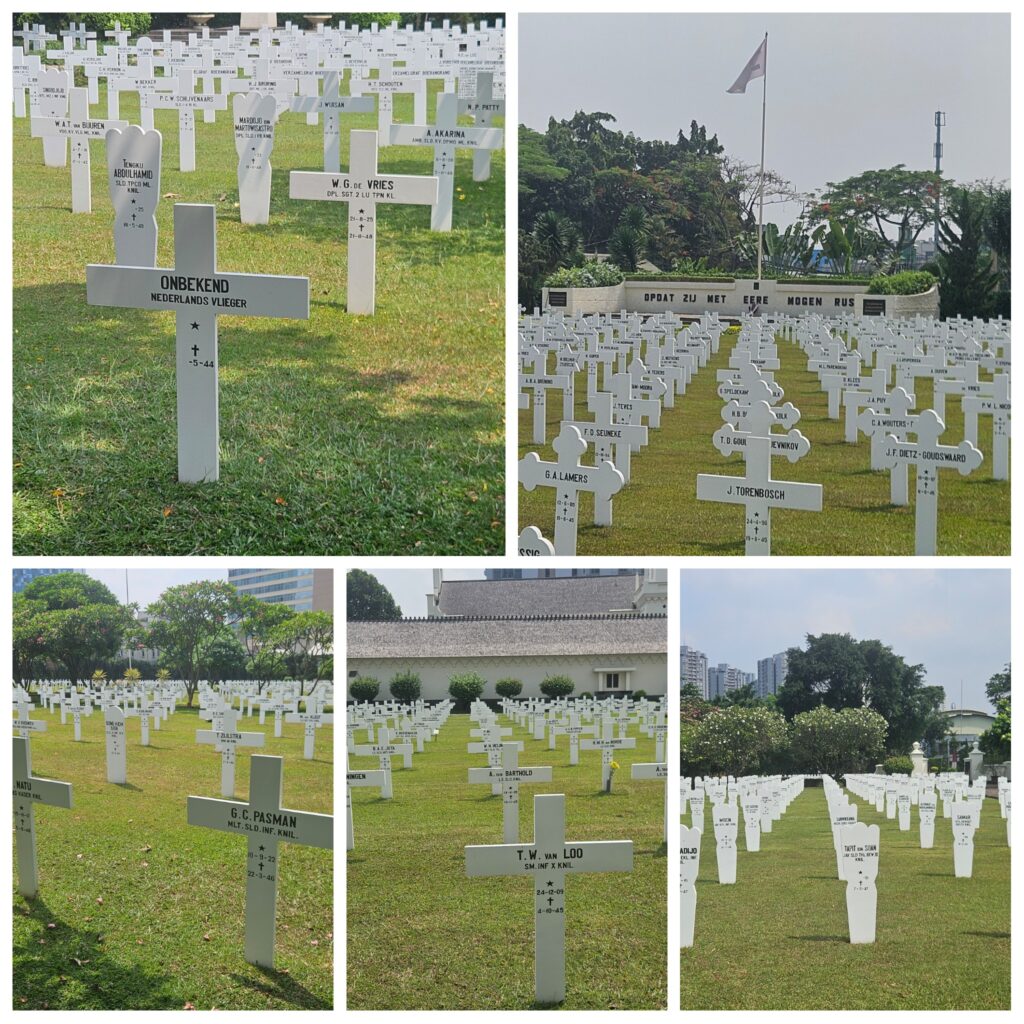
In November 2025 I visited this very impressive cemetery. It is a meticulously maintained, oases of quietness and peace situated on the busy southern side of Jakarta, hemmed in by high-rise apartments and traffic, It is one of the most important WWII remembrance sites in Asia: the Menteng Pulo cemetery complex.
Inside the same walled area, you find two distinct war cemeteries:
- Ereveld Menteng Pulo – the Dutch field of honour, owned and maintained by the Netherlands War Graves Foundation (Oorlogsgravenstichting).
- Jakarta War Cemetery – a Commonwealth War Graves Commission (CWGC) cemetery for British, Australian, Indian and other Allied servicemen.
For Dutch Australians, this site is a powerful reminder of the war in the Netherlands East Indies (NEI), the Japanese occupation and the violent years of the Indonesian struggle for independence. For Australians, it is the principal place in Indonesia where their country’s casualties of the Java and Sumatra campaigns – and some of the post-war dead – are buried together.
Dutch and NEI graves at Ereveld Menteng Pulo
Ereveld Menteng Pulo is one of seven Dutch war cemeteries on Java. Since the 1960s it has also received reburials from former Dutch cemeteries elsewhere in the archipelago, making it one of the largest Dutch war burial grounds outside Europe.
Key facts:
- The cemetery covers around 29,000 m² and holds approximately 4,300 graves.
- The dead include Dutch and Indisch civilians who died in Japanese camps, KNIL and Royal Netherlands Army soldiers killed in the 1941–42 campaign and the later “politionele acties”, and a number of Indonesian Muslims who served in KNIL units.
- In addition, a columbarium beside the Simultaankerk holds 754 urns containing the ashes of Dutch POWs who died in Japan.
Across all seven Dutch erevelden on Java, more than 24,000 Dutch war dead are buried, many of them re-interred from smaller or remote cemeteries on Sumatra, Borneo, Ambon and other islands. Ereveld Menteng Pulo is the best known of these, partly because of its distinctive Simultaankerk – an ecumenical church that incorporates religious symbols from multiple faiths – and partly because it is the main site for Dutch national commemorations in Jakarta on 4 May and 15 August.
The rows of white crosses and name plaques include men, women and children. Among them lie senior Dutch commanders such as Lieutenant-General Simon Spoor, commander of Dutch forces in the NEI after the war, as well as many ordinary KNIL soldiers and civilian camp victims whose families later migrated to countries such as Australia.
The Commonwealth cemetery next door – and the Australians
Directly adjacent to the Dutch section, separated only by a low wall and a change of headstone style, is Jakarta War Cemetery. This CWGC cemetery was created after the war to gather Commonwealth graves from across Java and Sumatra. Initially it held 474 graves; later reburials from places such as the Netherlands Field of Honour at Surabaya, Palembang, Medan and Muntok brought the total to about 1,000, and CWGC today speaks of “over 1,100 servicemen” buried there.
Jakarta War Cemetery commemorates:
- Soldiers who fought in the doomed defence of Java and Sumatra in early 1942.
- Sailors from the Battle of the Java Sea.
- Airmen who died in flying operations and airfield defence.
- Prisoners of war who died in captivity.
- A number of British and Indian soldiers killed in later fighting during the Indonesian National Revolution.
Within this Commonwealth cemetery lie 96 Australian servicemen and women. Australian defence sources and commemorative posts consistently refer to “96 Australian veterans” resting in Jakarta War Cemetery.
They represent several different stories:
- Members of “Blackforce” – the ad-hoc Australian formation sent from Java in 1942 – who died in the campaign or as POWs.
- Airmen of the Royal Australian Air Force, including those who perished in bombing raids and transport flights over the NEI.
- Australian army nurses from units such as 2/10th Australian General Hospital and the Vyner Brooke tragedy, re-interred from other burial sites after the war.
- Post-war casualties, such as the three Australian servicemen murdered near Bogor in April 1946 while investigating Japanese war crimes.
For Australians, Jakarta War Cemetery is therefore a significant place of burial in Indonesia for those who fought and died in the NEI campaigns and in the unsettled years that followed. Most Australians are however, most likely buried at Galala on Ambon.
A landscape where histories meet
Standing at Menteng Pulo you can literally see how Dutch, Australian, British, Indian and Indonesian histories intersect.
On the Dutch side, the graves and monuments tell the story of Dutch civilians and KNIL soldiers who suffered under Japanese occupation and in the chaotic Bersiap years. On the Commonwealth side, the plaques record the names of Australians and other Allied personnel who fought in the same battles, were held in many of the same camps, or were drawn into the later conflict around Indonesian independence. Sadly a significant number of these soldiers died in the period immediately following WWII.
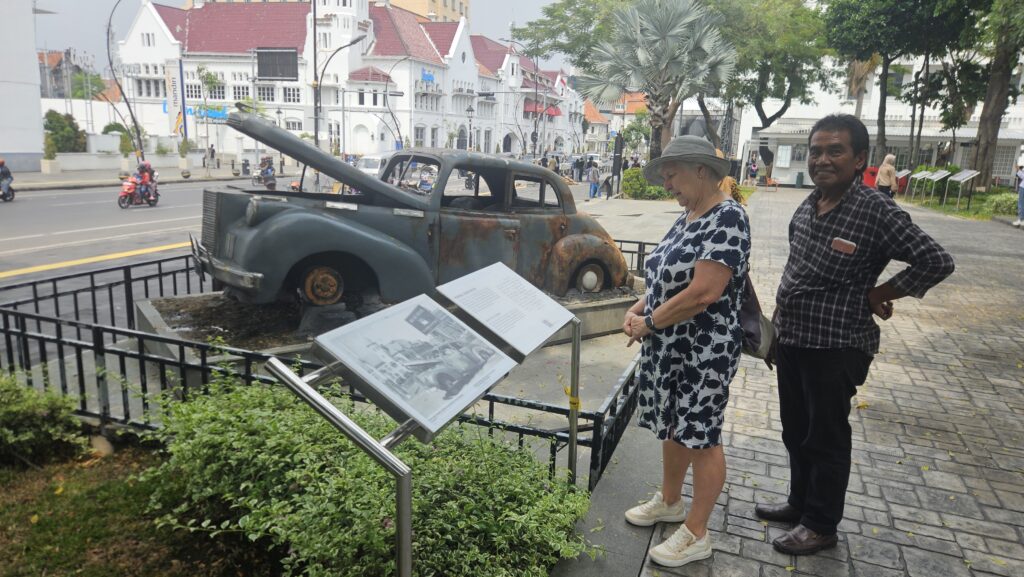
Some stories cross the low wall between the two cemeteries. British Brigadier Aubertin Mallaby, whose death in Surabaya in 1945 became a turning point in the Indonesian National Revolution, is buried at Menteng Pulo, while many of his Indian troops rest in the CWGC cemetery next door. We visited the site where the so called Battle of Surabaya started.
For the Indo-Dutch community and their descendants in Australia, Menteng Pulo is also a place of personal memory. Many families have relatives buried or commemorated there whose surviving children and grandchildren later migrated to Australia after 1945. The site embodies the shared, and sometimes painful, wartime experience that connects the Netherlands, Indonesia and Australia.
Paul Budde, November 2025