Early Dutch claims set the framework
When the Australian colonies began to look northward in the late nineteenth century, the island of New Guinea was not an unclaimed space. The Netherlands had already laid claim to the western half of the island in 1828, incorporating it—at least formally—into the Dutch East Indies.
This decision can be understood within a broader moment of strategic reassessment. Around the same time, The Netherlands King Willem I suggested the possibility of establishing a Dutch settlement on the west coast of New Holland. While this idea did not materialise—partly due to practical constraints and the rapid establishment of the Swan River Colony in 1829—it reflects a wider concern about maintaining a presence in the region. In contrast to the abandoned Australian proposal, the Netherlands did take concrete action in New Guinea, where the proclamation of sovereignty in 1828 marked an attempt to secure the outer boundaries of the Dutch East Indies against increasing European competition.
At the same time, Dutch presence in New Guinea remained minimal. The claim was internationally recognised, but only lightly administered, with limited infrastructure and little economic development. New Guinea remained peripheral to the main centres of Dutch colonial activity
Queensland moves into the Torres Strait
Against this earlier background of tentative Dutch strategic thinking and the formal claim to western New Guinea in 1828, the focus in the region shifted in the second half of the nineteenth century. By then, it was no longer the Netherlands but the Australian colonies—particularly Queensland—that began to take more active steps in shaping developments to the north.
The first concrete move came in 1878–79, when Queensland annexed the Torres Strait islands, located between Cape York and New Guinea. The motivations were practical and administrative rather than overtly imperial:
- control of shipping routes through the Torres Strait
- regulation of pearling and maritime industries
- extension of colonial governance over island communities
At this stage, there was no direct Dutch dimension. The islands lay south of New Guinea and outside Dutch territorial claims.
The 1883 annexation attempt of eastern New Guinea
The situation changed in 1883, when Queensland attempted to annex the eastern half of New Guinea.
This move was undertaken unilaterally and without prior approval from Britain. London initially refused to endorse it, but the attempt itself reveals the growing strategic anxiety in the Australian colonies.
Reports citing officials from the Colony of Queensland state that annexation proposals applied only to territory: “not claimed by the Government of the Netherlands”
Fear of Germany, not the Netherlands
Contemporary reports underline the level of concern within the Australian colonies, which directed their objections to the British government. Separately, the Dutch Consul-General in Australia, in a report to the Department of Foreign Affairs in The Hague, expressed astonishment and indignation, noting in particular that the German claim extended as far south as East Cape.
There was widespread anxiety that Germany might establish a further foothold in New Guinea, bringing a potentially hostile European power uncomfortably close to Australia’s northern approaches. This sense of urgency drove Queensland’s actions and shaped the broader colonial debate.
In contrast, the Dutch presence was viewed as stable and predictable. While German expansion generated alarm, the Netherlands was seen as an established, non-threatening neighbour whose territorial claims were already understood and, importantly, accepted.
British policy and the creation of a protectorate
After rejecting Queensland’s unilateral annexation, Britain adopted a more controlled approach.
In 1884, it proclaimed a protectorate over south-eastern New Guinea. At the same time:
- Germany annexed the north-eastern part of the island
- the Netherlands retained the west
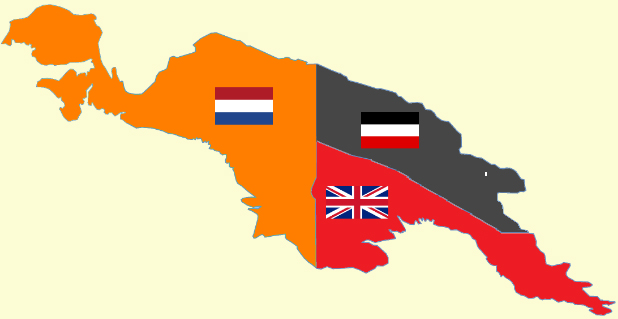
This resulted in the partition of New Guinea into three colonial zones.
British ministers made it clear that Dutch territory had been carefully excluded from their actions. On that basis, they saw no need to consult the Netherlands before proceeding.
The Dutch response: watching rather than acting
What is most striking in the historical record – as far as we have been able to research – is the absence of an active Dutch response.
There is little evidence that the developments in New Guinea in the 1880s triggered a strong or public reaction in the Netherlands. There are no clear indications of a formal diplomatic protest, nor of a sustained campaign in the Dutch press, and the issue does not appear to have generated significant parliamentary urgency in The Hague. Compared to the intensity of debate in Australia and Britain, the Dutch response remained relatively low-key.
At the same time, this should not be interpreted as indifference. Dutch diplomats followed the situation closely through their networks in London and Berlin, reporting on British and German actions and assessing the potential implications for Dutch interests in western New Guinea. Developments were clearly being monitored at official level.
Taken together, the available evidence suggests a response characterised less by disengagement than by restraint. The Netherlands remained attentive to safeguarding its existing position but showed little inclination to escalate the matter into a broader political or diplomatic issue.
Explaining Dutch passivity
The limited Dutch reaction can be understood in the broader context of the time. By the 1880s, the Netherlands was already deeply engaged in consolidating control over the Dutch East Indies. Conflicts such as the Aceh War placed heavy demands on military and administrative resources. New Guinea, by contrast, offered little immediate economic value and remained remote and underdeveloped.
Dutch authority in New Guinea was largely nominal. With limited infrastructure and settlement, the Netherlands lacked the practical means to assert or expand its position beyond existing claims. At the same time, as a second-tier colonial power, the Netherlands had little interest in challenging Britain or Germany in the Pacific. A policy of avoiding confrontation while safeguarding existing territory was both pragmatic and consistent with its broader imperial strategy.
Perhaps most telling is the lack of urgency in Dutch public discourse. While Australian and British newspapers debated New Guinea intensely, the issue appears to have remained largely confined to administrative and diplomatic circles in the Netherlands.
By choosing not to contest developments, the Netherlands effectively accepted the partition of New Guinea. The outcome was not imposed upon them but accommodated through inaction.
From nineteenth-century boundaries to twentieth-century cooperation
The boundary established in the 1880s proved durable, but the colonial administration of the eastern half changed over time. After the First World War, Germany lost its colony, and the former German territory came under Australian administration. From that point on, the island was divided between the Netherlands in the west and Australian-administered territories in the east
In the twentieth century, this division became the basis for a more cooperative relationship.
Following the Second World War, the Netherlands and Australia shared:
- adjacent territories on New Guinea
- concerns about regional stability
- an interest in coordinated administration and border management
This marked a shift from passive coexistence to pragmatic cooperation in the Pacific.
Several articles on the DACC website explore this period of Dutch–Australian collaboration, particularly in relation to border arrangements and regional policy coordination.
Piet Merkelijn: bridging the Netherlands, Australia and Dutch New Guinea
Defining a frontier: Dutch–Australian border cooperation in New Guinea, 1954–1960
The Dutch Resident of Merauke visits Australian Papua New Guinea
The end of Dutch presence in New Guinea
This cooperative framework came to an abrupt end in the early 1960s.
With the incorporation of Dutch New Guinea into Indonesia:
- the Netherlands withdrew from the region
- Australia’s neighbour was no longer a European colonial power
- the geopolitical landscape of the Pacific changed fundamentally
The shared Dutch–Australian administrative space disappeared, replaced by a new regional dynamic shaped by decolonisation.
Paul Budde April 2026
Further reading.
Kees van Dijk, The Netherlands Indies and the Great War / related studies on New Guinea diplomacy, Brill, Leiden (chapter on 1880s New Guinea developments). Available via De Gruyter/Brill.
“Archival Documents on Dutch New Guinea Administration,” Papua Erfgoed (Papua Heritage Foundation), based on Dutch colonial archives (Nationaal Archief, The Hague).
Trove articles below