Australian newspapers report Dutch East Indies support for Britain
During 1940, as Britain faced German air attacks, communities across the British Empire and beyond organised fundraising campaigns to help finance Spitfire fighter aircraft for the Royal Air Force.
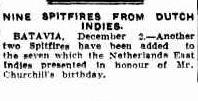
The Netherlands East Indies (NEI), under Dutch colonial administration, participated in this international effort. Its contributions attracted attention in Australian newspapers, demonstrating Australian awareness of the colony’s participation in the Allied war effort.
On 2 November 1940, The Canberra Times reported that residents of the Netherlands East Indies had contributed sufficient funds to purchase nine Spitfires, valued at approximately £5,000 each. The final contribution came from employees of the Billiton Tin Company, with one aircraft to carry the name Billiton.
Another Australian newspaper report, Nine Spitfires from Dutch Indies, appeared on 4 December 1940.
These reports appeared during a period when Australia and the Netherlands East Indies were developing closer economic, political and defence relations following Germany’s occupation of the Netherlands in May 1940.
Australians organise similar fundraising campaigns
Australian communities were simultaneously participating in the Spitfire fundraising movement.
In December 1940, residents of Strathfield and Burwood in Sydney established a Spitfire Fund, led by Emily Herron. The campaign involved public meetings, door-to-door collections, tennis tournaments, garden parties and the sale of miniature Spitfires.
By May 1941, the organisers had raised £3,750, which was forwarded to British Prime Minister Winston Churchill, who acknowledged their contribution.
Similar initiatives emerged elsewhere in Australia.
In Victoria, the Buln Buln Shire Citizen’s Spitfire Fund raised £6,607 14s 4d. The Australian War Memorial preserves a framed certificate recording this donation to Prime Minister Robert Menzies in 1941.
The Australian government, however, adopted a different policy towards fundraising for military aircraft overseas. In June 1941, it decided that funds raised in Australia should generally support Australian military requirements rather than the purchase of British aircraft.
The fundraising campaigns nevertheless illustrate the enthusiasm of Australian communities to support Britain’s defence during the early years of the war.
Netherlands East Indies Spitfires serve with Australian squadrons
A particularly significant connection emerged through the operational histories of Spitfires financed or named in association with the Netherlands East Indies.
Aircraft records compiled by Australian aviation researchers identify at least two NEI-named Spitfires that subsequently served with No. 452 Squadron RAAF in Britain.
Spitfire P8361 – Krakatao (NEI)
This Spitfire Mk IIA initially served with No. 303 Squadron RAF from 18 April 1941 before being transferred to No. 452 Squadron RAAF on 4 June 1941.
On 9 August 1941, the aircraft failed to return from operations. Its pilot, Sergeant Christopher Geoffrey Chapman, RAAF service number 404198, was killed.
Spitfire P8371 – Palembang-Oeloe (NEI)
This Spitfire Mk IIA entered RAF service in May 1941 and subsequently served with several squadrons.
On 21 July 1941, it was transferred to No. 452 Squadron RAAF, before moving to No. 411 Squadron RCAF later that month.
The aircraft remained on the British aircraft register until January 1945.
These two aircraft provide a tangible link between Netherlands East Indies support for Britain’s air defence and Australian airmen serving in Europe.
Their precise relationship to the nine Spitfires reported in Australian newspapers during November and December 1940 remains to be established.
A shared contribution to the Allied war effort
The Dutch East Indies and Australian fundraising campaigns demonstrate how communities in both territories supported Britain’s defence before the Pacific War brought the conflict directly to their region.
The Australian newspaper coverage also illustrates growing public awareness of developments in the Netherlands East Indies during 1940–1941.
The subsequent service of NEI-named Spitfires with an Australian squadron adds a direct military dimension to this story.
Together, these developments provide an additional perspective on the Australian–Dutch relationship before the Japanese invasion of the Netherlands East Indies in 1942.
Sources and further reading
- Nine Spitfires from Dutch Indies – Australian newspaper, 4 December 1940
- The Canberra Times, 2 November 1940 – Netherlands East Indies Spitfire fundraising.
- The Strathfield and Burwood Spitfire Fund – Strathfield Council
- Australian War Memorial – Guide to the Appeals and Fund Raising Souvenir Collection – Buln Buln Shire Citizen’s Spitfire Fund, 1941.
- ADF Serials – Spitfire aircraft histories – records of P8361 and P8371.
- Presentation Spitfires in Australian Service – ADF Serials
- From distant neighbours to regional partners – DACC
Related DACC research
This article forms part of the DACC’s research into Australian–Netherlands East Indies relations before the Pacific War and the history of Dutch and NEI aviation during the Second World War.
See also the Research Portal – Dutch and Netherlands East Indies Air Forces in Australia during World War II.