The rapid Japanese advance through Southeast Asia fundamentally changed the fate of 32 Douglas DB-7B Boston light bombers intended for the Netherlands Naval Aviation Service—the Marine Luchtvaartdienst, or MLD—in the Netherlands East Indies.
Most never reached their intended destination. Six were delivered to Java only days before its capitulation, while 22 were diverted to Australia and entered Royal Australian Air Force service. Although ten of the aircraft were briefly associated with No. 18 (Netherlands East Indies) RAAF Squadron, the Dutch squadron ultimately adopted the longer-range B-25 Mitchell.
The story illustrates how aircraft orders, ownership and operational control were repeatedly rearranged during the chaotic opening months of the Pacific War.
The Dutch order
At the end of December 1941, the Netherlands East Indies Government received confirmation that 32 Douglas DB-7B aircraft would be made available under United States defence-aid arrangements.
The aircraft had originally been intended for the Royal Air Force and were already painted in RAF camouflage and allocated serial numbers in the AL series. Dutch orange-triangle nationality markings were subsequently applied, together with the words KON. MARINE beneath the cockpit.
They were also allocated the proposed MLD serial numbers D-47 to D-78.
The DB-7B was a twin-engined light bomber with a crew of three: pilot, navigator/bombardier and air gunner. It was known as the Boston in British and Australian service. Related versions used by the United States Army Air Forces were designated A-20 and generally known as the Havoc.
The aircraft represented a major change for the MLD, whose Netherlands East Indies operations had previously relied heavily upon Dornier Do 24 and Catalina flying boats.
Twenty-eight aircraft shipped across the Pacific
Four of the 32 aircraft remained in the United States. Two of these subsequently went to the Soviet Union.
The remaining 28 DB-7Bs were transported across the Pacific aboard Dutch merchant ships during the opening months of 1942.
| Ship | DB-7Bs carried | Eventual port |
|---|---|---|
| Kota Baroe | 6 | Tjilatjap, Java—27 February 1942 |
| Tosari | 3 | Hobart—6 March 1942 |
| Mapia | 6 | Melbourne—25 March 1942 |
| Tarakan | 5 | Sydney—31 March 1942 |
| Tabinta | 3 | Sydney—1 April 1942 |
| Weltevreden | 5 | Sydney—2 April 1942 |
Only the six aircraft carried aboard the Kota Baroe reached Java. The other 22 were diverted to Australian ports because the Japanese advance made delivery to the Netherlands East Indies impossible.
The six Bostons delivered to Java
The Kota Baroe reached Tjilatjap—now Cilacap—on Java’s south coast on 27 February 1942. Its cargo included six DB-7Bs, Lockheed 12As and Curtiss-Wright CW-22Bs.
Three of the Bostons were sent by rail towards Bandung, while three remained concealed or stored around the harbour. A Dutch naval technical team of approximately seventy personnel, led by Lieutenant H.V. van der Houwen, attempted to assemble aircraft under increasingly dangerous conditions.
Douglas test pilot J.G. Haizlip provided ground instruction because there was no opportunity for proper flight training.
On 5 March, Lieutenant Hugo V. Burgerhout, commander of the locally based Catalina group GVT 5, flew one hastily assembled Boston from an improvised runway between the harbour warehouses. The aircraft reached Tasikmalaja but could not be refuelled. It was subsequently destroyed to prevent its capture.
A second aircraft, RAF serial AL904 and proposed MLD serial D-51, was completed at Tjilatjap. After the capitulation, KNILM pilot Karl Rüpplin von Keffikon was compelled to fly it to Andir airfield near Bandung. The Japanese later transported it to Japan, where it was tested under the identification J-DA-1.
Another aircraft, AL906/D-52, was assembled near Bandung and was also captured and taken to Japan for evaluation. Other Bostons were disabled or destroyed before they could become operational.
The six aircraft therefore arrived too late to make an operational contribution to the defence of Java.
Twenty-two Bostons enter RAAF service
The 22 aircraft diverted to Australia were assembled at:
- No. 1 Aircraft Depot at Laverton, Victoria; and
- No. 2 Aircraft Depot at Richmond, New South Wales.
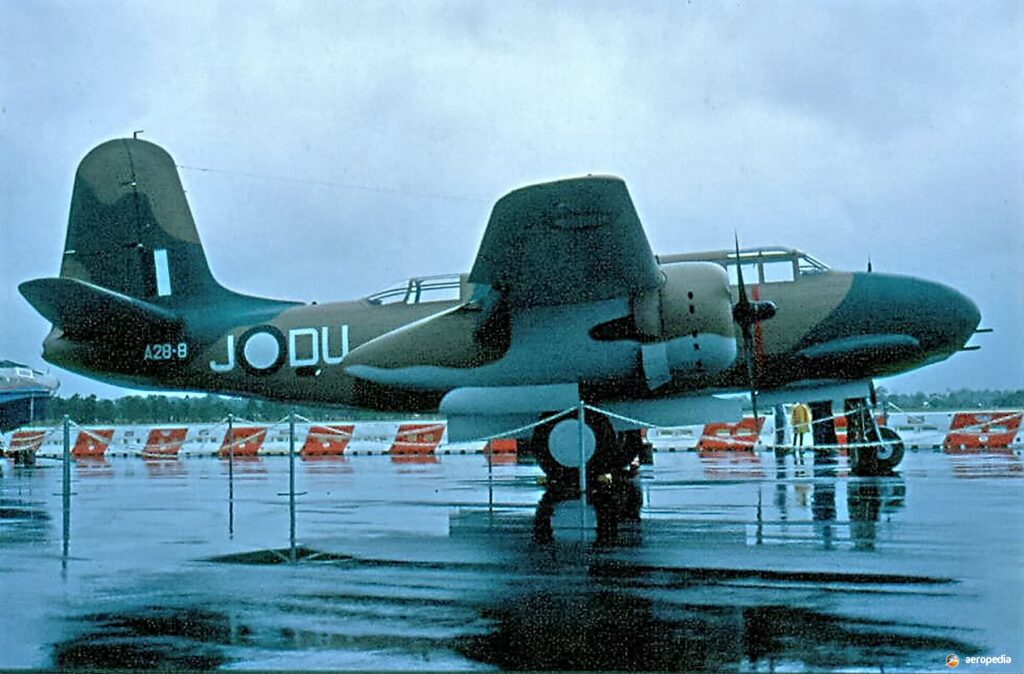
They entered RAAF service as A28-1 to A28-22 and were allocated to No. 22 Squadron RAAF. Their Dutch orange triangles were painted over with Australian roundels, although the original KON. MARINE inscription reportedly remained visible on some aircraft for a time.
The brief connection with No. 18 Squadron
No. 18 (Netherlands East Indies) Squadron was formed at Canberra on 4 April 1942 while its permanent aircraft allocation remained unsettled.
Ten of the former Dutch DB-7Bs were temporarily associated with the squadron in administrative planning. Dutch crews also undertook a brief period of familiarisation using RAAF DB-7Bs and American A-20As between 6 and 13 June 1942.
The arrangement did not develop into operational service. The DB-7B’s range was inadequate for the long over-water missions the squadron was expected to fly against targets in the Netherlands East Indies. The squadron also lacked sufficient pilots trained on the aircraft.
An arrangement involving ten DB-7Bs and eight American A-20As was considered as the Allied authorities attempted to redistribute the available aircraft. The eight A-20As were temporarily allocated to No. 18 Squadron but were returned to the USAAF’s 89th Bombardment Squadron in July 1942 without becoming operational with the Dutch unit.
No. 18 Squadron was instead equipped with the longer-range North American B-25 Mitchell, which was much better suited to its intended operations.
Read the related DACC article: B-25 bombers ordered by the Dutch but transferred to the USAAF.
Wartime service with No. 22 Squadron
The former Dutch DB-7Bs served operationally with No. 22 Squadron RAAF in Australia and New Guinea.
The squadron employed the Bostons in bombing and ground-attack operations against Japanese forces. Aircraft that had been ordered to strengthen Dutch naval aviation consequently made their wartime contribution under Australian markings and command.
This service became an enduring part of the shared Dutch–Australian aviation story, even though the aircraft never operated as an MLD squadron and did not become the permanent equipment of No. 18 Squadron.
A surviving Dutch-ordered Boston
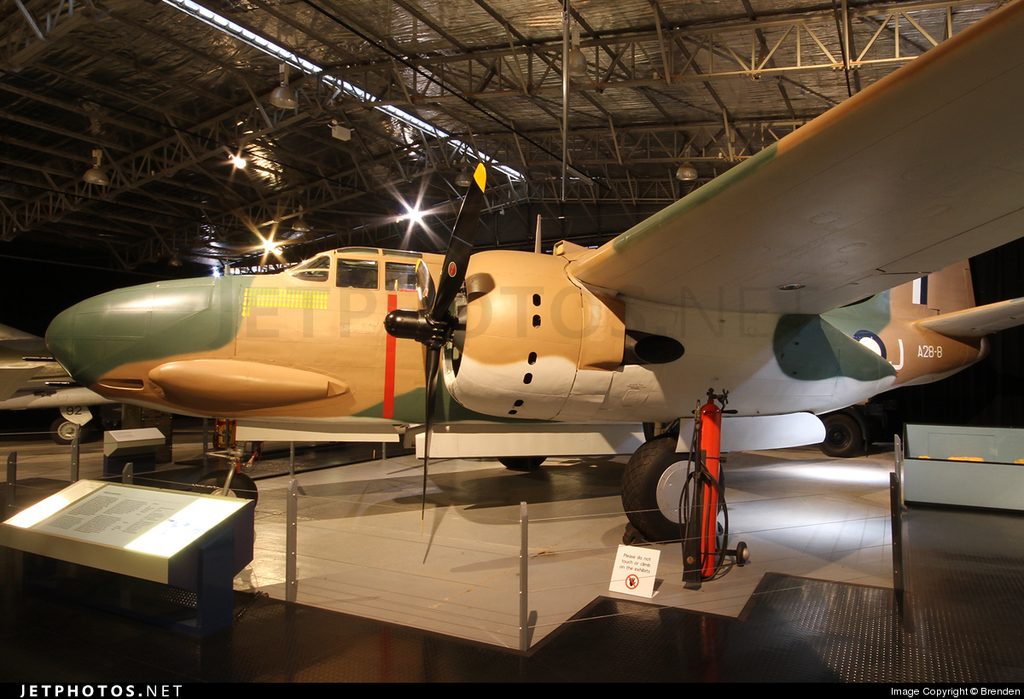
One of the aircraft, A28-8, survives at the RAAF Museum at Point Cook.
It was recovered from Papua New Guinea and restored during the 1980s. During restoration, layers of its successive identities were discovered: an original RAF roundel, the Dutch orange triangle painted over it and the later RAAF marking above both.
This physical evidence confirmed the aircraft’s intended Dutch service and subsequent transfer to the RAAF.
Historical significance
The history of these aircraft records several important aspects of Dutch–Australian wartime cooperation:
- the urgent Netherlands East Indies programme to obtain modern aircraft;
- the use of American defence-aid aircraft originally intended for Britain;
- the role of Dutch merchant ships in transporting military aircraft;
- the last-minute effort to deliver and assemble aircraft on Java;
- the diversion of military cargoes to Australia following the collapse of the Netherlands East Indies;
- the early uncertainty surrounding the equipment of No. 18 Squadron; and
- the operational use of Dutch-ordered aircraft by No. 22 Squadron RAAF.
Detailed Dutch-language study
The following illustrated Dutch-language article by Jan Gerrits examines the DB-7B Bostons intended for the Netherlands Naval Aviation Service.
Gerrits explains that 32 aircraft were allocated to the Netherlands East Indies, of which 28 were shipped across the Pacific. Six reached Java, while 22 were diverted to Australia and entered RAAF service. His research follows the ships carrying the aircraft, the emergency assembly of Bostons at Tjilatjap, the aircraft captured and tested by Japan, the brief association with No. 18 Squadron and the later restoration of A28-8 at Point Cook.
The article includes photographs, aircraft identities, shipping information and details not reproduced fully in this DACC overview.
Original transfer documentation
The following document, provided by aviation historian Peter Dunn, reproduces wartime correspondence concerning Dutch aircraft taken over by the United States Army Air Forces. It is particularly relevant to the temporary allocation and proposed exchange involving the DB-7Bs and American A-20As.
Aviation Historical Society presentation
Related DACC articles
- DACC Air Force Research Portal
- No. 18 (Netherlands East Indies) Squadron RAAF
- B-25 bombers ordered by the Dutch but transferred to the USAAF
- The Dutch at Archerfield Airport, Brisbane
- The fall of the Netherlands East Indies, March 1942
Sources and further reading
- Jan Gerrits, De Douglas DB-7B Boston van de Marine Luchtvaartdienst bestemd voor Nederlands-Indië, March 2025.
- P.C. Boer, The Story of the Douglas DB-7B Bostons of the Dutch Naval Air Service, revised February 2012.
- P.C. Boer, The NEI Army Aviation Corps in Australia and British India, February 1942–May 1943, 2021.
- Mark “Syd” Harbour, DB-7B/A-20 Boston in RAAF Service, presentation to the Aviation Historical Society of Australia (Queensland), Archerfield, 27 September 2024.
- René J. Francillon, McDonnell Douglas Aircraft Since 1920, Volume 1, 1988.