The story of Dutch enterprise in Australia is often associated with shipping, manufacturing, agriculture, engineering and post-war migration. Optiver represents a much more recent chapter: the arrival of a Dutch company operating at the intersection of finance, mathematics and advanced computer technology.
Founded in Amsterdam in 1986, Optiver has developed from a small options-trading business into one of the world’s leading electronic market-making firms. Sydney has played an important role in that development. Since establishing an office there in 1996, the company has built its Asia-Pacific operations from Australia, making Optiver an important example of contemporary Dutch investment and technological activity in the Australian economy.
From Amsterdam’s trading floor
Optiver’s first trade took place in 1986 on the floor of the Amsterdam Options Exchange. At that time, trading was conducted by people standing on an exchange floor, using hand signals and calling out orders to one another.
The company began with a single trader making markets in options. Its name is derived from the Dutch word optiehandelaar, meaning options trader. From these modest beginnings, Optiver expanded alongside the rapid transformation of financial markets from physical trading floors to electronic exchanges and globally connected data centres.
The company was founded by Johann Kaemingk, Ruud Vlek and Chris Oomen. Its early business was based on providing continuous prices at which other market participants could buy or sell options. This activity is known as market making.
A market maker generally offers both a buying price and a selling price for a financial product. By being prepared to trade when buyers or sellers enter the market, market makers provide liquidity. This can make it easier for investors, institutions and other participants to complete transactions without having to wait for someone willing to take the opposite side of a trade.
Optiver trades using its own capital and accepts the associated financial risks. Over time, its activities expanded beyond options to include listed derivatives, shares, exchange-traded funds, bonds and foreign exchange.
Technology transforms the business
The financial markets in which Optiver operates have changed dramatically since the company was established. Traditional trading floors have largely been replaced by electronic systems that process enormous quantities of market information in fractions of a second.
As a result, modern market making depends not only on financial knowledge but also on mathematics, statistical modelling, software engineering, telecommunications and extremely powerful computing infrastructure.
Optiver describes itself today as a technology- and research-driven trading firm. Its teams include scientists, engineers, mathematicians, researchers and traders who design the models and systems used to interpret market conditions and calculate prices.
This makes Optiver substantially different from a conventional bank, stockbroker or investment adviser. It does not primarily manage the savings of individual customers or provide financial advice to the public. Its principal role is to trade in financial markets and provide prices and liquidity using its own resources and technology.
The move to Australia
Optiver established its Sydney office in 1996. According to the company, Sydney became the place from which it built its Asia-Pacific business and remains a core hub for its regional operations.
This was an important step in Optiver’s transition from a Dutch trading company into a global organisation. Australia offered a stable financial system, well-regulated markets, a highly educated workforce and a strategic location within the Asia-Pacific region.
The Sydney office became Optiver’s Asia-Pacific headquarters. From Australia, its teams participate in markets across the region, including Japan, Hong Kong, South Korea and Taiwan. These markets have different regulations, products, trading systems and levels of development, requiring trading and technological systems that can be adapted to local circumstances.
Optiver’s Australian business is therefore not simply a branch servicing the domestic market. Sydney became the operational foundation from which the company expanded throughout Asia.
Following Sydney, Optiver established offices in other Asia-Pacific financial centres, including Taipei, Hong Kong, Shanghai, Singapore and Mumbai. Nevertheless, Sydney has continued to hold a central place in the company’s regional structure.
An Australian company with Dutch roots
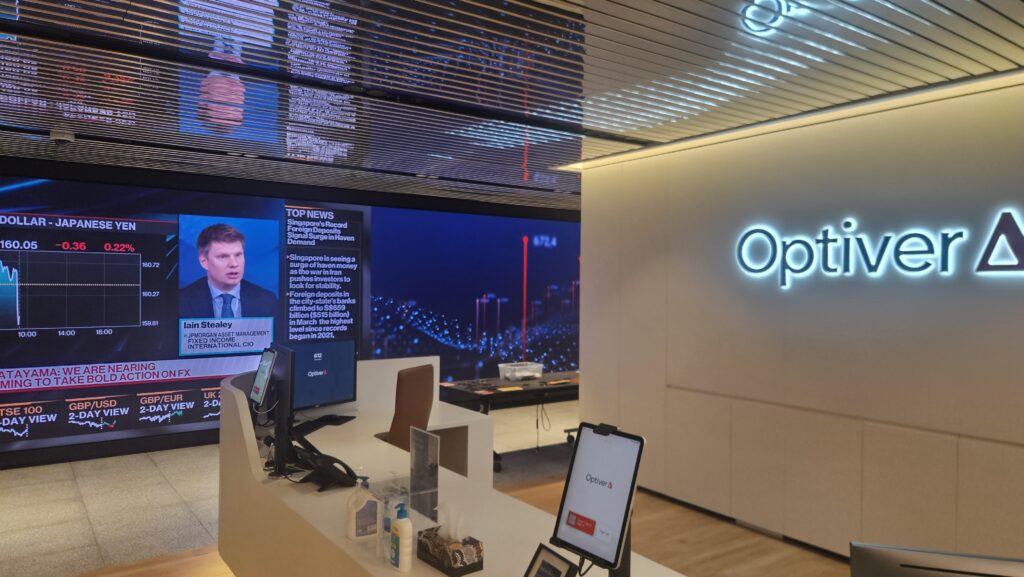
Optiver Australia Pty Limited is registered as an Australian private company and operates under Australian financial-services regulation. Its Australian business has grown into a substantial employer of traders, engineers, software developers, quantitative researchers and other highly specialised professionals.
In October 2025, the company moved its Sydney operation into a new office at 275 Kent Street. Optiver described the purpose-built premises as a centre for innovation and talent and as a means of strengthening its role as a market maker and liquidity provider across the Asia-Pacific region.
The significance of the Sydney operation can also be seen in the scale of the wider company. By 2025, Optiver had close to 2,000 employees across its international offices. The company reported global net trading income of €4.556 billion for that year and a net profit attributable to shareholders of €1.769 billion.
These are worldwide figures and should not be interpreted as the results of the Australian operation alone. They nevertheless demonstrate the scale of the international organisation of which Sydney has become such an important part.
Contributing to Australia’s knowledge economy
Optiver’s Australian presence is notable not only because of its financial activities but also because of the type of employment and expertise it has brought to Australia.
The company recruits heavily in mathematics, computer science, engineering, physics, statistics and related disciplines. Its operations require professionals capable of building complex mathematical models, designing low-latency computer networks, analysing large quantities of information and developing systems that can operate reliably in rapidly changing markets.
Optiver also offers Australian graduate programs, internships and training opportunities. These programs introduce university students and graduates to quantitative trading, software engineering and market research.
The company’s presence contributes to a broader ecosystem of financial technology and quantitative trading in Sydney. Along with other international and Australian trading firms, it has helped create a specialised employment market for people with advanced mathematical and technological skills.
This is an increasingly important aspect of Australia’s modern economy. While the country remains heavily dependent on natural resources, agriculture and traditional services, companies such as Optiver demonstrate how Australia can also participate in globally competitive industries based on knowledge, research and high-performance computing.
Investment in STEM education
Optiver’s links with Australia extend into education and community investment.
In 2025, the Optiver Foundation awarded a $2.7 million grant to the University of New South Wales to support the university’s Future You program. The program is designed to encourage children between eight and twelve years of age to develop an interest in science, technology, engineering and mathematics.
The three-year grant is intended to help UNSW expand the program, produce additional educational resources and reach more students, teachers and families.
This initiative reflects the company’s dependence on future generations of mathematicians, scientists and engineers. It also demonstrates how the Australian operation has developed relationships extending beyond financial markets and employment.
Continuing a long Dutch tradition
Optiver’s history can be placed within a much longer Dutch tradition of commerce and financial innovation.
Amsterdam became one of the world’s most important commercial and financial centres during the seventeenth century. The Amsterdam Stock Exchange, established in connection with the Dutch East India Company, is generally regarded as one of the earliest modern securities markets.
Dutch merchants, investors and institutions developed sophisticated methods of raising capital, spreading risk and financing international trade. Options, forward contracts, shares and other financial instruments were traded in Amsterdam centuries before the development of modern electronic markets.
Optiver operates in an entirely different technological and regulatory environment. Nevertheless, its emphasis on trade, pricing, risk management, mathematics and international markets can be seen as a modern expression of this Dutch commercial heritage.
Instead of merchant ships and paper contracts, the company now relies on software, algorithms, telecommunications networks and data centres. The underlying Dutch tradition of international entrepreneurship and financial innovation, however, remains recognisable.
A modern Dutch–Australian story
The establishment of Optiver in Sydney reflects the changing character of relations between the Netherlands and Australia.
Earlier Dutch business links were often associated with shipping companies, banks, airlines, manufacturers and multinational corporations. Optiver belongs to a newer generation of Dutch enterprises whose most important resources are intellectual property, computer systems and highly skilled people.
Its Australian operation also reverses the traditional image of Australia as a distant market managed from Europe. Sydney is not merely a destination for Dutch products or capital. It is a regional headquarters from which an international Dutch company manages and develops activities throughout the Asia-Pacific.
Optiver therefore deserves a place in the history of Dutch business in Australia. It illustrates how Dutch–Australian economic relations have continued to evolve, moving from maritime exploration and colonial trade through migration and industrial investment to financial technology, quantitative research and the global digital economy.
From a single trader on the floor of the Amsterdam Options Exchange in 1986, Optiver has become a major international financial technology company. Its decision to establish its Asia-Pacific business in Sydney in 1996 created a substantial and enduring Dutch commercial presence in Australia.
Nearly three decades later, the Sydney office remains one of the company’s principal international centres and an important link between Dutch entrepreneurship, Australian talent and the rapidly developing markets of the Asia-Pacific region.
Paul Budde
July 2026