An Early Initiative for Dutch–Australian Heritage Cooperation
The SBS video below records a visit to Australia in 2011 by representatives of the Centre for International Heritage Activities (CIE), based in the Netherlands. The visit formed part of the Australian–Dutch Heritage Cooperation Project, which sought to identify, connect and promote organisations and individuals working with the shared heritage of Australia and the Netherlands.
CIE was established as an independent, non-profit organisation promoting international knowledge exchange, academic research and cooperation in the field of shared cultural heritage. Its work explored the heritage created through Dutch maritime exploration, trade, migration, military activities and colonial encounters in different parts of the world.
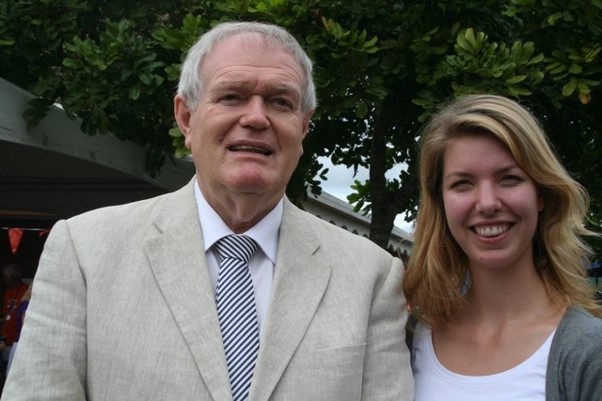
Koosje Spitz represented the Australian–Dutch Heritage Cooperation Project during the Australian visit. Among the events she attended was the Dutch community’s Aprilfest in Brisbane, where she met representatives of Dutch organisations and discussed opportunities for greater cooperation. Paul Budde was among those who met Koosje during her visit.
The project aimed to collect and share information about the historical connections between Australia and the Netherlands. These ranged from early VOC voyages and shipwrecks along the Western Australian coast to later military, migration and commercial connections.
The project anticipated the four themes that now provide the framework for Dutch–Australian international heritage cooperation:
- Maritime heritage
- Military heritage
- Migrant heritage
- Mercantile heritage
These four Ms also form the basis of the Dutch Australian Cultural Centre’s national research, collection and digitisation program.
Follow-up in Fremantle and The Hague
The 2011 visit was followed by an Australian–Dutch Heritage Day at the Western Australian Maritime Museum in Fremantle on 21 February 2012. The event was organised by CIE in cooperation with the Embassy of the Kingdom of the Netherlands and the Western Australian Museum.
It brought together professionals and specialists working across the four principal areas of Dutch–Australian heritage. The program included presentations, panel discussions and workshops intended to encourage cooperation and the exchange of knowledge.
The event also marked the official launch of the Australian section of Cultural Heritage Connections, an online international platform developed to bring together information about shared heritage, relevant organisations and heritage projects. The platform was launched by the Dutch Ambassador to Australia, Willem Andreae.
Speakers and participants included representatives of the Western Australian Museum, the National Archives of Australia, the National Trust, universities, community organisations and Dutch-linked businesses. Professor Nonja Peters and Stella Groenhof presented the Dutch Australians at a Glance project, or DAAAG. Much of the material associated with DAAAG has subsequently become part of the DACC’s national digital heritage collection.
Later in 2012, a further Australian–Dutch Heritage Day was held in The Hague. This meeting placed particular emphasis on the military heritage shared by Australia and the Netherlands and encouraged participants to explore opportunities for future cooperation.
The initiative also contributed to discussions surrounding the commemoration of the 400th anniversary of Dirk Hartog’s landing in Western Australia, which was marked in 2016.
An ambition that remains relevant
Although these activities created valuable connections, the proposed international platform does not appear to have developed into a permanent national network for Dutch–Australian heritage. The Australian project is now mainly documented within CIE’s historical archive covering its activities from 2006 to 2016.
CIE continues to operate as an international heritage organisation. Its present work places considerable emphasis on education, community participation, inclusive storytelling, contested histories and the ways in which heritage and memory can contribute to resilience and social change.
The 2011 video remains significant because it records an early recognition that Dutch–Australian heritage needed a central and more visible platform. At the time, members of the Dutch community expressed the hope that the initiative would help bring the often “invisible” Dutch contribution more clearly into Australia’s historical consciousness.
The DACC is now advancing many of the objectives identified during that period. It is developing a national resource covering maritime, military, migrant and mercantile history; digitising and preserving archival collections; recording personal stories; and building partnerships with museums, archives, universities and heritage organisations in Australia, the Netherlands and Indonesia.
The Netherlands’ Cultural Policy for Australia 2025–2028 has again placed the four Ms at the centre of bilateral heritage cooperation. It supports sustained relationships between Dutch and Australian heritage organisations, research and digitisation, improved heritage management, and the protection and transmission of intangible cultural heritage.
Seen in that context, the video is more than a record of a visit. It documents an early chapter in the continuing effort to establish coordinated Dutch–Australian heritage cooperation.
Video: CIE representatives visiting Australia as part of the Australian–Dutch Heritage Cooperation Project, 2011.
This is a YouTube video. After playing the video, press the return button to go back to the DACC Hub.