In her book Zoals het leven komt, Dutch author Michelle Visser explores family secrets and their impact on family relationships, and Dutch migration to Australia after the Second World War. The book was published in 2021 by Uitgeverij Boekerij; its title translates loosely into English as ‘As life comes’.
Plot summary
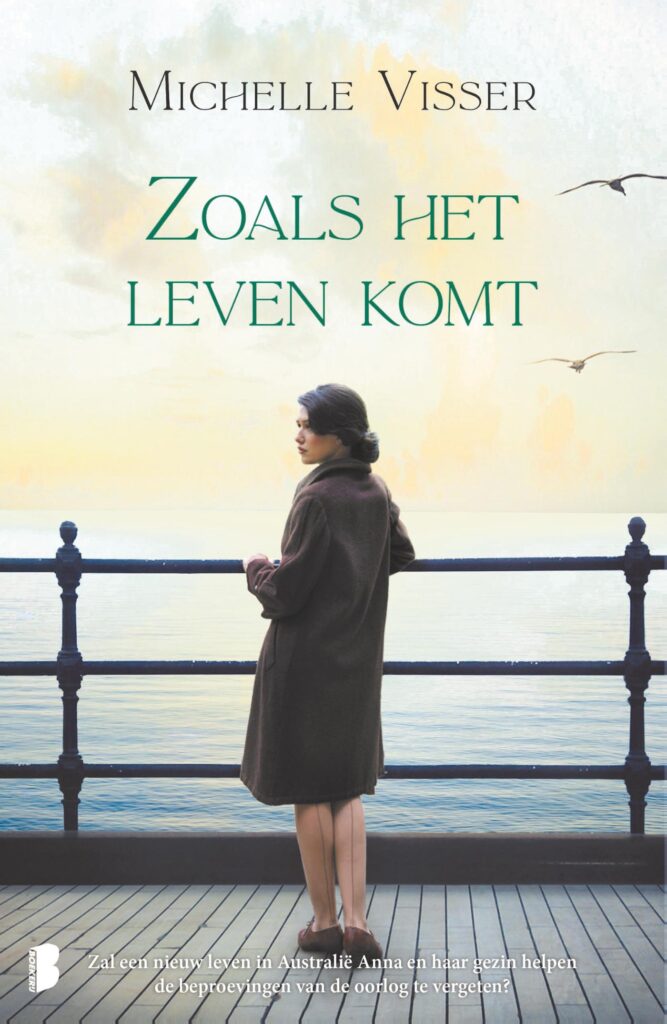
Zoals het leven komt traces the long-term impacts of family secrets in the Leeflang family. The novel begins in Enschede in the region of Twente in 1939, when the Second World War upends life completely for greengrocers Herman and Anna Leeflang and their young daughter Vera. Anna’s parents and brother Hans are killed in a bombing attack and her other brother, Bram, is involved in a strike at the Stork machinery factory that turns nasty. With her parents dead, Anna and Herman take Anna’s younger sister Trijntje into their family. However, Nazi Germans seize Herman during a razzia and transport him to a labour camp in Germany. Left alone with her daughter and younger sister, Anna does her best to care for Vera and Trijntje and run the greengrocer’s store amidst increasing food shortages. Herman sends word to Anna when he can, but soon Anna stops hearing from him and she begins to fear her husband is dead. The war drags on, and Anna tries to make the best of her difficult circumstances.
Finally, in April 1945 Allied forces arrive to liberate Enschede. Everyone is euphoric. Caught up in the jubilation and celebrations and believing her husband dead, Anna has a brief romance with one of the Canadian soldiers. This romance is not without its consequences and Anna gives birth to a daughter, Marlies, nine months later.
Two and a half years after the war’s end, Herman returns to Anna and the Twente region. Anna is shocked; she thought her husband had died years ago during the war. Although now reunited with his family, Herman struggles to readjust to life in the Netherlands. Consequently, the family makes a drastic decision: they will emigrate to Australia. Against Anna’s will, though, Marlies will remain in the Netherlands in the care of Anna’s sister Trijntje. The Leeflang family eventually arrives in Australia and begins a new life there.
Six decades later, retired teacher Marlies searches for the truth about her heritage and her family’s past. When her mother passed away Marlies discovered she is not her parents’ biological child. Shocked, she sets out to find answers and to her surprise her journey takes her to Australia. Do her biological relatives there know about her? Will they accept her as part of the family? As she slowly learns more about the past Marlies considers the impact of choices her biological parents made decades earlier, and wonders how she would have acted in the same circumstances.
About the author
Michelle Visser is a Dutch writer who debuted with her novel Véronique in 2012. Visser mainly writes historical fiction but has also published a series of ‘feel good’ novels about Dutchwoman Anneloes (Loes) Beekman, who swaps her life in the Netherlands for a new life running a bed and breakfast in Central France. Visser previously worked in communications and lives in Hengelo.
Sources and further reading
- Video (30 September 2021), ‘Michelle Visser vertelt in dit filmpje over haar nieuwe historische roman ‘Zoals het leven komt’! Komt dit boek op jouw lijstje?’
- Zoals het leven komt on publisher Uitgeverij Boekerij’s website
- Review of Zoals het leven komt by Jeannie Bertens
- Selling a Dream: Expectation Versus Reality – Post-war Dutch and Other Migration to Australia 1945–1970
- A Dutch Home in Australia: Dutch Women’s Migration Stories
- A Touch of Dutch: Maritime, Military, Migration and Mercantile Connections on the Western Third, 1616-2016 by Nonja Peters