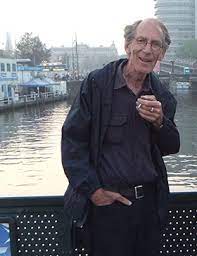
Hans Morell Arkeveld was born on 28 August 1942 in Scheveningen. He was the second eldest of four sons born to Dirk Arkeveld, a builder and brickmaker, and Fokiena Arkeveld, née Moeske.
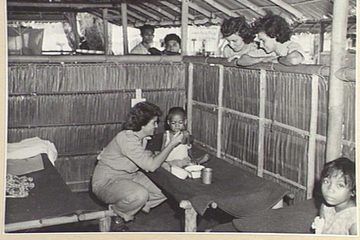
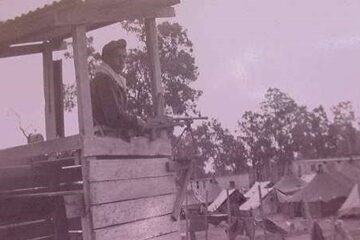
After five years of war and German occupation, the Dutch government encouraged emigration as part of the country’s post-war reconstruction. In September 1952, the Arkeveld family migrated to Australia. They initially spent six months at the Bonegilla Migrant Reception and Training Centre in Victoria before moving to Western Australia. There they lived successively at the Northam and Graylands migrant camps before settling in Collie.
Arkeveld received relatively little formal education. He left school at the age of 13 and worked first as a builder’s labourer and then as an apprentice beekeeper. Art, however, became his way of exploring and understanding the world around him. He studied ticket writing and typewriting before enrolling at Perth Technical College in the early 1960s. In 1966, he obtained a Diploma in Fine Art, specialising in painting.
During his studies, teacher and artist Nola Farman introduced Arkeveld to the Department of Anatomy at the University of Western Australia. He received permission to draw from its collections of anatomical specimens, including cadavers and foetal forms. This began an association with UWA’s School of Anatomy and Human Biology that would continue for approximately 60 years.
Arkeveld subsequently completed formal courses in gross anatomy and embryology. His detailed knowledge of the human body enabled him to tutor medical students in anatomical drawing and to produce and cast anatomical models for use as teaching aids. Over time, he became the School of Anatomy’s first artist-in-residence. His studio and artworks were later recognised as among UWA’s “100 Treasures”.
After completing their studies, Arkeveld and fellow artist David Hughes travelled through Australia, New Zealand and Papua New Guinea. They spent approximately six months in the Sepik River region of Papua New Guinea, where Arkeveld encountered traditional woodcarving and other forms of art embedded in everyday and spiritual life. These experiences reinforced his longstanding interest in tribal art, which he had previously studied through the collections of the Western Australian Museum.
After returning to Perth, Arkeveld completed an Associateship in Fine Art, majoring in sculpture, at the newly established School of Art and Design at the Western Australian Institute of Technology, now Curtin University. He later enrolled in the institute’s first graduate diploma in art and design.
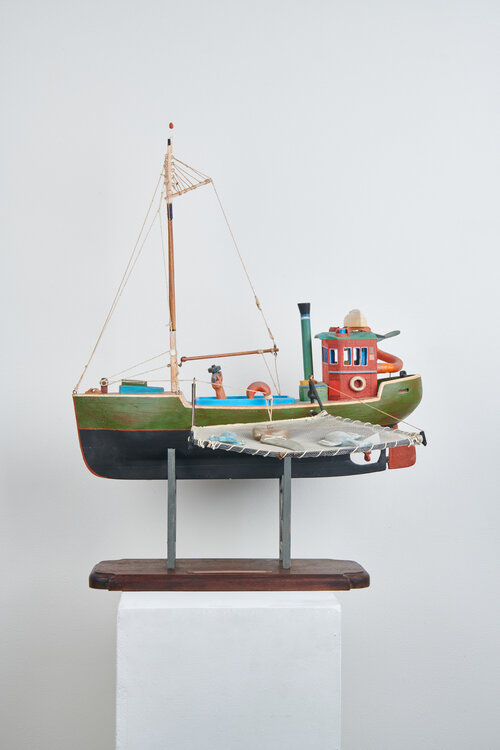
His graduate work drew upon the recurring imagery of boats and the plight of refugees following the end of the Vietnam War. This became part of his Transmigration series and reflected an enduring concern with migration, displacement and the treatment of refugees and asylum seekers. These subjects held particular resonance for an artist who had himself arrived in Australia as a child migrant and lived in several migrant camps.
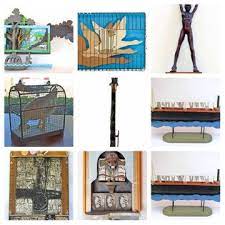
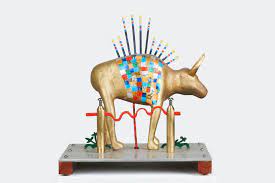
Arkeveld worked across sculpture, printmaking, painting and drawing. The human body remained central to his art, providing a means of examining consciousness, self-awareness, mortality and the forces of good and evil. Bones, muscles, embryos, skulls, boats and imagery drawn from traditional cultures appeared throughout his work, connecting anatomy and science with broader questions about humanity, spirituality, migration and human rights.
He also taught drawing and sculpture at several art schools and within UWA’s departments of Architecture and Fine Art. His teaching extended to workshops in India and Sri Lanka. Known for his technical skill, curiosity and humour, he made an important contribution to both arts education and the teaching environment within UWA’s medical school.
In 1981, Arkeveld moved with his then wife, artist Rone Rumble, and their children, Skye and Emanuel, to Hovea, on the edge of John Forrest National Park. There he built his final home and studio. Alongside his regular work at UWA and his teaching commitments, he continued producing commissioned artworks and participating in exhibitions.
In 1994, he met artist Joan Johnson, who became his partner in 2002. They frequently exhibited together, including in the inaugural Sculpture by the Sea exhibition at Cottesloe Beach in 2005. Johnson also helped develop Arkeveld’s 2020 retrospective, Homo Eclectic, at the Mundaring Arts Centre. For the exhibition, she recreated his distinctive UWA workroom, with its collection of skulls, tools, scientific instruments and other objects accumulated over many decades.
Arkeveld exhibited extensively in Australia and internationally, participating in more than 200 group exhibitions as well as numerous major solo exhibitions. He also undertook many public and private commissions. His work is represented in collections including the National Gallery of Australia, Art Gallery of Western Australia, State Library of Western Australia, the Holmes à Court Collection, New Norcia Monastery and the collections of UWA, Curtin University, Murdoch University, Edith Cowan University and North Metropolitan TAFE. His artworks are also held by hospitals, local councils and private collectors throughout Australia.
Source: Robyn Taylor and Joan Johnson, “Body of work drew art into daily life”, The West Australian, 4 September 2026. (see below)
His contribution to art, education and Western Australian society received considerable recognition. In 2000, UWA awarded him the Chancellor’s Medal and appointed him an honorary fellow. He received the Commonwealth Centenary Medal in 2001 for services to the arts. In 2009, he was one of the first two artists to receive Artsource’s Lifetime Achievement Award, and he was also granted Honorary Life Membership of the Mundaring Arts Centre.
Hans Arkeveld died in Perth on 5 June 2026, aged 83. He was survived by his partner, Joan Johnson; his children, Skye and Emanuel; two grandchildren; and a great-grandchild. His legacy lies not only in the extensive body of work he created, but also in the unusual and productive connection he established between art, anatomy, medical education and some of the most difficult moral questions confronting Australian society.
Other Sources: