Derk Johannes Kippers was a Dutch merchant seaman and qualified wireless operator whose maritime career connected the Netherlands, the Netherlands East Indies and Australia. During the Second World War, he served aboard the KPM vessel Swartenhondt, one of the Dutch merchant ships employed in support of Allied operations in New Guinea.
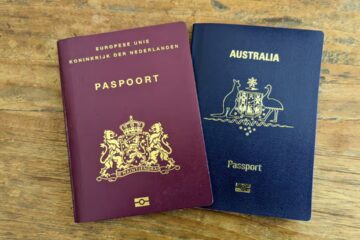
His subsequent marriage to Australian Women’s Land Army member Colleen Wyatt and his postwar career with Australia’s Overseas Telecommunications Commission made Australia his permanent home.
Early life and maritime career

Derk Johannes Kippers was born in The Hague on 9 November 1909. He obtained his First Class Wireless Operator’s Licence around 1928.
Partly because of the economic conditions created by the Great Depression, he did not immediately enter the Dutch merchant service. During the following decade, however, he served aboard ships operating across the Atlantic, Pacific and Indian oceans.
Vessels on which he served included:
- Oranje Nassau in 1936;
- Siantar between 1936 and 1939;
- Saparoea in 1939;
- Tarakan in 1940; and
- other Dutch merchant vessels.
Wireless operators performed an essential role aboard ocean-going ships, maintaining communication with shore stations and other vessels and receiving navigational, operational and emergency messages.
War service aboard Swartenhondt
Kippers subsequently served aboard the KPM motor ship Swartenhondt. After the Japanese invasion of the Netherlands East Indies, surviving Dutch merchant vessels were redirected to Australia and placed at the disposal of the Allied transport organisation.
The ships remained Dutch vessels, generally retaining their Dutch officers and predominantly Indonesian crews, but their movements were directed according to Allied military requirements.
Swartenhondt became a troop and supply transport operating between Australian ports and New Guinea. In September 1942, it carried personnel of the United States Army’s 8th Photographic Reconnaissance Squadron from Townsville to Port Moresby.

The ship also participated in Operation Lilliput, the dangerous escorted supply service between Milne Bay and Oro Bay that supported the Allied campaign in Papua.
Jack Ford records that Swartenhondt delivered the first RAAF personnel sent to operate from the completed Milne Bay airfield. The vessel was among the Dutch merchant ships that provided the transport capacity needed to reinforce and supply Allied forces in New Guinea.
On 20 December 1943, Swartenhondt arrived at Bowen in northern Queensland while continuing its wartime transport service between Australia and New Guinea.
Later wartime operations
In October 1944, Swartenhondt transported the Australian 36th Battalion to Cape Hoskins on New Britain.
The voyage proved difficult. Soldiers complained about the ship’s cramped accommodation and its condition, while navigational problems arose because the captain had originally been given charts extending only as far as Talasea. Australian Army maps were subsequently used to assist the vessel in completing the voyage to Cape Hoskins.
These difficulties form part of the broader history of wartime merchant transport. Dutch vessels and multinational crews were operating under severe pressure, frequently entering inadequately charted waters with limited port facilities and under the continuing threat of Japanese attack.
Marriage in Australia
While in Australia, Kippers met Colleen Wyatt, who was serving with the Australian Women’s Land Army.
They married in Sydney on 2 January 1945. Their marriage was one of many personal connections formed between Dutch and Netherlands East Indies personnel and Australians during the war.
Derk and Colleen travelled to the Netherlands in 1946. Kippers continued working in the Dutch merchant service and served aboard Blijdendijk in 1948.
The couple returned to Australia in 1949 and established their permanent home there.
Australian telecommunications career
After returning to Australia, Kippers initially worked for His Master’s Voice in Sydney. He subsequently joined the Overseas Telecommunications Commission, commonly known as OTC.
His experience as a maritime wireless operator was directly relevant to the shore-to-ship radio communications undertaken by OTC. His Australian postings included:
- Sydney, 1951–1952;
- Darwin, 1952–1958;
- Brisbane and Caboolture, 1958–1970; and
- Sydney again in 1971.
He retired from OTC around 1971.
Derk and Colleen had one son, Vaughan, who was born in Sydney in 1951.
Death and legacy
Derk Kippers died in a motor-vehicle accident near Timaru on New Zealand’s South Island on 26 March 1976. His ashes were placed at the crematorium at Cattle Valley in South Canterbury.
His life connects several important aspects of Dutch–Australian history: the international Dutch merchant service, the wartime contribution of KPM ships operating from Australia, Dutch–Australian wartime marriages and the development of Australia’s international radio communications.
The story also demonstrates how skills developed in the merchant navy—in Kippers’ case, wireless communication—contributed to Australia’s postwar telecommunications services.
Information about Derk and Colleen Kippers was provided by their son, Vaughan Kippers.
Related DACC articles
- Research Portal: The Dutch Merchant Fleet and the Allied War Effort in Australia
- The KPM lifeline: Operation Lilliput and the Allied advance in Papua
- Who controlled the KPM fleet? Dutch ships under Allied command in Australia
- The crews behind the KPM fleet: Dutch officers and Indonesian seafarers in wartime Australia
Sources and further reading
- Information and family photographs supplied by Vaughan Kippers.
- Jack Ford, “The Netherlands Merchant Navy in the Pacific War,” Journal of Australian Naval History, vol. 6, no. 1, 2009, pp. 75–89.
- Australian War Memorial, 36th Australian Infantry Battalion.