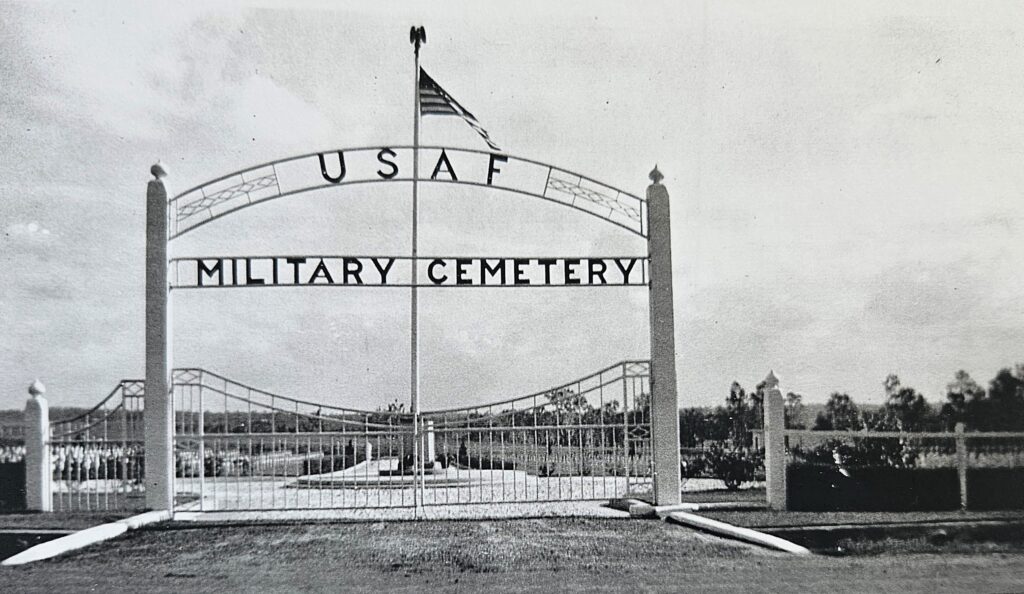
Research initiated by the Dutch Australian Cultural Centre (DACC), with the assistance of the Nederlandse Oorlogsgravenstichting (OGS) and Ipswich City Council, has clarified the wartime burial history of several Dutch and Netherlands East Indies (NEI) servicemen in Queensland. This research showed that three Dutch or NEI soldiers were originally interred at the former USAF Military Cemetery in Ipswich. When the American war dead were repatriated to the United States in 1947, these three Dutch and NEI burials were moved from the American section and reinterred in unmarked graves at the Ipswich General Cemetery. Their names were recorded as Paturuhu, Koesman and Barends.
Archival sources in the Netherlands help to reconstruct what happened next. In the OGS record card for C. Paturuhu (card number 115780), it is noted that he was initially buried at Ipswich General Cemetery (Row B, number 1125). In 1950 his remains were exhumed by the Legergravendienst van het KNIL, the KNIL Military Graves Service, and transferred to Indonesia. He was reburied at the Dutch Ereveld Menteng Pulo in Jakarta.
Dutch archival notes confirm that all three Dutch war dead once listed at Ipswich were later transferred to Indonesia by the KNIL Military Graves Service and reinterred at Menteng Pulo. The men were:
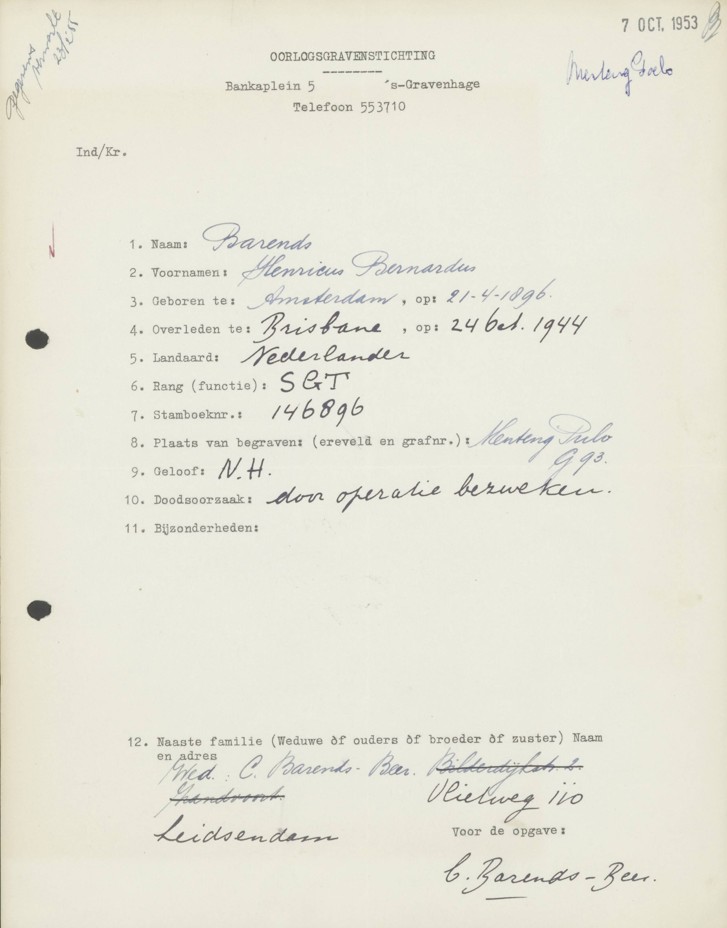
Henricus Bernardus Barends
Koesman
C. Paturuhu


The work of the KNIL Military Graves Service focused primarily on the remains of KNIL soldiers, whose graves they monitored, consolidated or repatriated after the war. This explains why the KNIL took responsibility for transferring these Ipswich burials to the Dutch fields of honour in Indonesia. By contrast, the graves of Koninklijke Marine personnel and merchant navy casualties were generally not managed by the KNIL Military Graves Service. Their graves were usually left in place in Australia, often because they fell under different registration systems and administrative responsibilities.
An example of this can be seen in Brisbane’s Toowong Cemetery, where three Dutch naval graves remain. These graves are cared for locally and were never included in the post-war transfers undertaken by the KNIL Military Graves Service. They illustrate the different treatment of naval casualties compared with KNIL servicemen, whose remains were more systematically brought together in Dutch war cemeteries such as Ereveld Menteng Pulo.
The cases of Paturuhu, Koesman and Barends show the varied ways Dutch and NEI servicemen were buried in Australia and how their graves were handled after the war. They also highlight the value of ongoing cooperation between the DACC and the OGS in reconstructing this lesser-known chapter of Dutch–Australian wartime history.
Documentation of Transfer of Henricus Barends to Indonesia
Received for the Dutch War Graves Authority (Oorlogsgraven stichting)
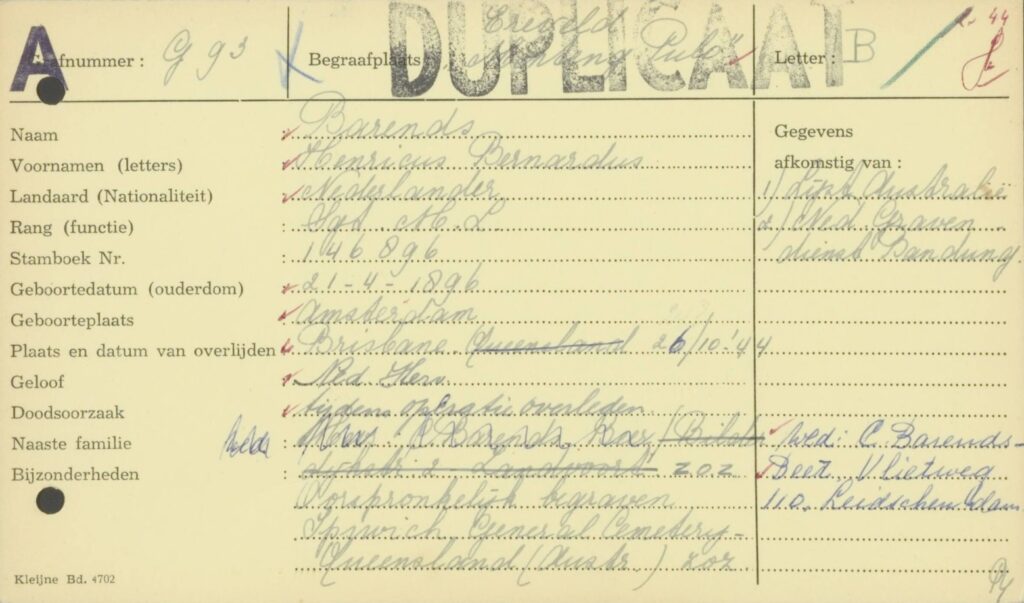
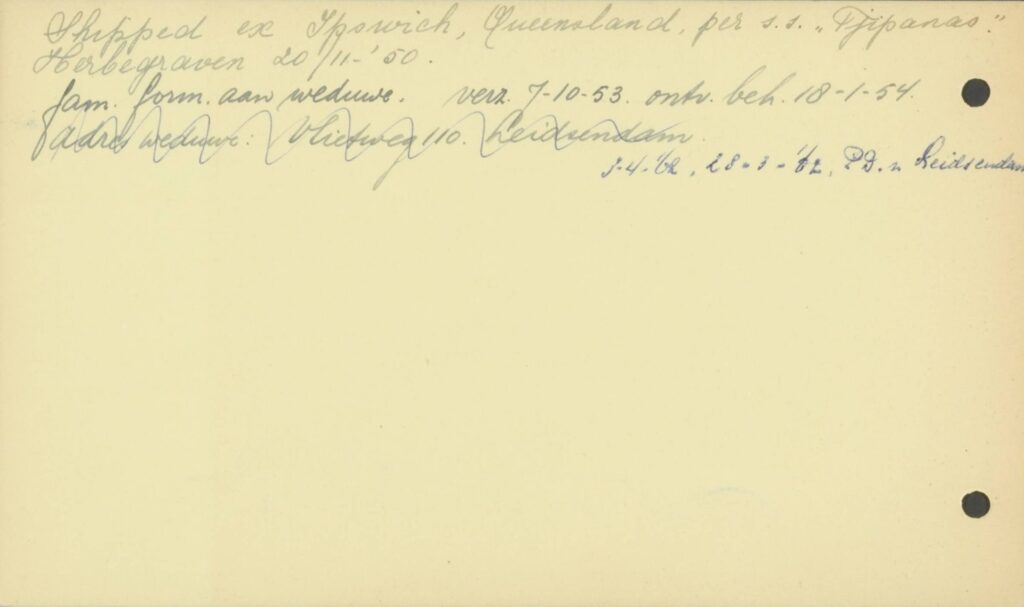
The family form below from 1953 shows that his widow had been informed.