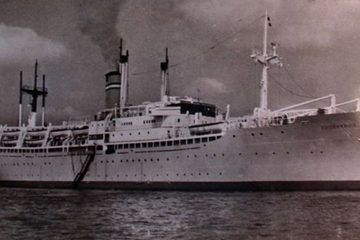
The Groote Beer, Waterman and Zuiderkruis occupy a distinctive place in the history of post-war Dutch emigration. Built in the United States during the Second World War, the three vessels began their lives as standardised Victory ships. After the war, they were acquired by the Dutch Government, first used as troop transports and subsequently rebuilt to carry emigrants to Australia and other destinations.
Known collectively in the Netherlands as the Kleine Drie—the “Little Three”—they carried thousands of people away from the post-war Netherlands to begin new lives overseas.
From Liberty ships to Victory ships
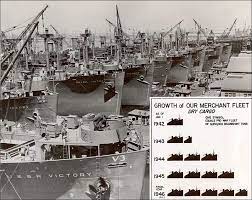
During the Second World War, the United States undertook an enormous shipbuilding programme to replace merchant vessels lost to enemy action and supply Allied forces across the world. The best-known products of this programme were the Liberty ships, which were relatively simple cargo vessels that could be constructed quickly and in large numbers.
The Victory ship was developed as a faster and more advanced successor. The design retained the advantages of standardised mass production but incorporated more powerful engines, greater speed and improvements intended to give the ships a useful commercial life after the war.[1]
Although primarily cargo vessels, a number of Victory ships were completed or adapted as troop transports. Their cargo spaces were fitted with bunks, mess facilities, washrooms, ventilation and basic medical accommodation. They could carry approximately 1,600 military personnel, but comfort was secondary to capacity and efficiency.
The three vessels that later entered Dutch service were:
| Original American name | Dutch name | Meaning |
|---|---|---|
| Costa Rica Victory | Groote Beer | Great Bear |
| La Grande Victory | Waterman | Aquarius or Water Bearer |
| Cranston Victory | Zuiderkruis | Southern Cross |
Their Dutch names all referred to constellations, reinforcing their identity as a closely related group.
Acquisition by the Dutch Government
The Dutch Government purchased the three ships from the United States in 1947. The Netherlands faced an immediate shortage of shipping after the enormous destruction and disruption caused by the war. At the same time, large numbers of Dutch military personnel had to be transported to and from the Netherlands East Indies.
The ships were placed under the management of established Dutch shipping companies while remaining government-owned. Groote Beer was initially managed by Stoomvaart Maatschappij Nederland, while Waterman and Zuiderkruis were associated with the Rotterdamsche Lloyd.
During this first period of Dutch service, the vessels retained much of their troopship character. They transported military personnel to Asia and carried returning servicemen, repatriates and families back to the Netherlands. Their role was connected with the conflict surrounding Indonesian independence and the gradual withdrawal of Dutch forces following the transfer of sovereignty in December 1949.
As the military transport requirement declined, the Dutch Government found another urgent purpose for the three ships.
Conversion into emigration ships
The Netherlands emerged from the war with housing shortages, economic difficulties and widespread concern about future employment and population pressure. The Dutch Government adopted an active emigration policy, encouraging people to establish themselves in countries including Australia, New Zealand, Canada, the United States and South Africa.
This created a need for affordable long-distance passenger transport. The three former Victory ships were structurally sound and relatively modern, but their troop accommodation was unsuitable for families undertaking voyages lasting several weeks. Beginning in 1951, they therefore underwent major reconstruction in Dutch shipyards.
Dutch shipping engineer Cornelis Bijvoet, technical adviser to the Ministry of Shipping, played a leading role in planning and supervising their conversion. An additional passenger deck was constructed, while the bridge was raised and moved forward. Much of the original dormitory accommodation was replaced by cabins, generally accommodating between five and eight passengers and equipped with washbasins providing hot and cold water.
Some dormitory accommodation remained, particularly for passengers travelling alone, but the ships were reorganised as single-class emigrant vessels rather than troop transports. They were fitted to carry approximately 800 to 850 passengers, although capacity varied between ships and at different stages of their service.
Facilities included:
- dining rooms and lounges;
- a cinema;
- recreation and writing rooms;
- children’s playrooms and a nursery;
- hospital and medical facilities;
- laundries and ironing rooms;
- a barber or hairdresser;
- a shop and bar;
- open deck and sports areas.
A surviving 1957 accommodation plan for the three ships shows six-berth cabins as well as lounges, a nursery, baby washroom, laundry, writing room and dining saloon. The plan is now held by Museums Victoria and was used by a migrant family to mark the cabins occupied during its voyage to Australia.[2]
The conversions were recognised as an important Dutch technical achievement. When Waterman was completed in November 1951, Director-General of Shipping J.J. Oyevaar stated that foreign trade journals had written with admiration about the conversion of Zuiderkruis and Waterman into emigrant ships. Bijvoet was appointed an Officer of the Order of Orange-Nassau for his contribution.[3]
The voyage to Australia
Following their conversion, the three ships became familiar sights on the international emigration routes. They did not operate exclusively between the Netherlands and Australia: voyages also carried emigrants to Canada, the United States, New Zealand and South Africa. Nevertheless, their Australian services made them an important part of Dutch-Australian migration history.
Routes varied. Some voyages travelled through the Mediterranean and Suez Canal, while others crossed the Atlantic, passed through the Panama Canal and continued across the Pacific. Ports of call could include Curaçao, Tahiti and Wellington before the ships reached Fremantle, Melbourne or Sydney.
For most passengers, the voyage lasted several weeks. Conditions were modest compared with those aboard the larger Dutch passenger liners, but the converted Victory ships offered the facilities needed to create a functioning community at sea.
Daily life was organised around meals, children’s activities, films, concerts, religious services, deck games and other entertainment. Sinterklaas celebrations and ceremonies marking the crossing of the Equator became lasting memories for many passengers. Seasickness, storms, heat and confined living conditions were also part of the experience.
The ships carried more than passengers and luggage. They transported people at a decisive moment in their lives, between a country they knew and an Australia most had never seen.
The importance of the “Little Three”
The Groote Beer, Waterman and Zuiderkruis were not luxury liners. Their importance lay in their practicality, capacity and adaptability. Designed as wartime cargo vessels, converted into troopships and then reconstructed as emigrant vessels, they reflected the upheavals of the mid-twentieth century.
They also illustrate the direct role of the Dutch Government in facilitating post-war emigration. Unlike the established mail ships and commercial passenger liners, the “Little Three” were government-owned vessels adapted specifically to meet national transport requirements.
Their physical transformation paralleled the experiences of the emigrants themselves. Ships built for war became vessels carrying families towards new lives. For thousands of Dutch Australians, the names Groote Beer, Waterman and Zuiderkruis consequently remain connected with farewell, uncertainty, adventure and the beginning of a new homeland.Copy these directly into the WordPress Text/Code Editor:
Related DACC articles
- SS Groote Beer – From troop transport to emigrant ship
- Dutch immigrant ship SS Waterman
- Cornelis Bijvoet, shipping engineer and architect of Dutch emigration ships
- The Broekman family and the SS Zuiderkruis
- Hennik family on the Zuiderkruis
- The migration of the Douwes family on the Zuiderkruis, 1960–1961