The ships that carried a generation to a new homeland
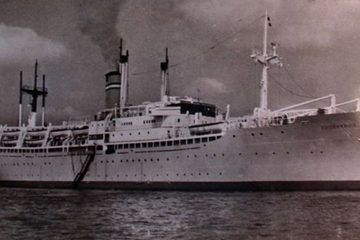
During the decades following the Second World War, tens of thousands of Dutch emigrants travelled by sea to begin new lives in Australia. Their journeys formed part of the much larger post-war migration movement that transformed Australian society and established Dutch communities throughout the country.
For the emigrants, the ship was much more than a means of transport. It was the place where they said farewell to the Netherlands, crossed the world and prepared themselves for an unfamiliar future. The voyage marked the transition between two lives: the home, family and community they had left behind and the country in which they hoped to build a more secure future.
The Netherlands emerged from the war facing severe housing shortages, economic disruption and concerns about population pressure. The Dutch Government actively encouraged emigration, while Australia sought migrants to increase its population and workforce. In 1951, Australia and the Netherlands concluded an assisted-migration agreement that helped make the journey possible for many Dutch families
Before long-distance air travel became affordable, almost all emigrants made the journey by sea. Voyages generally lasted between five and seven weeks, depending on the route, ports of call and weather conditions. Ships departed principally from Amsterdam or Rotterdam and commonly travelled through the Mediterranean and Suez Canal, or across the Atlantic and through the Panama Canal. Australian destinations included Fremantle, Melbourne and Sydney, from where passengers continued to their final destinations or to migrant reception centres.
Different ships for a common purpose
The Dutch ships employed in the migration service were not a uniform fleet. They had been built for different purposes and reflected several periods of Dutch and international maritime history.
Some were established passenger liners or mail ships originally built for services between the Netherlands and the Netherlands East Indies. These included the Johan van Oldenbarnevelt, Sibajak, Willem Ruys and Oranje. Political change in Indonesia and the decline of the traditional Netherlands–Asia passenger service led shipping companies to redirect some of these vessels to round-the-world routes serving Australia and New Zealand.
The Volendam, operated by the Holland America Line, was another established passenger liner adapted to carry emigrants. It brought Dutch passengers to Australia during the early post-war migration period.
A second group had very different origins. The Groote Beer, Waterman and Zuiderkruis were American-built Victory ships constructed during the Second World War. Acquired by the Dutch Government after the war, they were initially used to transport troops and were subsequently converted into emigrant ships. Known collectively in the Netherlands as the Kleine Drie—the “Little Three”—they carried emigrants to Australia, New Zealand, Canada, the United States and South Africa.
Dutch shipping engineer Cornelis Bijvoet played an important role in their conversion. Large troop accommodation spaces were replaced by smaller cabins and improved passenger facilities. The converted ships included dining and recreation rooms, children’s facilities, laundries, medical accommodation, a cinema and open deck areas. They were practical rather than luxurious, but they represented a considerable improvement over their wartime configuration.
Life aboard an emigration ship
Conditions varied considerably between vessels. Some passengers travelled in cabins aboard established liners, while others slept in shared accommodation containing tiered bunks. Families could be divided between male and female quarters, although arrangements improved as ships were converted and modernised.
Life aboard developed its own routines. Meals, deck games, concerts, church services, films, children’s activities and celebrations such as Sinterklaas helped structure the long weeks at sea. Equator-crossing ceremonies were remembered by many passengers, as were ports of call in places such as Curaçao, Tahiti, Colombo and Port Said.
The voyage could also be difficult. Seasickness, storms, heat, cramped accommodation and anxiety about the future were common experiences. For children, however, the ship could seem like an enormous playground. Friendships formed during the journey sometimes continued long after arrival in Australia.
Each vessel consequently occupies two places in Dutch-Australian history. It has its own maritime story—of construction, shipping companies, wartime service, conversion and eventual fate—but it also survives in the memories, photographs, diaries, menus, tickets and passenger records of the people it carried.
This portal brings together the histories of the principal Dutch ships associated with post-war emigration to Australia. It concentrates on the vessels and the voyages themselves. The experiences of migrants after disembarkation, including their time in Australian migrant camps and reception centres, are covered separately in the DACC’s migration collections.
The ships
- The Dutch Victory ships: Groote Beer, Waterman and Zuiderkruis
- SS Groote Beer – From troop transport to Dutch emigration ship
- SS Waterman – From Victory troopship to Dutch emigration ship
- SS Zuiderkruis – From Victory troopship to Dutch emigration ship
- SS Volendam – Dutch liner, wartime troopship and emigration ship
- MS Sibajak – From Netherlands East Indies mail ship to Dutch emigration ship
- MS Willem Ruys – Dutch flagship and emigration ship to Australia
- MS Oranje – Dutch hospital ship, passenger liner and emigration ship
- MS Johan van Oldenbarnevelt – Dutch emigration ship to Australia
Personal accounts from the Zuiderkruis
These family accounts complement the ship’s history by recording how individual passengers experienced departure, the voyage and arrival in Australia.
- The Broekman family and the SS Zuiderkruis
- The Hennik family aboard SS Zuiderkruis
- The migration of the Douwes family on the Zuiderkruis, 1960–1961
Passenger lists and migration research
- Finding Dutch migrant passenger lists and arrival records in Australia
- Dutch immigration to Australia – Statistics and other resources
Supporting article
This portal concentrates on Dutch-owned or Dutch government-operated ships that played a substantial role in post-war emigration to Australia. Dutch migrants also travelled aboard foreign vessels such as Nelly, Skaubryn, Fairsea and Castel Felice. These ships form part of the wider history of Australian migration but fall outside the deliberately defined scope of this portal.
Dutch shipbuilding and maritime design
Several ships represented in this portal were products of the Netherlands’ major passenger-shipping companies and shipyards.
Johan van Oldenbarnevelt was constructed in Amsterdam by the Nederlandsche Scheepsbouw Maatschappij. The company had been established in 1894 and initially operated at Oostenburg, close to the former Amsterdam shipyard of the Dutch East India Company. As ships became larger, its activities gradually moved to the northern side of the IJ.
Following wartime damage and industrial reorganisation, the Nederlandsche Scheepsbouw Maatschappij and Nederlandsche Dok Maatschappij began working together and merged in 1946 to form the Nederlandsche Dok en Scheepsbouw Maatschappij—NDSM.
The Amsterdam yards built numerous cargo-passenger vessels, mail ships and ocean liners. Their interiors often reflected the prestige of the Dutch shipping companies and the colonial routes for which they had been designed. When completed in 1930, Johan van Oldenbarnevelt offered four classes of accommodation and contained elaborate decorative work influenced by Dutch and Indonesian art.
The post-war emigration trade required a very different approach. Established liners were adapted to carry greater numbers of passengers, while former military transports such as Groote Beer, Waterman and Zuiderkruis required extensive reconstruction. Dutch naval architect and shipping engineer Cornelis Bijvoet played an important role in transforming these functional troopships into vessels suitable for families undertaking voyages of five or six weeks.
This change from colonial liner and wartime transport to emigration ship reflected a broader transition in Dutch maritime history. Ships originally built to connect the Netherlands with its colonial empire were redirected towards Australia, New Zealand and other countries receiving post-war emigrants.
Then add the following short section near the end, before the article index:
Ships preserved in family memory
The emigration ships continued to occupy an important place in Dutch-Australian family memory long after their final voyages. Photographs, passenger lists, menus, tickets, diaries, model ships and souvenirs were preserved as reminders of the journey.
Personalised ceramic plaques depicting ships in a Delft-blue style became another way of commemorating the voyage. Displayed in family homes, they recorded the vessel that carried a family to Australia and transformed the name of a passenger ship into part of that family’s history.
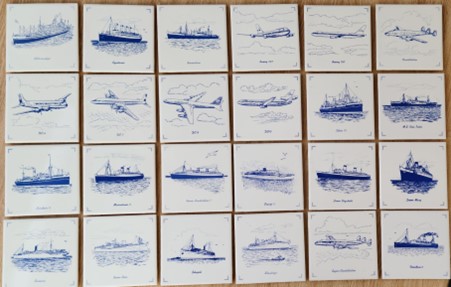
Dutch immigrant ships (and planes) – Vanderheide Publishing was the source of personalized, ceramic wall plaques, all Delft Blue-style.