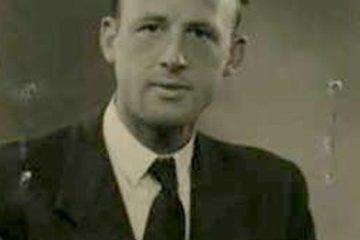
Maurits Groen was a Dutch pilot and navigator who served in Europe before joining No. 18 (Netherlands East Indies) Squadron RAAF in Australia.
His recollections were recorded in an interview conducted by Dr Sue Summers for the Migration and Ethnicity Research Centre at Curtin University. The interview provides a first-hand account of operational life at Batchelor, the long missions flown by No. 18 Squadron and the difficulties experienced by Dutch veterans seeking official recognition in postwar Australia.
From Amsterdam to the Netherlands East Indies
Maurits Groen was born in Amsterdam on 7 December, apparently in 1919, although the final two digits of the year are missing from the surviving transcript.
He lived in the Netherlands East Indies between 1934 and 1937. Maurits came from a Jewish family and told the interviewer that nearly his entire family was lost during the Second World War. Only one other family member reportedly survived.
The interview suggests that Maurits rarely discussed these experiences with his family. A separate second-generation interview with his son David Groen apparently records David’s recollections of his father’s reluctance to speak about the war.
Wartime service in Europe
Before joining No. 18 Squadron in Australia, Maurits served for an extended period in Britain. He recalled participating in operations over Germany and France.
He contrasted the European air war—characterised by large formations, frequent missions and intense opposition—with the very different conditions encountered in northern Australia and the Netherlands East Indies. In the Southwest Pacific, aircraft travelled enormous distances over sparsely populated land and sea, often with limited navigational facilities and few alternative landing grounds.
The surviving interview does not identify the British or Dutch unit with which he served in Europe. This remains an important subject for further research.
No. 18 Squadron at Batchelor
Maurits subsequently served as a pilot and navigator with No. 18 (Netherlands East Indies) Squadron RAAF.
The squadron operated B-25 Mitchell medium bombers from northern Australia against Japanese airfields, shipping and military positions throughout the eastern Netherlands East Indies.
Maurits described life at Batchelor as basic. Personnel lived in tents, food was limited and fresh provisions arrived intermittently by transport aircraft. Crew members waited for announcements over the camp’s public-address system. When a crew number was called, its members reported to the briefing tent to receive their assignment.
The missions could involve bombing an airfield or military installation, searching for Japanese shipping, armed reconnaissance or attacking a previously identified target.
Batchelor should not be described as having become Rum Jungle, as suggested in the transcript. The wartime airfield was at Batchelor, while Rum Jungle was a separate locality nearby.
Long-distance operations
The B-25 Mitchell was a medium bomber rather than a strategic long-range aircraft. Flying from northern Australia to targets in the Netherlands East Indies required careful management of fuel, bomb loads and operating distances.
Maurits recalled using Truscott airfield in north-western Australia as an intermediate refuelling point for some operations. Aircraft could refuel there before continuing towards their assigned targets and again on the return journey.
This recollection may relate to the period in 1944 when No. 18 Squadron aircraft were temporarily deployed to Western Australia during the so-called Western Australian Emergency. The precise missions in which Maurits participated should be checked against his service record and the squadron’s Operations Record Books.
Dutch and Australian personnel
No. 18 Squadron was a combined Netherlands East Indies–Australian unit. Its Dutch and Netherlands East Indies personnel provided most of the aircrew, while the RAAF supplied much of the ground organisation and a significant number of air gunners and technical personnel.
Maurits recalled that Dutch and Australian personnel worked together at Batchelor, although command and administrative responsibilities were divided between the two national organisations.
This joint structure later created difficulties for some Dutch veterans. They had served in an RAAF-designated squadron under Australian operational control but remained members of a foreign military force.
Recognition in postwar Australia
A significant part of Maurits’s interview concerns the recognition received by Dutch veterans after the war.
He explained that he regarded himself as having served in the defence of Australia but was not eligible for an Australian veterans’ Gold Card. This became particularly important after he was diagnosed with cancer and began facing substantial medical expenses.
Maurits understood that his ineligibility resulted from his formal service in a Dutch rather than Australian military force, despite No. 18 Squadron operating within the RAAF structure.
He did become a member of the Returned and Services League, but he believed that Dutch personnel who had served under similar arrangements did not receive the same medical and educational benefits as Australian veterans.
His testimony provides an important personal perspective on the ambiguous position of Netherlands East Indies personnel who served alongside Australians but remained administratively part of the Dutch armed forces.
Migration and life in Australia
Maurits returned to Australia permanently in 1948. By then, he had married an Australian woman who had lived with him in Indonesia for approximately eighteen months to two years.
He enrolled in medicine at the University of Queensland and studied for approximately two years. According to the interview, he could not obtain the financial assistance available to qualifying Australian ex-servicemen and was unable to complete the degree.
Maurits subsequently became a diamond trader and was naturalised as an Australian citizen as soon as he was eligible.
His story therefore connects the wartime service of the Netherlands East Indies forces with the broader postwar history of Dutch migration and settlement in Australia.
Preserving Maurits Groen’s testimony
The interview contains several statements about the wider war that reflect contemporary memories and understandings but are not supported by later historical research. These include references to the supposed “Brisbane Line”, the Battle of the Coral Sea and No. 18 Squadron’s involvement in the evacuation of Java.
The “Brisbane Line” was not an adopted Australian government policy to abandon northern Australia. The Battle of the Coral Sea took place in May 1942 and stopped the Japanese seaborne attempt to capture Port Moresby; it was not the destruction of an invasion fleet carrying troops directly to Australia. No. 18 Squadron was formed in April 1942, after the evacuation and surrender of Java, and therefore did not participate in that evacuation as a squadron.
Interview transcript
The following document contains the transcript of Dr Sue Summers’ interview with Maurits Groen for the Migration and Ethnicity Research Centre at Curtin University.
The transcript records Groen’s own memories and opinions. Some dates and statements remain uncertain, and the document should be read as an oral-history source rather than as a complete operational history of No. 18 Squadron.
Related DACC articles
- No. 18 (Netherlands East Indies) Squadron RAAF during World War II
- Nos. 18 and 120 Squadrons and the Western Australian Emergency
- The Dutch at Batchelor Airport during World War II
- DACC Air Force Research Portal
Sources and further reading
- Dr Sue Summers, Maurits Groen: 18th Squadron Veteran, Migration and Ethnicity Research Centre, Curtin University, interview transcript.
- No. 18 (Netherlands East Indies) Squadron RAAF—Australian War Memorial
- O.G. Ward, De Militaire Luchtvaart van het KNIL in de jaren 1942–1945, National Library of Australia catalogue record.