Calvin School- the why and the consequences
In the 1950s, education of children was the joint responsibility of the State and the local Municipality. The State provided the buildings, the teachers and the curriculum. The Municipal Councillors enforced truancy regulations , and managed requests for absences (because mum was sick or hops needed harvesting or other jobs children could do).
Tasmanian schools were ill-prepared for non-English speaking kids, and many of them were pressed into house and garden duties for the headmaster.
The Dutch migrants: – were not impressed with the quality of State schooling.
– had good memories of Christian schools in the Netherlands
– had bad memories of indoctrination processes during the occupation
Some of the Dutch migrants in Kingston decided to take control of educating their children. The document below was circulated, inviting people to a public meeting at 8.15 p.m. in the middle of winter.
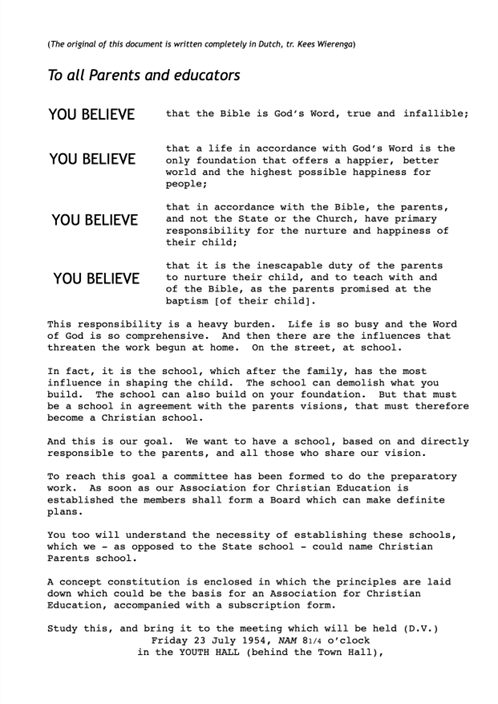
Parents and grandparents were challenged to think about their position and their intentions with respect to the education of their children. Principles were succinctly stated. There is only a vague reference to money.
Trade tables and other money raising ventures (but never raffles) were held spasmodically over the years. These were consolidated into an annual school fair. Somebody suggested that oliebollen be made, and sold to Australians! This turned out to be a good idea. The school fair was re-named as the Oliebollen Festival. Oliebollen are the main fundraiser at this major community event. A team of 24 volunteers make and sell about 15,000 oliebollen in the four hours of the fair.
Seven and a half years after this meeting, a school was begun in buildings erected by the parents in working bees. There were 77 students and three teachers. The school was named “Calvin School”, and it was owned and operated by the Christian Parent-controlled School Association.
The State required standards of reading, writing and ‘rithmatic to be met.
The Municipal Council had no involvement in any manner except for providing mains water.
The Church was not involved in establishing or owning or managing any aspect of the school.
The school was not a mission field of or for the Church, and didn’t teach doctrine or theology.
The Christian Parent-controlled School Association schooling model has been emulated Australia wide. Hundreds of schools have been established, with hundreds of thousands of students.
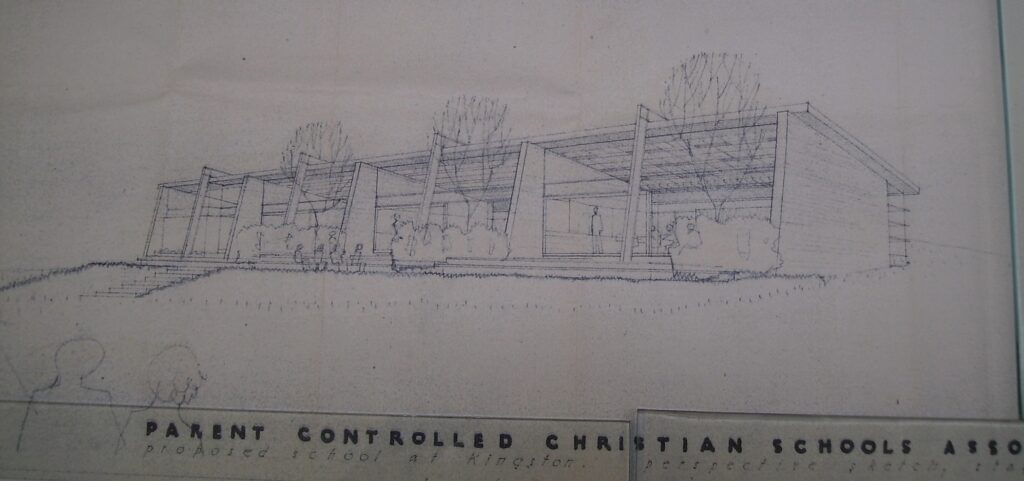
The first Calvin School building, designed by Dirk Bolt, featured glass curtain walls facing north, more than double the glazing to solid wall ratio of State school buildings. The windows let the world see into the school, and the school to see the world.
The contribution of volunteers is also illustrated by the recollections of Dutch migrant Dirk Verdouw. As a youth group leader, he helped raise funds for Calvin School by collecting and selling apples. He subsequently contributed his welding skills to the school’s construction, working alongside his brother Gerry Verdouw and Mr Spoelstra. His experiences provide a personal perspective on the practical efforts of the migrant community in establishing Christian education at Kingston.
Read the personal history of Dirk Verdouw – From Dutch migrant teenager to Kingston community builder.
Related research
The establishment of Calvin School was an important achievement of the Dutch migrant community at Kingston. It reflected the migrants’ commitment to Christian education and their determination to establish institutions that would serve future generations.
The school’s development depended on the voluntary contributions of parents, builders, architects and other members of the community. Its parent-controlled educational model subsequently influenced the establishment of similar schools elsewhere in Australia.
- Tasmanian architect Dirk Bolt – The Dutch-Australian architect who designed the original Calvin School building.
- Peter Herweynen – From Canadian chocolate to Antarctic builder – His recollections include voluntary building work at Calvin School.
- Bart Jan Folkerts – Eulogy 1999 – A member of the original Groningen migration group who supported Christian education.
- Shaping Kingston – The story of God’s children in Kingston – Kees Wierenga’s wider history of the Kingston Reformed community and its educational and social initiatives.
- Little Groningen – Tasmania – The origins and development of the Dutch migrant settlement at Kingston.
This article forms part of the DACC’s Research Portal – Little Groningen: Dutch migration, faith and community in Kingston, Tasmania.