From the Netherlands to Australian marine science
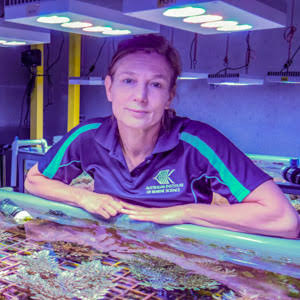
Professor Madeleine van Oppen is a Dutch-trained ecological geneticist whose pioneering research has contributed to international efforts to protect coral reefs from climate change. Based at the Australian Institute of Marine Science (AIMS) and associated with the University of Melbourne, she has played a leading role in developing scientific approaches to improving the resilience of corals to rising ocean temperatures.
Van Oppen completed her PhD at the University of Groningen in the Netherlands in 1995, graduating cum laude. Her doctoral research investigated the molecular biogeography and evolution of cold-water seaweeds.
Following postdoctoral research at the University of East Anglia in Britain, she moved to Australia in 1997 to undertake research at James Cook University in Queensland. This marked the beginning of a scientific career closely associated with Australia’s tropical marine ecosystems, particularly the Great Barrier Reef.
In 2001, she joined the Australian Institute of Marine Science, where she subsequently held several senior research positions. Between 2008 and 2011, she was the inaugural director of the Centre for Marine Microbiology and Genetics.
Pioneering research into coral adaptation
Van Oppen is internationally recognised as a pioneer of assisted evolution, an approach that seeks to enhance the ability of corals to survive environmental changes by accelerating or supporting natural adaptation processes.
Her research examines how corals interact with the microscopic algae and bacteria that live in association with them. These organisms are essential to coral health, but their relationships can be disrupted by rising ocean temperatures, resulting in coral bleaching.
Working with Australian and international colleagues, she has investigated several approaches to improving coral resilience, including selective breeding, coral hybridisation, beneficial bacteria and the adaptation of microscopic algae to warmer conditions.
The objective is to help coral populations withstand increasingly severe marine heatwaves while broader efforts to address climate change continue.
Her work has contributed to the development of coral restoration research programmes in Australia and internationally.
Recognition in Australia and internationally
Van Oppen’s scientific contributions have received significant recognition.
In 2005, she received the Dorothy Hill Award from the Australian Academy of Science for her contributions to coral reef science.
In 2013, she and fellow researcher Ruth Gates received the Paul G. Allen Ocean Challenge award for their proposal to develop biological tools to improve coral reef resilience.
From 2019 to 2023, she held a prestigious Australian Research Council Laureate Fellowship, supporting research into the potential of microorganisms to enhance coral climate resilience.
In 2024, she was elected a Fellow of the Australian Academy of Science, one of Australia’s highest forms of scientific recognition.
A Dutch-Australian contribution to environmental science
Madeleine van Oppen’s career illustrates the contribution of internationally trained scientists to Australian research and innovation.
Her academic foundations were established in the Netherlands, while her subsequent career in Australia placed her at the forefront of research into one of the country’s most important natural environments, the Great Barrier Reef.
Her work demonstrates how scientific knowledge and international collaboration can contribute to addressing environmental challenges extending well beyond national borders.