When the Netherlands East Indies collapsed under Japanese attack in early 1942, hundreds of Dutch and Indonesian military personnel found themselves in Australia. Among the units reorganised there was No. 18 (Netherlands East Indies) Squadron RAAF, a joint Dutch–Australian squadron equipped with American-built B-25 Mitchell bombers.
During the difficult months of reorganisation and training in Canberra, members of the squadron found an unusual way to maintain morale and preserve a connection with home: they formed a Dutch choir.
Formation of the choir
The No. 18 Squadron Dutch Choir was organised under the direction of Sergeant H.L. “Henk” Borghuis. He brought together squadron members with musical experience and an interest in Dutch national and traditional songs.
The choir was formed during a difficult period for the squadron. Many of its Netherlands East Indies personnel had wives, children and other family members trapped in Japanese-occupied territory. The squadron had initially received only a small number of B-25s, which limited flying and training. Differences in pay, military status and conditions also affected morale.
Squadron officers responded by organising sporting teams, English-language classes and other activities. The choir became one of the most visible and successful of these initiatives.
Rehearsing and performing together provided companionship and purpose while helping the men maintain their Dutch cultural identity in exile.
The Sydney radio performance
On 26 September 1942, members of the choir travelled from Canberra to Sydney in five of the squadron’s B-25 Mitchells.
In Sydney, the choir performed a concert program for radio broadcast. Its appearance on Sydney radio station 2GB brought Dutch voices—and the story of the exiled Netherlands East Indies forces—to a wider Australian audience.
A surviving photograph shows the choir in Sydney with the elderly driver of the bus used to transport them during their visit.
The choir returned to Canberra on 28 September.
Performance for the Governor-General
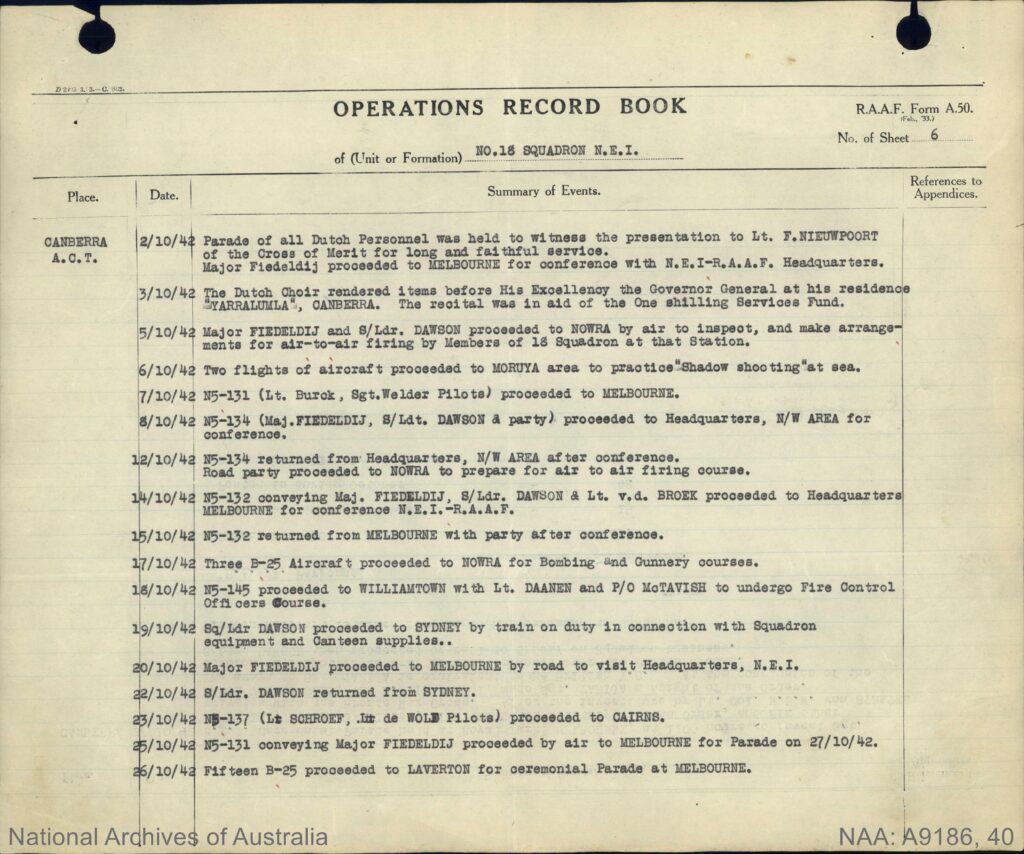
On 3 October 1942, only a few days after returning from Sydney, the choir performed for Australia’s Governor-General, Lord Gowrie, at his official residence at Yarralumla in Canberra.
The performance supported the One Shilling Services Fund, a wartime fundraising initiative.
No. 18 Squadron’s Operations Record Book records the event, making it one of the best-documented appearances by the choir. The occasion also demonstrated the increasing visibility of the Dutch forces within Australia’s wartime military and diplomatic community.
Church and ceremonial appearances
The choir also sang at St Andrew’s Church in Canberra, where many members of the squadron attended services. Its performances helped raise money for the church during the war.
The choir contributed to other public and ceremonial occasions. On 27 October 1942, members of No. 18 Squadron attended a parade in Melbourne connected with the presentation of awards for service during the Netherlands East Indies campaign.
On 19 November, Lord Gowrie formally inspected the squadron at Canberra, with the choir again contributing to the program.
These appearances allowed the Netherlands East Indies forces to present themselves publicly as an active part of the Allied war effort.
Recordings of the choir
During its Sydney visit, the choir recorded part of its repertoire on shellac records. The recorded songs included:
- Wilhelmus van Nassouwe;
- Wiens Neerlands Bloed; and
- Gelukkig is het Land.
The recordings could be used at Dutch military, national and ceremonial occasions in Australia. Copies have survived in private and public collections.
Members of the choir
Sergeant H.L. “Henk” Borghuis directed the choir.
Joop van Doorn, who served with No. 18 Squadron as a radio operator, telegraphist and navigator, was also a member. His personal history is recorded separately by the DACC:
Joop van Doorn—No. 18 Squadron RAAF
The accompanying video includes a photograph of the choir and identifies additional members. Their names should eventually also be transcribed into this article so that they become searchable and remain preserved independently of the video.
Preserving the recordings and photograph
The video accompanying this article combines a surviving photograph of the squadron choir with recordings of its songs.
It was made possible through the cooperation of three people:
- Ingrid Schodel in Australia provided the choir photograph;
- Coert Munz in the Netherlands preserved the music record; and
- Fred Pelder in the Netherlands combined the photograph and recordings to create the video.
Ingrid’s father, Joop van Doorn, was a member of both No. 18 Squadron and its choir. The video was provided to the DACC by Ingrid Schodel and is reproduced with her permission.
Cultural and historical significance
The choir demonstrates that wartime history encompasses more than combat operations and aircraft. Music helped displaced servicemen maintain morale, cultural identity and a sense of community while separated from their homeland and families.
The choir also had a public and diplomatic role. Its performances reassured Australian audiences that the Dutch remained committed to the Allied war effort and strengthened contact between Netherlands East Indies personnel, Australian institutions and the wider public.
Through its performances, broadcasts and recordings, the choir became a small but significant expression of resilience, identity and Dutch–Australian wartime cooperation.
Sources and further reading
- National Archives of Australia—No. 18 Squadron Operations Record Book, 1942–1945, A9186, 40
- National Archives of Australia—Selection of RAAF aircrew for No. 18 Squadron, A705, 163/1/872
- Dr Jonathan Ford and Allies in a Bind
- No. 18 (N.E.I.) Squadron RAAF: The First Difficult Year, 4 April 1942–1943
- Information and historical material supplied by Ingrid Schodel, Coert Munz and Fred Pelder