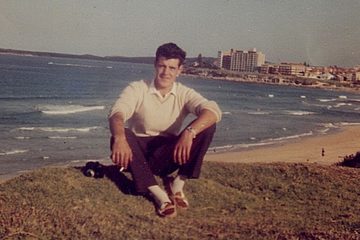
Among the Dutch airmen who formed part of No. 18 (Netherlands East Indies) Squadron RAAF during the Second World War was Lieutenant J. van Loggem, a navigator whose wartime experience reflects both the operational realities of the Pacific war and the deeply personal struggles of those living in exile.
From Java to Australia
Like many of his fellow airmen, Van Loggem was evacuated from the Netherlands East Indies in early 1942 as Japanese forces advanced rapidly across the region. He was among the last to leave, departing for Australia while many others, including his partner Anneke Kouwenhoven, were left behind.
In Australia, Dutch aircrew began the difficult process of rebuilding their operational capability. The early months were marked by shortages of aircraft, organisational challenges and considerable frustration. For many, the uncertainty about the fate of their loved ones added an intense emotional burden.
Early operational service
Despite these difficulties, Van Loggem became part of the squadron’s first operational deployments. As an observer and navigator, he took part in one of the earliest missions in June 1942, when B-25 Mitchell bombers were tasked with searching for enemy submarines off the east coast of Australia.
During this operation an enemy submarine was sighted and attacked, resulting in its destruction — one of the first operational successes of the squadron .
Van Loggem continued to serve actively, and on 8 March 1943 he was awarded the Dutch Vliegerkruis (Flying Cross), recognising courage and dedication in operational flying .
See: De Militaire Luchtvaart van het KNIL in de jaren 1942-1945
Anneke in the camps
While Van Loggem was engaged in the air war, Anneke remained in the Netherlands East Indies, where she endured years of hardship in Japanese internment camps. Her experiences, recorded in a secret camp diary, describe a world of isolation, deprivation and uncertainty.
For Anneke, as for many others, communication with the outside world was minimal. Messages, when they arrived at all, were often delayed by many months. The emotional strain of not knowing whether loved ones were still alive was a constant burden.
After the war, Anneke would later draw on her diary, as well as previously unpublished drawings and correspondence, to document this period of her life. For much of her life, however, she chose not to make these experiences public.
Searching from the sky
For Van Loggem and his fellow aircrew, operational flights became more than military missions. They also offered rare opportunities to search for those left behind.
In 1945, in a now well-documented episode, navigator Ros van Loggem and pilot Guus Hagers flew low over Japanese internment camps in a B-25 Mitchell bomber, calling out the names of their loved ones. In addition, improvised banner-like strips of cloth were dropped, bearing handwritten messages such as “Is Anneke daar?” and “Is Lienke daar?”.
These extraordinary actions illustrate how the boundaries between military duty and personal hope could blur under the extreme conditions of war.
A parallel story
The story of Van Loggem and Anneke forms a direct parallel to that of Guus Hagers and his wife Lienke Both men, part of the same operational environment, used their aircraft not only for combat missions but also as a means of searching for their loved ones.
These were not isolated acts, but part of a broader pattern among Dutch airmen in exile, driven by frustration, separation and the desire to reconnect with those left behind.
Reunion and later life
Following the Japanese surrender in 1945, these efforts ultimately led to reunion. Van Loggem and Anneke found each other again after years of separation, marking the end of a long and uncertain wartime chapter.
In 1948, Anneke moved to the Netherlands, a country that was in many ways unfamiliar to her after her upbringing in the Netherlands East Indies. The transition to post-war life brought its own challenges.

Only later in life did she begin to share her story more openly. After encountering the publication of Een onwankelbare liefde by Charles den Tex and Anneloes Timmerije — based in part on the story of Guus Hagers and Lienke — Anneke recognised elements of her own experience. This led to renewed interest in her story, including a full-page article in de Volkskrant and a television appearance.
Encouraged by these responses, she eventually decided to document her personal history, drawing on her wartime diary and other materials. Her story was also recorded on film by documentary maker André Eilander.
Anneke van Loggem-Kouwenhoven passed away in 2017 at the age of 94, shortly after entrusting her memories to paper and film.
A broader perspective
The story of Ros van Loggem and Anneke adds an important human dimension to the history of No. 18 Squadron. It highlights how the war in the Pacific was experienced not only through military operations, but also through separation, endurance and the enduring hope of reunion.
Together with other personal accounts, it contributes to a more complete understanding of the Dutch wartime experience in Australia and the Netherlands East Indies.