The story of the B-25 Mitchell N5-185, known as “Lienke”, is one of the most compelling examples of how wartime aviation, personal history and Allied cooperation came together in Australia during World War II.
Operated by No. 18 (Netherlands East Indies) Squadron RAAF, this aircraft was not only part of the Allied air campaign against Japanese forces in the Netherlands East Indies (NEI), but also carried a deeply personal meaning for one of its pilots, Guus (Gerson) Hagers.
From Archerfield to operational service
Following the fall of Java in March 1942, Dutch airmen who had reached Australia regrouped and eventually formed 18 (NEI) Squadron. Equipped with North American B-25 Mitchell bombers, the squadron became a key element in the Allied effort to maintain pressure on Japanese forces north of Australia.
The aircraft were initially used in conventional roles, including bombing missions, reconnaissance flights and anti-shipping operations across the region, particularly targeting Japanese positions in Timor and surrounding islands.
The allocation of N5-185
On 4 August 1944, two B-25 aircraft were specifically allocated for special operations: N5-180 and N5-185. While N5-180 was already in good condition, N5-185 required significant work, including the installation of a completely new nose section before it became operational later that month.
N5-185 would go on to play a distinctive role in the next phase of Allied operations.
Source: De Militaire Luchtvaart van het KNIL in de jaren 1942-1945 by O.G. Ward
Conversion for leaflet operations
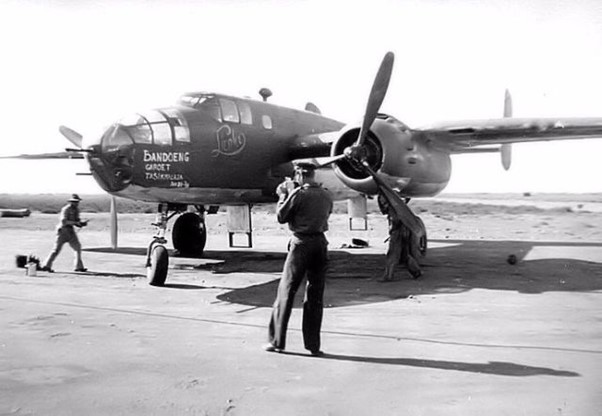
As Allied strategy shifted towards the liberation of the NEI, psychological warfare and intelligence gathering became increasingly important. The aircraft assigned to drop propaganda leaflets, this task required extensive modification to maximise range and efficiency.
For N5-185, this involved:
- removal of most armament to reduce weight
- installation of additional fuel tanks, including a large auxiliary tank in the tail section
- storage of fuel in cans distributed throughout the aircraft to maintain balance
- modification of the fuel system to allow flexible fuel transfer
- removal of non-essential communication equipment
- careful cleaning and preparation of the airframe to improve aerodynamic performance
- application of large red-white-blue markings to ensure visibility when flying at low altitude over camps and populated areas
These modifications transformed the aircraft into a long-range platform capable of reaching deep into occupied territory and returning safely.
Naming the aircraft “Lienke”
The aircraft was given the name “Lienke”, after the wife of pilot Guus Hagers, who had been left behind in Java and was interned in a Japanese camp.
This personal naming was not unusual among aircrews, but in this case it took on a particular significance. The aircraft itself became part of Hagers’ attempt to reconnect, in whatever way possible, with his wife during the war.
The flights to Java
The first missions using the modified aircraft took place in September 1944 from the Potshot airfield on the western shore of Exmouth Gulf in Western Australia.
To avoid Japanese radar detection, the aircraft flew extremely low — around 30 metres above the ocean — during the outbound journey. When dropping pamphlets, they descended to no more than 100 metres, ensuring that the material would fall within reach of people on the ground, particularly in and around internment camps.
These missions were long and demanding. Flights lasted over 12 to 13 hours and covered distances of approximately 3,600 kilometres.
During these operations:
- one aircraft flew over Batavia, targeting camps and central locations
- another focused on Bandung, where it came under attack from Japanese fighter aircraft
- pamphlets were successfully dropped despite these threats
- detailed reconnaissance photographs were taken, providing valuable intelligence for future operations
January 1945 missions and N5-185
A second series of missions took place in January 1945, this time specifically involving N5-185.
Departing from Broome, the aircraft flew to Surabaya, Solo, Semarang and the Ambarawa area, where large camps held women and children. The aircraft remained over Java for more than four hours before returning to Australia after a total flight time of over 14 hours, landing with minimal fuel remaining.
Two days later, the same aircraft and crew conducted another mission, focusing on detailed photographic reconnaissance of the port of Tjilatjap on the southern coast of Java.
These missions combined leaflet distribution with intelligence gathering, illustrating the dual role of the aircraft.
The “Lienke” notes
During these leaflet operations, Hagers reportedly included small personal notes bearing the name “Lienke”, which were dropped over the camps where women and children were interned.
According to later accounts, one of these notes was picked up by a woman in one of the camps. She kept the note for many years without knowing what it referred to. Only decades later, after the publication of the story of Guus and Lienke, did she realise its significance.
While the physical note itself has not yet been traced in publicly accessible collections, the story has become an enduring part of the historical narrative.
Impact and interpretation
The immediate impact of the leaflet missions varied. For internees in the camps, the sight of Allied aircraft flying low overhead — often displaying Dutch markings — and the arrival of pamphlets provided a powerful signal that they had not been forgotten.
For the broader Indonesian population, however, the effect was more complex. By this stage of the war, nationalist sentiment was growing, and many Indonesians were looking towards independence rather than a return to Dutch colonial rule.
The fate of N5-185
At present, the post-war fate of N5-185 remains unclear. While Dutch B-25 aircraft continued to play a role in the immediate post-war period, including during the Indonesian conflict, specific records confirming the subsequent service or disposal of N5-185 have not yet been fully identified.
Further research, including consultation with aviation historians and archival sources, is ongoing.
Legacy
Today, the story of N5-185 “Lienke” stands at the intersection of military history and personal experience. It represents not only the technical ingenuity and operational reach of Allied air power in the Pacific, but also the human dimension of war — separation, hope and the enduring search for connection.
A model of the aircraft is held at Darwin Aviation Museum, providing a tangible link in Australia to this unique story of Dutch-Australian wartime cooperation.