The history of No. 18 (Netherlands East Indies) Squadron RAAF is usually told as one of Allied cooperation and operational success. Yet during its formation in Australia, the squadron experienced a profound internal crisis that culminated in one of the most controversial military trials involving Dutch forces in exile during the Second World War.
Three Dutch airmen—Second Lieutenant William J. Burck and Sergeant-Pilots Eric H.J. de Lyon and Henry Kelder—were accused of conspiring to steal a B-25 Mitchell bomber, fly to Japanese-occupied Java and surrender to the enemy. Burck received life imprisonment, while De Lyon and Kelder were each sentenced to twenty years.
A fourth man, Sergeant Hendrik Johan “Harry” Burgers, was prosecuted separately for failing to report what he had heard.
The case became known as the Colombo tragedy. Later investigations argued that desperate and largely impracticable talk had been deliberately developed into a treason case to restore discipline within a troubled squadron.
Stranded at Archerfield
The origins of the affair lay in the rapid Japanese conquest of the Netherlands East Indies in early 1942.
In February, 43 ML-KNIL personnel—including 18 pilots, seven telegraphists and 14 mechanics—were sent from Java to Archerfield Airport in Brisbane. They expected to take delivery of newly ordered B-25 Mitchell bombers and return with them to help defend the Netherlands East Indies.
The handover was expected to take approximately a week. Instead, the aircraft were delayed. The first three B-25s did not reach Archerfield until 3 March 1942, only days before the surrender of the Netherlands East Indies.
The Dutch airmen were now stranded in Australia. Their wives and children had been left behind in Java, where many were subsequently interned by the Japanese.
For the airmen, this was not an abstract military setback. They knew their families were in danger but had no reliable information about them and no means of returning. Their frustration was intensified by reports that some senior officers had succeeded in bringing their own families to Australia.
Declining morale and tensions within the squadron
The Dutch personnel assembled in Australia were eventually combined with RAAF personnel to form No. 18 Squadron. Because Archerfield had become too congested for training, the squadron was transferred to Canberra.
During this formative period, the unit suffered from shortages of aircraft, prolonged inactivity, poor living conditions and tension between officers and other ranks. Airmen trained to fight were left waiting while Java remained under occupation.
Lieutenant Will Burck became particularly preoccupied with returning to Java. According to later testimony, he had repeatedly spoken about rescuing his family. These conversations were not confined to a secret circle: several officers and airmen appear to have known about them and generally regarded them as fantasy, wishful thinking or the emotional outbursts of a desperate man.
Nevertheless, Dutch military intelligence began to take an interest.
Major Spoor and the intelligence operation
The investigation was led by Major Simon Hendrik Spoor, deputy head of the Netherlands Forces Intelligence Service (NEFIS) in Australia and later commander of Dutch forces during the Indonesian War of Independence.
Spoor used Sergeant-Major Adriaan Scholte, a mechanic associated with Burck, as an informant. According to the investigation later undertaken by J.C. Bijkerk, Scholte was instructed to encourage Burck, De Lyon and Kelder to explain their intentions and develop their proposed return to Java in greater detail.
On 10 November 1942, the men gathered in De Lyon’s room at Canberra’s Tourist Hotel. There was considerable drinking. A map was examined and there was talk of taking a B-25, fitting an additional fuel tank, flying first to Melbourne and then continuing towards Java. A suggestion about dropping a bomb on Dutch headquarters in Melbourne was, according to Kelder’s later account, greeted with laughter.
Scholte had arranged to whistle the tune “Ramona” as a signal that the meeting had begun. Spoor occupied an adjoining room and intended to record or monitor the conversation.
The operation was unsuccessful. The walls were too solid, the recording equipment was not ready and Spoor later acknowledged that he could hear little more than isolated words such as “Java”, “Timor” and “airfields”. Consequently, the case depended heavily on Scholte’s written report.
Scholte was not arrested. Burck, De Lyon and Kelder were taken into custody the following day.
Fiedeldij excluded from the investigation
The three men were arrested on 11 November 1942 in Major Fiedeldij’s office in Hangar 48 at Canberra. Fiedeldij had not been warned about the arrests and was not initially given an opportunity to investigate the allegations concerning members of his own squadron.
Later that day, Fiedeldij telephoned Lieutenant Colonel N. van Straten at Dutch headquarters in Melbourne. He asked to conduct his own investigation and provide formal advice before the matter proceeded further. Fiedeldij was concerned that the arrests could provoke a strong reaction from the squadron’s aircrew and cause another deterioration in morale.
Van Straten maintained that Spoor was the appropriate person to conduct the investigation and allowed him to report directly to Dutch headquarters. Fiedeldij nevertheless carried out his own inquiries and submitted a formal letter. Van Straten responded negatively on 24 November. The following day, the case was referred to the Dutch Sea Court Martial in Ceylon.
By then, Sergeant-Major Scholte had been transferred from No. 18 Squadron to KNIL headquarters in Melbourne. This removed the principal informant from the squadron while the accused airmen remained in detention.
Bijkerk’s later reconstruction suggests that instructions for the arrests may already have been issued on the evening of the meeting. If correct, this raises the possibility that the intelligence operation was designed less to discover whether a genuine conspiracy existed than to obtain evidence against men already regarded as dangerous or disloyal.
From desperate talk to treason
The three men were accused of conspiring to commit military treason and desertion to the enemy. Burck also faced an allegation of espionage.
There was no dispute that the men had discussed returning to Java. The more difficult question was whether their discussions constituted a genuine and executable military conspiracy.
The practical obstacles were considerable. A B-25 operating from Canberra could not fly directly to Java without refuelling. No aircraft had been seized, no flight had begun and no contact with the Japanese had been established. Much of the alleged planning had occurred during drinking sessions and was widely known within the squadron.
Burck’s former defence counsel, S.J. Baron van Tuyll van Serooskerken, later argued that the proposal could never have been carried out in the form discussed. He concluded that the proceedings had produced a miscarriage of justice.
The defence also maintained that Scholte had not merely observed the men but had actively encouraged them. In contemporary terms, the intelligence operation displayed significant characteristics of provocation or entrapment.
Removed from Australia
After their arrest, Burck, De Lyon and Kelder were detained in Australia for approximately seven months. They were held in police custody, at Pentridge Prison in Melbourne and later in military detention near Fremantle.
The Dutch authorities decided not to try them in Australia. They were transferred by ship to Colombo in Ceylon, now Sri Lanka, and placed under the jurisdiction of a Dutch naval court martial, even though they were air-force personnel.
The trials were held aboard the Dutch submarine depot ship Plancius in Colombo Harbour. The defendants were detained in Hulftsdorp Prison outside Colombo; they were not imprisoned aboard Plancius after the proceedings.
No witnesses were brought from Australia to testify in person. The court instead relied heavily upon written statements. Scholte—the informant whose evidence was central to the prosecution—was not present and could not be cross-examined.
This severely limited the ability of the defence to test the evidence or call squadron members who could have explained how widely Burck’s ideas had been discussed and how seriously—or otherwise—they had been regarded.
Severe sentences
Burck was tried first. The prosecutor sought the death penalty, but on 14 August 1943 the court sentenced him to life imprisonment.
De Lyon and Kelder were tried separately. The prosecution sought life imprisonment for both; each received a sentence of twenty years.
The severity of these sentences suggests that the proceedings served a broader disciplinary purpose. Dutch military leaders were struggling with discontent and deteriorating morale among personnel in exile. Making an example of the three men offered a means of warning the rest of the squadron.
One former member of the court, G.B.M. van Erkel, later acknowledged that the court had overreacted and that the proposed flight was not practically achievable. According to his later recollection, members of the court had nevertheless considered exceptionally severe punishment necessary.
The separate case against Harry Burgers
A fourth airman became entangled in the affair.
Hendrik Johan “Harry” Burgers was a wireless operator and air gunner. Before reaching Australia, he had flown operational missions during the Japanese invasion. On 19 February 1942 he shot down a Japanese Zero near Palembang—an action for which he later received the Bronze Cross.
Burgers had not attended the meeting at the Tourist Hotel and was not accused of agreeing to participate in the proposed flight. Burck had, however, approached him because a wireless operator would be needed to contact the Japanese before reaching Java.
Burgers said that he had rejected the proposal. He had not reported the conversations because he regarded Burck’s plan as so foolish and unrealistic that it could not be taken seriously.
On 29 November 1942, Burgers was summoned to Spoor’s office in Melbourne and arrested. Like the others, he was transported through Pentridge and Fremantle to Colombo.
His court martial was held on 22 October 1943. The prosecution sought eight years’ imprisonment for deliberately failing to report information that could harm the military service or the state.
Burgers’ defence pointed out that numerous other members of the squadron—including officers—had heard similar talk but had not been prosecuted. It argued that commanding officers either knew or should have known about Burck’s obsession with returning to Java.
The court rejected this as a question of prosecutorial policy rather than a defence. It found Burgers guilty and sentenced him to twelve months’ imprisonment, with the 328 days he had already spent in custody deducted from the sentence.
Significantly, the court recorded that Burgers had behaved loyally during the war and declined to strip him of his rank. His comparatively limited sentence also distinguished his position from that of the three men convicted of conspiracy.
Imprisonment and eventual release
Burck, De Lyon and Kelder were sent to a British military prison near Lucknow in India. In 1946 they were transported to the Netherlands and imprisoned at Leeuwarden.
Their attempts to obtain a review were hampered by difficulties locating the case files, some of which had been returned to the Netherlands East Indies.
By 1949, Dutch officials were privately acknowledging that the punishments had been excessive. In February 1950, the Dutch Minister of Justice wrote that the three men had been punished far too severely and that whatever could still be repaired should be repaired.
They were released from Leeuwarden Prison in April 1950.
Royal Decrees subsequently formalised reductions in their sentences. De Lyon’s sentence was reduced to ten years by a decree of 8 September 1951. On 23 April 1952, Royal Decree No. 77 reduced the sentences of Burck and Kelder to ten years, effective retrospectively from 24 September 1943. Burck was also discharged from military service.
These measures reduced their sentences but did not overturn the convictions. The men never received full legal rehabilitation or an official apology.
Lives permanently affected
The consequences extended well beyond the years of imprisonment.
Burck’s marriage ended, and he became estranged from his children. He died in Munich in 1981. De Lyon died following an accident in 1976. Kelder, the last surviving member of the three, eventually lost the desire to continue pursuing official exoneration.
Burgers’ life followed a different path. After the war he married Nora Hevel in Nijmegen. The family later returned to the Netherlands East Indies before migrating to Australia in 1950 and settling in Cowra. He died at Orange District Hospital in 1987.
His story connects the Colombo affair with the broader history of Dutch aviation in Australia, post-war migration and the Burgers family’s remarkable association with the former Boven Digul political prisoners buried at Cowra.
Discipline, injustice and the pressures of exile
The Colombo affair cannot be reduced to a simple story of innocent men accused of something they had never discussed. Burck, De Lyon and Kelder did talk about taking an aircraft and returning to Java. Burgers knew something of Burck’s intentions and chose not to report them.
The central question is whether these conversations amounted to an executable conspiracy to betray the Allied war effort—or whether Dutch military intelligence transformed grief, anger and drunken bravado into a treason case.
The evidence that emerged after the war raises serious doubts about the fairness of the proceedings:
- Burck’s desire to return to Java was widely known within the squadron.
- Officers and other airmen who heard similar discussions were not prosecuted.
- The alleged plan was operationally unrealistic.
- Scholte actively encouraged the discussions while working for Spoor.
- Spoor’s attempt to record the crucial meeting failed.
- The prosecution depended heavily on Scholte’s written account.
- Neither Scholte nor other important witnesses were available for cross-examination in Colombo.
- The trials took place far from Australia, where the events and witnesses were located.
- The sentences were extraordinarily severe and appear to have been influenced by a desire to restore discipline.
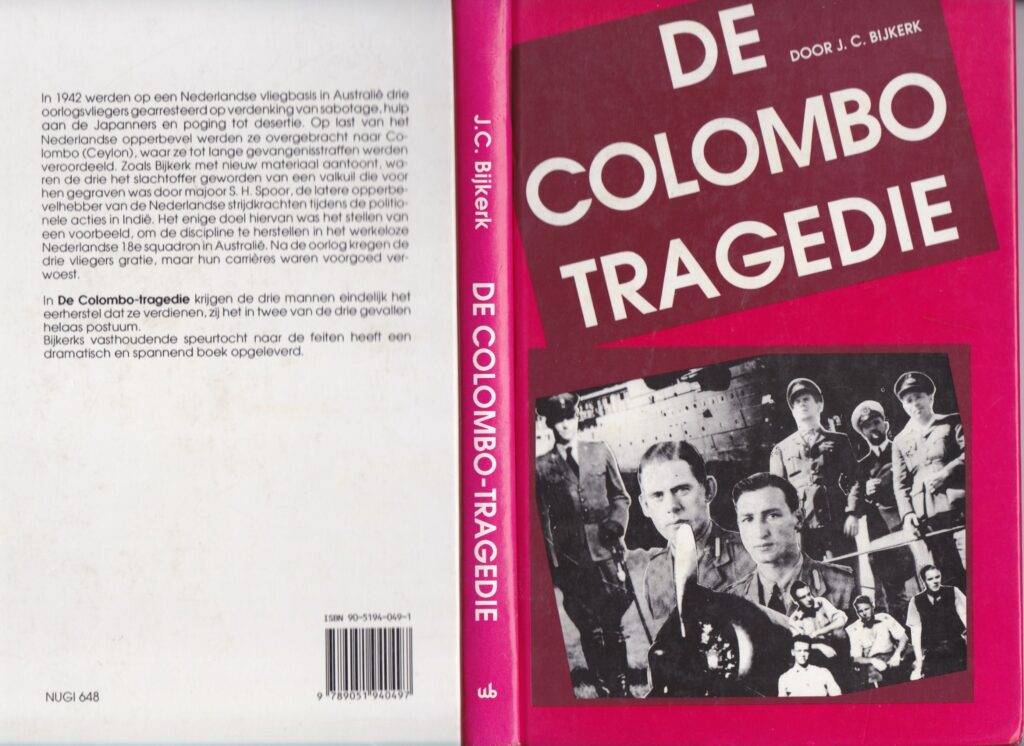
In 1991, J.C. Bijkerk brought the affair to renewed public attention in his book De Colombo-tragedie. His investigation, based on surviving records and interviews with witnesses, portrayed the convictions as a deliberate miscarriage of justice that destroyed the careers and personal lives of three capable Dutch airmen.
The case reveals the darker side of maintaining an armed force in exile. The Dutch airmen in Australia had lost their country, were separated from their families and initially lacked the aircraft needed to continue fighting. Their commanders, meanwhile, feared disobedience and the disintegration of military discipline.
From this volatile combination of desperation, resentment and authoritarian control emerged the Colombo tragedy—a case in which the requirements of wartime discipline appear to have overwhelmed proportionality, fairness and compassion.
Paul Budde, updated September 2026
Sources
- J.C. Bijkerk — De Colombo-tragedie — includes the book’s contents and related documentation about the case.
- De Colombo-tragedie — bibliographical details — J.C. Bijkerk, Van Wijnen, Franeker, 1991, ISBN 9789051940497.
- Doug Hurst — The Fourth Ally: The Dutch Forces in Australia in WWII — Australian War Memorial catalogue record.
- The Fourth Ally — DACC overview
- Dr Jack Ford — Allies in a Bind: Australia and the Netherlands East Indies in the Second World War — Australian War Memorial catalogue record.
- Dr Jack Ford and Allies in a Bind — DACC background article
- O.G. Ward — De Militaire Luchtvaart van het KNIL in de jaren 1942–1945
- Extract from O.G. Ward concerning the formation of No. 18 Squadron
- B-25 bombers ordered by the Dutch ended up with the USAAF
- The 18 Netherlands East Indies Squadron RAAF — WWII
- The Burgers family: Boven Digul, No. 18 Squadron and Cowra
- De Colombo Tragedie—case history, documents and campaign for rehabilitation
- Netherlands Veterans Institute—“Colombo-tragedie”