Marinus Willem Reith’s military career followed an extraordinary path from the Netherlands East Indies through Japanese captivity in Java and Thailand to aviation training in the United States and postwar service with Dutch military aviation in Australia and New Guinea.
His surviving military personnel record helps reconstruct this journey. It also demonstrates how some former prisoners of war returned to military service and participated in the difficult rebuilding of Netherlands East Indies aviation after the Second World War.
Early life in Sumatra
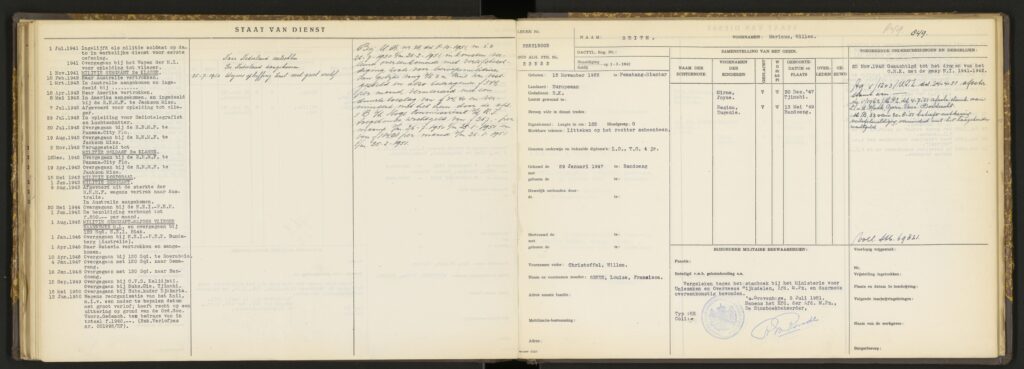
Marinus Willem Reith was born at Pematang-Siantar in northern Sumatra on 15 November 1920. His military record classified him as a European Dutch subject and noted that he had completed primary education followed by four years of technical schooling.
On 1 July 1941 he entered active service as a militia soldier in the Royal Netherlands East Indies Army. The service number associated with him in surviving prisoner-of-war records is 33522.
Captured on Java
Following the Japanese invasion of the Netherlands East Indies, Reith was made a prisoner of war on Java on 5 March 1942.
This was several days before the formal surrender of the Royal Netherlands East Indies Army on 9 March. Thousands of Dutch, Indonesian, Indo-European and other Allied servicemen were subsequently confined in camps and transported throughout the Japanese-controlled region as forced labour.
Reith was transferred from Java to Thailand. Surviving prisoner-of-war databases also identify him among the Dutch prisoners associated with the Burma–Siam Railway. These records place him in prisoner group IV and confirm that he survived captivity.
The available personnel card does not provide a detailed account of the camps in which he was held or the work he was compelled to perform. Nevertheless, his presence in Thailand places him among the large group of Allied prisoners exposed to forced labour, disease, malnutrition and extremely harsh treatment under Japanese control.
Liberation and return to military service
Reith survived the war and returned to Dutch military control after the Japanese surrender in August 1945.
Rather than leaving the armed forces, he entered a new phase of military training. His technical background and wartime service led to his selection for aviation duties during the postwar reconstruction of the Military Aviation of the Royal Netherlands East Indies Army.
His subsequent career must therefore be understood as that of a former prisoner of war who returned to active service, rather than as an airman who had escaped from Java in 1942.
Aviation training in the United States
On 18 April 1946 Reith departed for the United States and was assigned to the Royal Netherlands Military Flying School at Jackson, Mississippi.
His training included instruction connected with:
- aerial observation;
- radio telegraphy and airborne communications;
- aerial gunnery; and
- operational aviation duties.
The personnel card also records training at No. 6 Gunnery School at Panama City, Florida.
The Royal Netherlands Military Flying School had been established during the war to train Dutch and Netherlands East Indies aviation personnel in cooperation with the United States. Although most of its wartime students had arrived after escaping from the Netherlands East Indies or travelling from Britain, Reith entered the programme after surviving Japanese captivity.
He was removed from the strength of the flying school on 9 August 1946.
Marriage and family
On 29 January 1947 Reith married Mirna Joyce Regina Eugénie in Bandung.
The military record also contains information about their children. These family entries should be preserved in the reproduced record, although names and dates should only be transcribed into the article if they can be read and confirmed with confidence.
Service in Australia and New Guinea
On 20 May 1947 Reith travelled to Australia and joined the Netherlands East Indies Personnel and Equipment Pool. This organisation provided personnel, aircraft, training and technical support for Dutch aviation units operating from Australia and the Netherlands East Indies.
On 1 August 1947 he was transferred to No. 120 (Netherlands East Indies) Squadron at Biak.
No. 120 Squadron had been formed in Australia in December 1943 as a joint Netherlands East Indies–RAAF fighter unit. It initially operated P-40 Kittyhawks from Merauke and later moved through other bases in New Guinea and the Netherlands East Indies.
By the time Reith joined the squadron, the war against Japan had ended and the formal wartime RAAF arrangement had changed. Nevertheless, the unit retained the personnel, aircraft and organisational legacy of the Dutch–Australian wartime aviation partnership.
His Australian posting therefore belonged to the postwar continuation of a military aviation organisation that had originally been created and supported in Australia.
Return to the Netherlands East Indies
Reith subsequently returned to Batavia and continued serving in Dutch military aviation during the Indonesian struggle for independence.
His record contains later postings associated with:
- Batavia;
- Surabaya;
- Semarang;
- Yogyakarta; and
- aviation depot and administrative units.
These postings occurred during a period of intense military and political conflict. Former prisoners of war and personnel trained by the Allies were being used to rebuild Dutch military organisations while the Indonesian Republic sought international recognition and independence.
War Commemorative Cross
On 25 November 1948 Reith became entitled to wear the Oorlogsherinneringskruis, or War Commemorative Cross, with the 1941–1942 clasp.
The decoration recognised his military service during the Netherlands East Indies campaign. His years as a Japanese prisoner of war form an essential part of the history behind that award.
From prisoner of war to aviation serviceman
Reith’s military record documents two distinct experiences.
The first was his capture on Java and imprisonment in Thailand, including his association with the Burma–Siam Railway. The second was his return to military service, aviation training in the United States and subsequent posting to Australia and No. 120 Squadron at Biak.
His story illustrates the physical and personal disruption experienced by Netherlands East Indies servicemen. Within a relatively short period, Reith passed from colonial military service to Japanese captivity, liberation, American aviation training and renewed service during the Indonesian struggle for independence.
For the DACC, his Australian posting is important because it connects an individual prisoner-of-war history with the wider Dutch aviation organisation established in Australia during the Second World War.
Military personnel record
Related DACC articles
- DACC Air Force Research Portal
- The fall of the Netherlands East Indies, March 1942
- The NEI Personnel and Equipment Pool Squadron—Canberra and Bundaberg
- 120 Netherlands East Indies Fighter Squadron RAAF—WWII
- The strategic position of Merauke during WWII
Sources and further reading
- Military personnel record of Marinus Willem Reith, Bronbeek records; supplied by Michael Kramer.
- Dutch prisoners associated with the Burma–Siam Railway
- Database of Dutch forced labourers on the Burma Railway