Willy Erkelens was a Netherlands East Indies military pilot whose career extended from prewar flying training through Japanese captivity and into the violent struggle surrounding Indonesian independence.
After qualifying as a military pilot shortly before the Pacific War, he was captured following the surrender of Java. He survived more than three years as a Japanese prisoner of war, returned to flying after liberation and subsequently served with the Military Aviation of the Royal Netherlands East Indies Army.
Erkelens is particularly remembered as one of the two Dutch pilots involved in the interception of the Indian-registered Dakota VT-CLA near Yogyakarta on 29 July 1947. The aircraft was piloted by Australian Noel Constantine and was carrying Indonesian aviation officers and medical supplies. Its destruction became a major international incident.
Early life and technical education
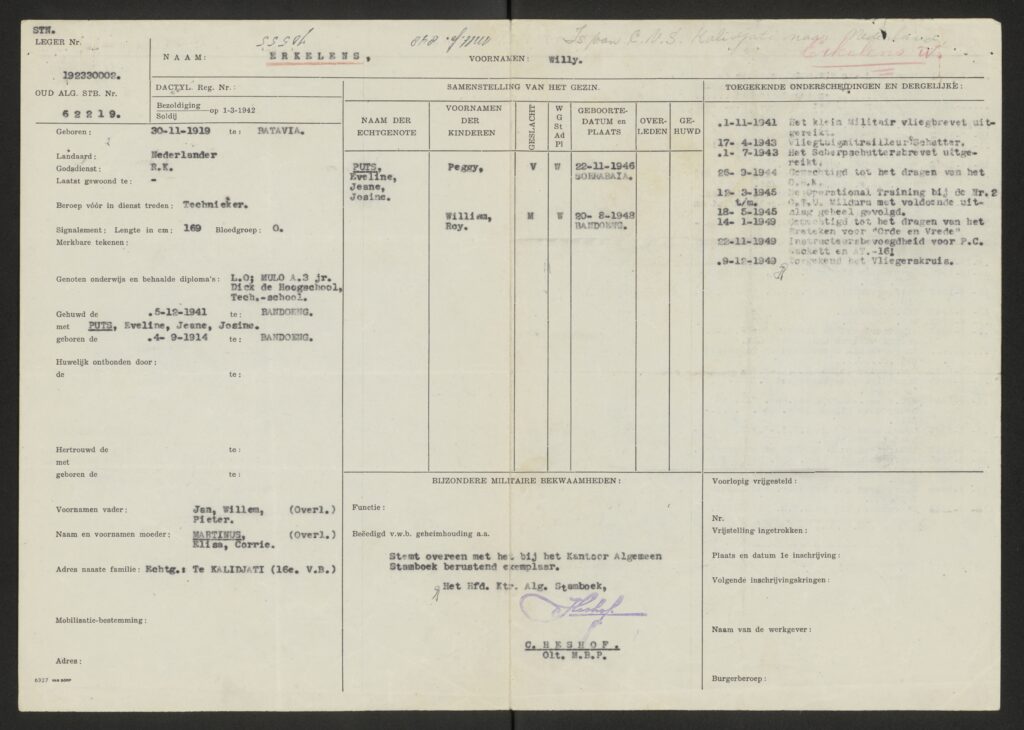
Willy Erkelens was born in Batavia—now Jakarta—on 30 November 1919.
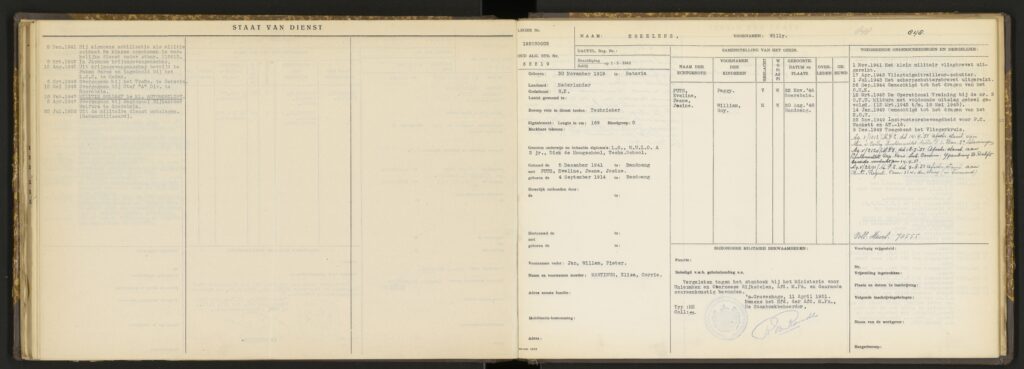
His military personnel record describes him as technically trained. His education included MULO secondary schooling, attendance at the Dick de Hoog School and three years of technical education.
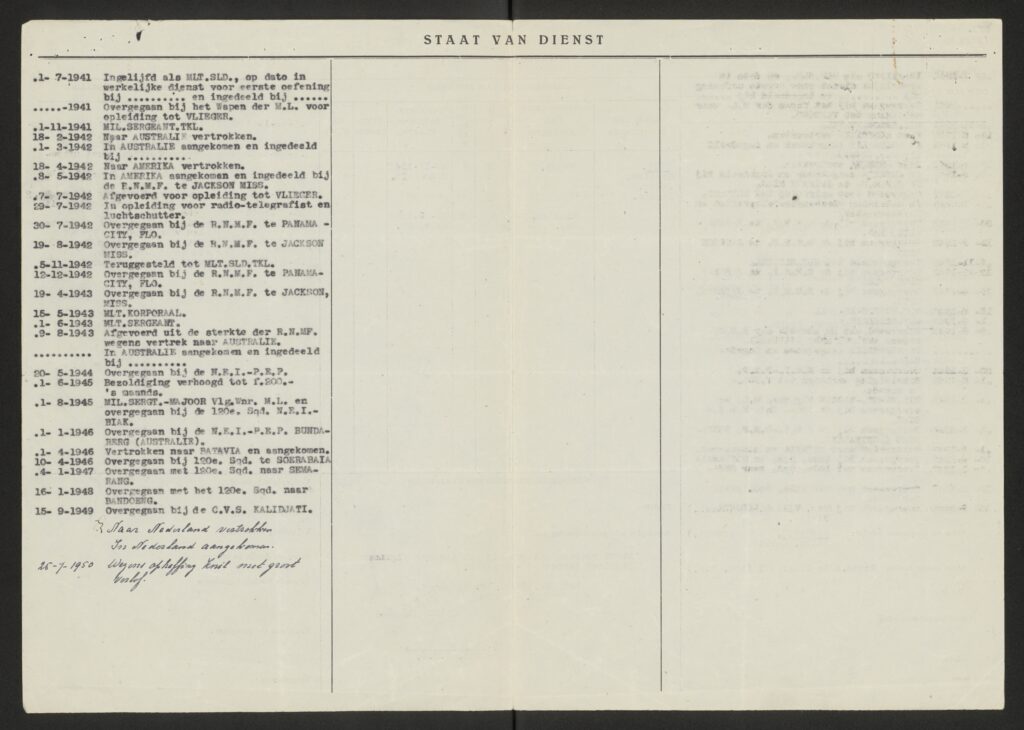
On 1 July 1941 he entered active service as a militia soldier in the Royal Netherlands East Indies Army. He subsequently undertook military flying instruction.
On 1 November 1941 Erkelens obtained the Klein Militair Vliegbrevet, a military pilot qualification awarded following elementary flying training.
Marriage and family
On 5 December 1941 Erkelens married Eveline Jeane Josine Puts in Bandung. Their marriage took place only days before the Japanese attack on Pearl Harbor and the beginning of the Pacific War.
Their children included Peggy, William and Roy. The family’s life was profoundly affected by Erkelens’s wartime captivity and his subsequent return to military service during the Indonesian struggle for independence.
Japanese captivity
After Japanese forces invaded Java, Erkelens was made a prisoner of war on 8 March 1942.
His personnel record does not provide a detailed account of the camps in which he was held. It nevertheless establishes that he spent the remainder of the Pacific War in Japanese captivity.
Erkelens was therefore not among the Netherlands East Indies aviation personnel evacuated to Australia in 1942. His wartime experience was instead shared by the thousands of KNIL servicemen imprisoned and subjected to forced labour under Japanese control.
Return to military aviation
Following liberation in 1945, Erkelens resumed service with the Dutch forces in the Netherlands East Indies.
His initial postwar appointments included duties with the Lines of Communication organisation and staff functions connected with A Division at Surabaya. In October 1946 he travelled to Batavia and returned to the military aviation organisation.
On 26 November 1946 he was appointed or promoted to sergeant major pilot. He subsequently flew Curtiss P-40 Kittyhawk fighters and served from airfields including Kalidjati.
His return to flying so soon after several years of captivity demonstrates the urgent need for experienced personnel as the Dutch attempted to rebuild their military aviation organisation.
No. 120 Squadron and its Australian origins
Erkelens’s postwar flying was connected with the organisation that had developed from No. 120 (Netherlands East Indies) Squadron RAAF.
No. 120 Squadron had been formed at Canberra in December 1943 as a joint Netherlands East Indies–RAAF fighter unit. The Dutch supplied its pilots and P-40 Kittyhawk aircraft, while the RAAF provided much of its ground organisation and support.
The squadron operated from Merauke and other bases in New Guinea before moving into the Netherlands East Indies. By the time Erkelens was flying during the Indonesian conflict, the unit’s formal wartime relationship with the RAAF had changed. Nevertheless, its aircraft, personnel and operating traditions had emerged from the Dutch–Australian wartime partnership.
The Jogja incident
On 29 July 1947 Erkelens and First Lieutenant Bernhard Jan “Ben” Ruesink were flying P-40 Kittyhawks near Yogyakarta. They were ordered to locate an aircraft suspected of involvement in Republican air activity.
Late that afternoon they encountered the Indian-registered Douglas C-47 Dakota VT-CLA, which was approaching Yogyakarta after flying from Singapore. The aircraft was piloted by Australian Alexander Noel Constantine and British co-pilot Roy Hazlehurst. Its passengers included senior Indonesian aviation officers Adisucipto and Dr Abdulrachman Saleh.
The Dakota was carrying medical supplies and other cargo intended for the Indonesian Republic.
Dutch authorities maintained that Erkelens and Ruesink fired warning shots and that VT-CLA crashed after descending to a dangerously low altitude while attempting to evade the fighters. Indonesian, Indian and other contemporary accounts concluded that the Dutch fighters had fired upon and fatally damaged the aircraft.
VT-CLA crashed near the villages of Ngoto and Wojo, approximately three kilometres from Yogyakarta. Eight of its nine occupants died, including Constantine, Hazlehurst, Adisucipto and Abdulrachman Saleh. Abdul Gani Handoko Cokro was the only person to survive.
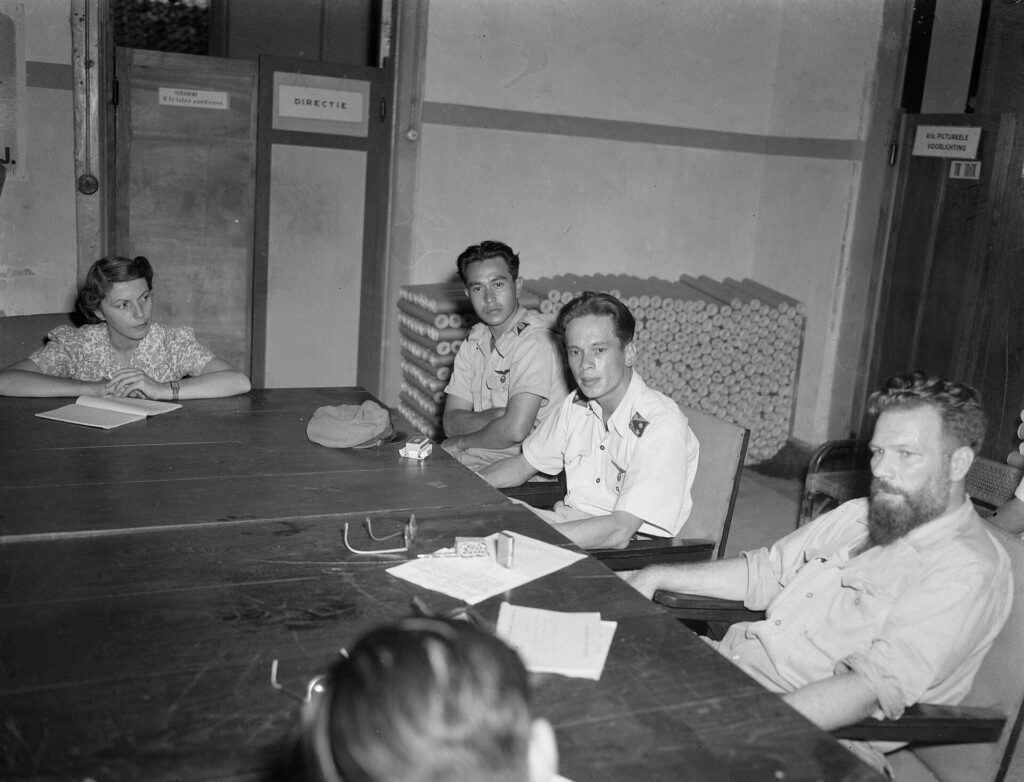
The incident prompted protests from India and attracted international attention. The Netherlands continued to defend the pilots’ account, while the Indonesian Republic regarded the loss as a deliberate attack on an aircraft carrying medical supplies.
The Dutch Government subsequently provided compensation and a replacement Dakota. In Indonesia, 29 July became associated with the commemoration of the country’s air-force service and the deaths of Adisucipto and Abdulrachman Saleh.
The differing accounts of the interception remain part of the contested history of the Indonesian struggle for independence.
Read the detailed DACC account: Foreign pilots, Dutch blockades and the Indonesian air war—the Jogja incident of 29 July 1947.
Flying instructor and aircraft qualifications
Erkelens continued serving as a military pilot and instructor after the Jogja incident.
His personnel record contains references to flying and instructional qualifications on several training aircraft, including:
- the Piper Cub;
- the Australian-designed Wackett trainer; and
- the North American AT-16 Harvard.
The abbreviation WAC on the personnel record refers to the Wackett aircraft. It should not be interpreted as Wacol in Queensland.
These qualifications indicate that Erkelens participated in the training of pilots during the final years of the KNIL aviation organisation.
Award of the Vliegerkruis
On 9 December 1949 Erkelens was awarded the Vliegerkruis, or Flying Cross.
The Vliegerkruis was a Dutch military decoration awarded for courage, perseverance, skill or devotion to duty demonstrated during operational flying. Erkelens’s personnel record confirms the award, although the associated recommendation or official citation should be located before attributing it to one particular operation.
His records also include military flying and observer qualifications. These aviation brevets were professional qualifications rather than decorations.
Dissolution of the KNIL
Following the international recognition of Indonesian sovereignty, the Royal Netherlands East Indies Army was dissolved in 1950.
Erkelens subsequently travelled to the Netherlands and received honourable leave in connection with the abolition of the KNIL. His service record contains the handwritten notation:
Wegens opheffing KNIL met goed verlof.
This brought to an end a military career that had encompassed pilot training, Japanese captivity, postwar fighter operations, flying instruction and the dissolution of the colonial military organisation in which he had served.
A complex aviation history
Willy Erkelens’s life illustrates the complicated transition from the Pacific War to the Indonesian struggle for independence.
He began as a young KNIL pilot preparing to defend the Netherlands East Indies against Japan. After surviving Japanese captivity, he returned to an air force that was itself being rebuilt amid a growing anti-colonial conflict.
His connection with Australia is less direct than that of many other personnel included in the DACC Air Force Research Portal. It rests principally upon the Australian origins of No. 120 Squadron, his later qualification on the Australian Wackett trainer and the presence of Australian pilot Noel Constantine aboard VT-CLA.
His story nevertheless provides important context for understanding what happened to the Dutch–Australian aviation organisation after the defeat of Japan and how personnel trained within that system became involved in the subsequent conflict in Indonesia.
Military personnel records
Related DACC articles
- DACC Air Force Research Portal
- 120 Netherlands East Indies Fighter Squadron RAAF—WWII
- Bernhard Jan “Ben” Ruesink
- Foreign pilots, Dutch blockades and the Indonesian air war—the Jogja incident of 29 July 1947
- The fall of the Netherlands East Indies, March 1942
Sources and further reading
- Military personnel records of Willy Erkelens, Bronbeek; supplied by Michael Kramer.
- Archival material concerning W.E. Erkelens—Netherlands Institute of Military History
- Archival documentation concerning the VT-CLA incident—National Archives of the Netherlands
- VT-CLA incident—compiled historical documentation