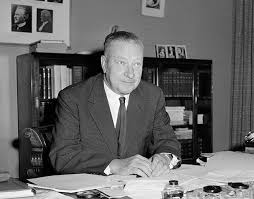
Most Australians remember Sir Richard (Dick) Kirby as one of the country’s most influential industrial relations judges. Yet before he became a leading figure in Australian public life, he played a significant international role in one of the most important political transitions in twentieth-century Southeast Asia: the struggle over the future of the Netherlands East Indies following the Second World War.
His involvement in the United Nations mediation process between the Netherlands and the emerging Republic of Indonesia placed him at the centre of events that would ultimately lead to the end of Dutch colonial rule in Indonesia. For Dutch-Australian history, Kirby’s contribution offers an important insight into Australia’s growing diplomatic engagement with the region and its complex relationship with both the Netherlands and Indonesia during the immediate post-war years.
Early career and wartime service
Richard Clarence Kirby was born in Charters Towers, Queensland, in 1904. Educated at the King’s School in Sydney and later at the University of Sydney, he became a solicitor in 1928 and was called to the New South Wales Bar in 1933.
During the Second World War he served in the Australian Imperial Force and, by 1945, was attached to the headquarters of Admiral Lord Louis Mountbatten in Ceylon (now Sri Lanka). Following Japan’s surrender, he worked with the Australian War Crimes Commission in the prosecution of Japanese war criminals.
These wartime experiences exposed Kirby to the political upheavals taking place across Asia as European colonial powers attempted to re-establish control over territories occupied by Japan during the war.
The Netherlands East Indies after 1945
The Japanese surrender in August 1945 transformed the political situation in the Netherlands East Indies. Indonesian nationalist leaders Sukarno and Mohammad Hatta proclaimed independence on 17 August 1945, only days after Japan’s capitulation.
The Dutch government, having spent the war years in exile in London, sought to restore its authority over the colony. This led to a prolonged and increasingly bitter conflict between Dutch authorities and Indonesian nationalists.
Australia became unexpectedly involved in the dispute. Australian trade unions imposed bans on Dutch shipping carrying military supplies to the East Indies, while the Chifley Government increasingly favoured negotiation and international mediation rather than military intervention.
The dispute soon attracted the attention of the newly formed United Nations.
Appointment to the Committee of Good Offices
In August 1947, following the first major Dutch military offensive against Republican-controlled territory, the United Nations Security Council established the Committee of Good Offices to mediate between the parties.
The committee consisted of three representatives:
- Belgium, nominated by the Netherlands
- Australia, nominated by the Republic of Indonesia
- The United States, selected jointly by both parties
The Australian Government appointed Richard Kirby as its representative.
For a 42-year-old lawyer and judge, the appointment was extraordinary. He suddenly found himself participating in one of the first major international disputes handled by the United Nations.
The Indonesian leadership welcomed his appointment. Prime Minister Amir Sjarifuddin expressed confidence that Kirby would approach the dispute fairly and understand the aspirations of the Indonesian people.
Mediating between the Dutch and Indonesian sides
Kirby’s task was exceptionally difficult.
The Dutch position was that sovereignty remained legally vested in the Kingdom of the Netherlands. Dutch authorities sought a federal structure that would maintain strong constitutional links with the Netherlands while gradually granting greater autonomy to Indonesian territories.
The Republican leadership argued that independence had already been achieved in August 1945 and that negotiations should focus on international recognition of that reality.
Working alongside the American representative Dr Frank Porter Graham and the Belgian representative Paul van Zeeland, Kirby participated in extensive negotiations aimed at securing ceasefires and political settlements.
One of the committee’s most significant achievements was the negotiation of the Renville Agreement in January 1948. The talks took place aboard the American naval vessel USS Renville anchored in Jakarta Bay.
Although the agreement ultimately failed to resolve the conflict permanently, it represented a major diplomatic effort to prevent further escalation and remains one of the landmark mediation exercises in early United Nations history.
Contemporary accounts describe Kirby as a patient and pragmatic mediator. Rather than acting as an advocate for either side, he focused on practical solutions and on maintaining communication between parties whose positions often appeared irreconcilable.
Relations with the Dutch administration
Kirby’s role inevitably brought him into contact with senior Dutch officials, including Lieutenant Governor-General Dr Hubertus van Mook, who was attempting to steer a course between Dutch political realities and growing international pressure for Indonesian self-determination.
The relationship between Van Mook and the international mediators was often complicated. Dutch authorities remained concerned that international involvement increasingly favoured the Republican position, while Indonesian leaders feared that mediation might delay full independence.
Kirby sought to maintain credibility with both sides. His legal training and reputation for independence allowed him to earn respect even when his conclusions were not always welcomed.
This balanced approach later became a defining feature of his career as a mediator and arbitrator.
Recognition by Indonesia
Perhaps the strongest indication of Kirby’s influence came decades later.
In 1995, the Indonesian Government awarded him the Bintang Jasa Utama (First Class Distinguished Service Star), one of Indonesia’s highest civilian honours. The award recognised his contribution to the peaceful resolution of the Indonesian independence struggle and his support for international diplomacy during a critical period in the nation’s formation.
The honour was particularly significant because it acknowledged an Australian whose role had been neither military nor political but diplomatic and humanitarian.
Significance for Dutch-Australian history
Sir Richard Kirby’s work occupies an important place in the shared history of Australia, the Netherlands and Indonesia.
His involvement occurred during the same period that thousands of Dutch military personnel, civilians and officials from the former Netherlands East Indies were living and working in Australia. The Netherlands East Indies government-in-exile had operated from Australia during the war, and many Dutch organisations continued to maintain strong connections with Australia during the post-war transition.
Kirby’s mediation efforts therefore formed part of a broader Australian engagement with the future of the Netherlands East Indies and the emergence of independent Indonesia.
While his later achievements in industrial relations brought him national prominence, his contribution to one of the earliest and most challenging United Nations peace initiatives deserves equal recognition. It demonstrates how Australia, through figures such as Richard Kirby, played a meaningful role in shaping the post-war order in Southeast Asia.
Paul Budde
Sources
D’Alpuget, Blanche. Mediator: A Biographhttps://catalogue.nla.gov.au/catalog/993725y of Sir Richard Kirby. Melbourne University Press.
Journal of Industrial Relations, Obituary: “The Hon Sir Richard Kirby AC”, 2001 (downloadable pdf).
Department of Foreign Affairs and Trade (Australia), Documents on Australian Foreign Policy.