Among the many fascinating objects in the collection of the Bronbeek Museum is a battered Japanese Type 90 combat helmet. At first glance it appears to be little more than a wartime relic, one of countless pieces of military equipment left behind in the Pacific after the Second World War. However, a closer examination reveals a remarkable story linking Japan, Australia and the Netherlands East Indies during one of the most important campaigns of the Pacific War.
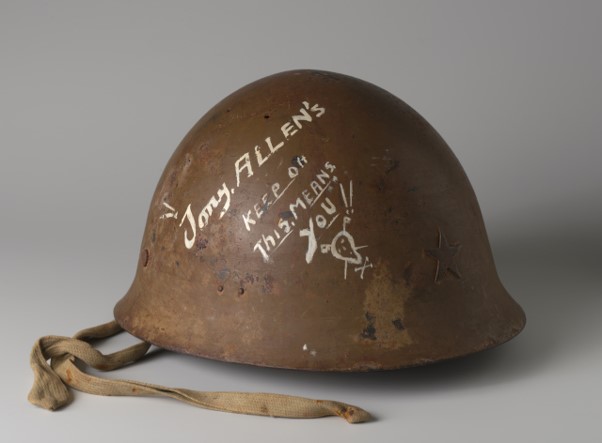
The helmet was displayed in Bronbeek as part of a collection of Japanese military artefacts recovered at Hollandia in Dutch New Guinea. Thanks to research by Bronbeek curator Dr Tristan Broos, we know considerably more about the object than might normally be expected for a wartime souvenir.
The helmet formed part of a group of Japanese military items discovered in a Japanese bunker at Hollandia in 1944. The artefacts were preserved by Australian serviceman R.W. “Bob” Allen and eventually found their way into the Bronbeek collection.
The story begins on 22 April 1944 during Operation Reckless, one of General Douglas MacArthur’s most ambitious amphibious operations. The objective was Hollandia, today known as Jayapura, then part of the Netherlands East Indies. Since the Japanese conquest of 1942, this territory had remained under Japanese occupation. The capture of Hollandia would provide the Allies with a major forward base from which they could continue their advance towards the Philippines and eventually Japan itself.
Although the operation is generally remembered as an American victory, Australian personnel also played important supporting roles. One of those Australians was Bob Allen.
Allen served as a coxswain aboard HMAS Manoora. Originally built as a passenger liner, Manoora had been requisitioned for wartime service and converted first into an armed merchant cruiser and later into a landing ship. During Operation Reckless, she carried troops and landing craft to the Hollandia beaches.
As coxswain, Allen was responsible for operating one of the landing craft that transported Allied troops ashore on the day of the invasion. In the aftermath of the successful landings, he acquired a number of Japanese military items discovered in a bunker, including the helmet now preserved in Bronbeek.
The helmet itself is a standard Japanese Type 90 steel combat helmet. Introduced in the early 1930s, it became the standard helmet of the Imperial Japanese Army and was widely used throughout the Pacific War. The example preserved at Bronbeek still bears the characteristic star insignia of the Imperial Japanese Army.
Yet it is not the helmet’s military significance that makes it especially interesting. What transforms it into a personal historical object is the inscription painted on its side.
Written in white paint are the words:
“Tony Allen’s
Keep Off
This Means You!!”
accompanied by a small cartoon bird.
According to the information preserved with the collection, the inscription was added not by Bob Allen himself but by his brother Tony. What had begun as a battlefield souvenir became a treasured family keepsake. The humorous warning reflects the type of irreverent humour commonly found among Australian servicemen and their families during and after the war.
The helmet therefore tells two intertwined stories. The first is the story of a Japanese soldier serving in occupied Dutch territory. The second is the story of an Australian sailor who participated in the liberation of that territory and preserved a tangible reminder of the campaign.
For Dutch-Australian history, the object has an additional significance. Hollandia was not simply another battlefield in the Pacific. It was the capital of Netherlands New Guinea. The Allied landings therefore marked one of the first major returns to Dutch territory after the devastating defeats of 1942.
The operation demonstrated the increasingly close cooperation between Dutch, Australian and American forces in the Southwest Pacific Area. While Dutch military resources had been largely destroyed or dispersed following the fall of the Netherlands East Indies, Dutch personnel continued to serve alongside Allied forces. Australia became the principal base for many Dutch military, governmental and intelligence organisations operating in exile. From Australia, preparations were made for the eventual return to Dutch territory.
The liberation of Hollandia was one of the milestones on that path. Although the Dutch role in the operation itself was limited, the capture of the territory helped create the conditions that would eventually allow Dutch authorities to return to parts of the Netherlands East Indies after the war.
The helmet therefore represents far more than a captured piece of military equipment. It is an object that links a Japanese soldier, an Australian sailor and a Dutch territory within a single historical narrative. It reminds us that the war in the Pacific was not fought by nations in isolation but through a complex network of alliances and shared objectives.
Today, displayed in the Bronbeek Museum, the helmet serves as a tangible reminder of the liberation of Dutch New Guinea, the contribution of Australian servicemen such as Bob Allen, and the close wartime relationship that developed between Australia and the Netherlands during the struggle against Japan.
As with many museum objects, its greatest value lies not in the artefact itself but in the human stories that surround it. Through one battered helmet, we gain a glimpse of the larger history of the Pacific War and of the individuals whose lives became connected across continents through the events of 1944.