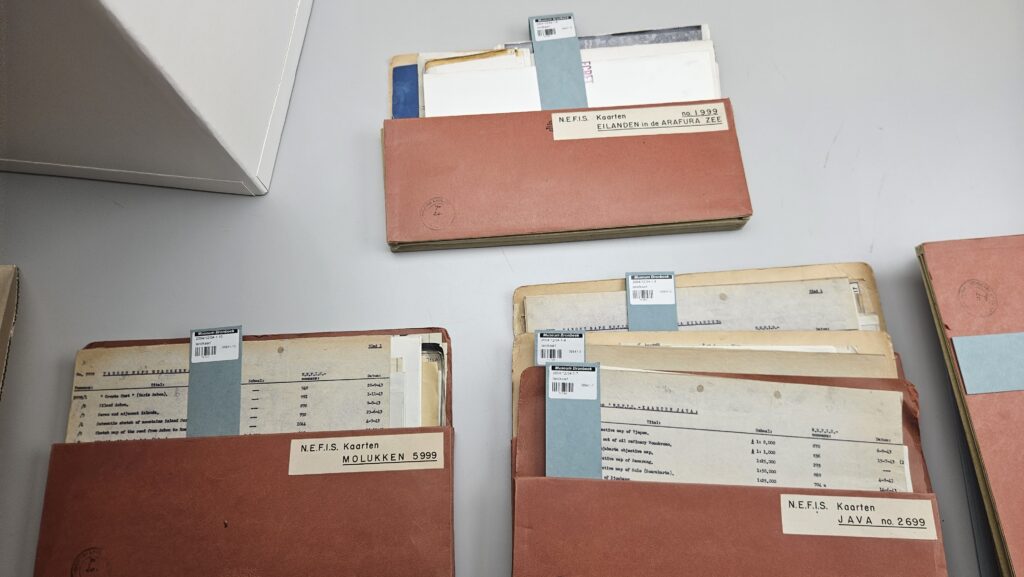
At first glance, a worn red file folder preserved in the collection of the Bronbeek Museum appears to be one of the least remarkable objects associated with the Second World War. Unlike aircraft, weapons or uniforms, it is simply a piece of office stationery.
Yet this modest object tells an important story about the multinational Allied effort that operated from Australia during the war.
The folder formed part of the archives of the Netherlands Forces Intelligence Service (NEFIS), the Dutch intelligence organisation that operated from Australia after the fall of the Netherlands East Indies in 1942. The folder contains map indexes relating to areas such as Java, the Moluccas and the islands of the Arafura Sea. These were among the many regions monitored by Dutch intelligence officers preparing for the eventual liberation of Japanese-occupied territory.
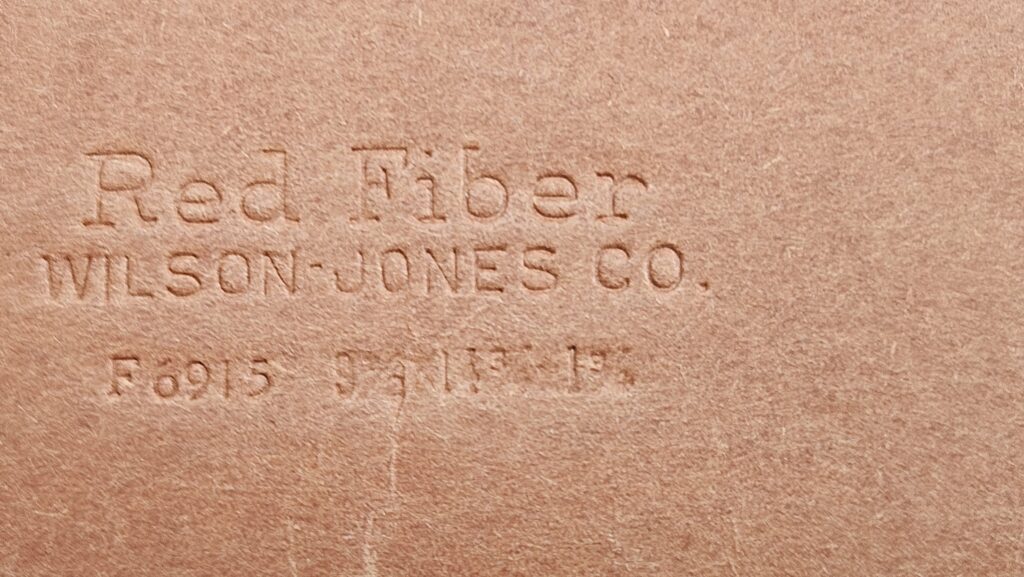
What makes the folder particularly interesting is a manufacturer’s stamp impressed into the cover:
“Red Fiber
Wilson-Jones Co.
Jan 18 1943″
The stamp identifies the folder as a product of the Wilson-Jones Company, an American manufacturer of filing systems, document covers and office supplies. The date most likely records when the fibre-board material used in the cover was manufactured.
While the folder itself may seem insignificant, it offers a glimpse into a largely forgotten aspect of the war: the vast logistical system that supported the Dutch government and military organisations operating in exile from Australia.
Following the Japanese occupation of the Netherlands East Indies, thousands of Dutch military personnel, government officials, intelligence officers and support staff relocated to Australia. New headquarters had to be established in Melbourne, Brisbane, Camp Columbia and other locations. These organisations included the Netherlands East Indies Government-in-Exile, the Royal Netherlands East Indies Army (KNIL), the Military Aviation Service (ML-KNIL), the Netherlands Indies Civil Administration (NICA) and NEFIS.
All of these organisations required supplies. They needed offices, filing cabinets, desks, typewriters, communications equipment, maps, stationery, printing facilities and storage systems. None of these resources could be brought from the occupied Netherlands East Indies. Everything had to be obtained through Allied supply channels.
Australia became the principal base from which Dutch wartime activities were organised, but Australia itself was heavily dependent on Allied production, particularly from the United States. American factories produced enormous quantities of military and civilian equipment that flowed across the Pacific. The same ships that transported aircraft, vehicles and ammunition also carried the countless administrative supplies needed to keep governments and military headquarters functioning.
The Wilson-Jones folder is an example of this process. Manufactured in the United States, it was transported through wartime logistics networks to Australia, where it eventually became part of the filing system used by Dutch intelligence officers.
For NEFIS, such folders were not merely stationery. They were working tools within a complex intelligence operation. Inside them were stored map indexes, survey information, intelligence reports and geographical data relating to Japanese-occupied territory. The information helped Dutch and Allied planners understand the terrain, infrastructure and strategic significance of regions that would later become targets for military operations and post-war administration.
The folder therefore illustrates an often-overlooked reality of wartime cooperation. The Dutch contribution in Australia depended not only on Dutch personnel but also on Australian facilities and American industrial production. Intelligence officers could only perform their work because an extensive Allied support system supplied everything necessary for a modern bureaucracy to function.
Seen in this light, the red folder becomes more than a piece of stationery. It represents the intersection of three Allied partners: American manufacturing, Australian logistics and Dutch intelligence operations. Together they formed part of the broader Allied effort that ultimately contributed to the liberation of the Netherlands East Indies and the defeat of Japan.
Today, preserved in the Bronbeek Museum, this simple folder reminds us that history is not only shaped by battles and military campaigns. It is also shaped by the countless practical systems that enable organisations to operate. Even a humble file cover can reveal the global networks of cooperation that underpinned the Allied war effort.