When people think of Dutch companies in Australia, names such as Philips, Shell often come to mind. Yet another Dutch company has quietly become one of the most important technology businesses in the world.
ASML, founded in the Netherlands in 1984, designs and manufactures the highly sophisticated lithography systems used to produce virtually every advanced computer chip made today. Without ASML’s technology, modern smartphones, artificial intelligence, cloud computing, medical equipment, telecommunications networks and countless other digital technologies would simply not exist.
Less well known is that ASML also has an Australian story. In the early 2000s the company supplied advanced lithography equipment to a semiconductor fabrication plant in Sydney, contributing to Australia’s capability to manufacture specialised microchips for communications, aerospace and scientific applications.
Although Australia has never been a major semiconductor manufacturing nation, this little-known partnership demonstrates how Dutch innovation has contributed directly to Australia’s high-technology industries.
From Eindhoven to the World
ASML was established in 1984 as a joint venture between Philips and Advanced Semiconductor Materials International (ASM International), another Dutch technology company. Based in Veldhoven, near Eindhoven, the company initially operated from modest premises while competing against much larger American and Japanese manufacturers.
The timing proved ideal. During the 1980s and 1990s the semiconductor industry expanded rapidly as computers, telecommunications and consumer electronics became increasingly sophisticated. Every new generation of microchips required greater precision in manufacturing, and ASML concentrated entirely on solving that challenge.
Since that time the company grew from a small Dutch engineering venture into one of Europe’s most valuable technology companies. Today, ASML supplies the lithography systems used by virtually every leading semiconductor manufacturer in the world.
Its customers include the companies that manufacture chips designed by firms such as Nvidia, AMD, Apple, Qualcomm and many others that power today’s digital economy.
What Does a Lithography Machine Do?
Microchips are manufactured by building billions of microscopic electronic components onto a thin silicon wafer,
One of the most critical steps in this process is lithography. Using highly specialised optics, powerful light sources and extraordinary engineering precision, a lithography machine projects intricate circuit patterns onto the wafer. These patterns are then developed and etched into the silicon before the process is repeated many dozens of times to build the finished integrated circuit.
The level of accuracy required is almost beyond comprehension. Modern lithography machines position wafers with an accuracy measured in nanometres—thousandths of a micron and thousands of times smaller than the width of a human hair.
The enormous complexity of these machines has made ASML the global leader in this field.
An Australian Connection
Australia’s semiconductor industry has always been relatively small, but during the late twentieth century several companies established advanced fabrication facilities capable of manufacturing specialised integrated circuits.
One of these was Quality Semiconductor Australia, which operated a semiconductor fabrication plant in Sydney. In the late 1990s the facility was acquired by the American company Peregrine Semiconductor Corporation and renamed Peregrine Semiconductor Australia. The Sydney plant specialised in manufacturing radio-frequency integrated circuits for advanced communications applications.
In February 2001, ASML announced that Peregrine Semiconductor Australia had placed a significant order for semiconductor manufacturing equipment.
The order included an ASML PAS 5500 lithography scanner together with complementary wafer-processing systems. The equipment enabled the Sydney fabrication plant to upgrade its manufacturing capability from a 0.5-micron process to a more advanced 0.25-micron process, allowing the production of increasingly sophisticated semiconductor devices.
ASML engineers worked closely with the Australian operation to configure the equipment for the specialised manufacturing requirements of the Sydney facility. For the Dutch company it represented another successful installation within the global semiconductor industry. For Australia it demonstrated that local manufacturers were capable of operating at internationally competitive standards in specialised semiconductor production..
Manufacturing Specialised Chips
Unlike the large semiconductor plants producing computer processors or memory chips, the Sydney facility focused on radio-frequency devices.
These integrated circuits were designed for demanding applications including satellite communications, fibre-optic telecommunications and aerospace systems.
The company used specialised silicon-on-sapphire technology that offered significant advantages for high-frequency electronic circuits and environments requiring exceptional reliability.
These were precisely the kinds of niche products where Australia could successfully compete internationally.
The installation of advanced ASML lithography equipment enabled the Sydney operation to manufacture increasingly sophisticated devices while remaining competitive in global markets.
Beyond Manufacturing
The significance of the Sydney fabrication plant extended beyond commercial production.
Following later ownership changes, the facility became known as Silanna Semiconductor and became involved in Australian research collaborations, including projects with CSIRO and La Trobe University.
One notable project involved the development of highly integrated radio receivers for radio astronomy—technology intended for future generations of Australian radio telescopes.
Although ownership of the facility changed over time, its continuing role demonstrated the importance of maintaining advanced semiconductor expertise within Australia.
The World’s Most Advanced Manufacturing Machines
Since supplying equipment to Australia in 2001, ASML has continued pushing the boundaries of engineering.
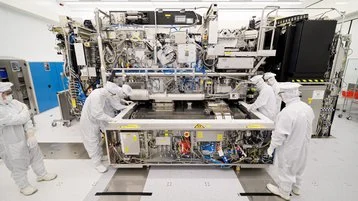
Its latest generation of Extreme Ultraviolet (EUV) lithography systems are among the most sophisticated machines ever constructed.
Each machine consists of more than 100,000 precision components and weighs approximately 180 tonnes. They require years to manufacture and are transported to customers in hundreds of carefully packaged modules before being assembled on site by specialist engineers.
The optical systems are manufactured to extraordinary tolerances. Tiny vibrations, microscopic dust particles or minute temperature changes can affect performance, requiring exceptionally controlled operating conditions.
These machines make possible the manufacture of the advanced semiconductor devices that underpin artificial intelligence, cloud computing, autonomous vehicles, medical technologies and modern communications.
Today, ASML occupies a unique position within the global semiconductor industry. No other company currently produces Extreme Ultraviolet lithography systems capable of manufacturing the world’s most advanced chips.
A Dutch Success Story
ASML represents one of the Netherlands’ greatest modern industrial success stories.
Building on the country’s long tradition of scientific research, precision engineering and international trade, the company has become indispensable to one of the world’s most important industries.
Its success reflects qualities that have characterised Dutch enterprise for centuries: innovation, technical excellence, international collaboration and a willingness to invest in long-term research and development.
A Dutch Contribution to Australian Technology
The relationship between ASML and the Sydney semiconductor fabrication plant is a relatively small chapter in the company’s global history, but it is an important one for Australia.
It demonstrates that Dutch innovation has contributed directly to Australia’s advanced manufacturing capability. Long before artificial intelligence became a household term, Dutch technology was helping Australian engineers manufacture specialised microchips for communications, aerospace and scientific applications.
The story also reminds us that Australia’s technology sector has a deeper history than is often recognised. While semiconductor manufacturing has never matched the scale seen in Asia, Europe or North America, Australian companies have developed world-class expertise in specialised technologies, often supported by partnerships with leading international firms such as ASML.
For the Dutch Australian Cultural Centre, ASML represents another example of the many ways Dutch enterprise has contributed to Australia’s economic and technological development. Alongside companies such as Philips, Shell, Optiver and other Dutch innovators, ASML forms part of a continuing story of cooperation between the Netherlands and Australia.
As Australia invests in emerging industries including artificial intelligence, quantum computing and advanced manufacturing, the role of semiconductor technology will become even more important. Although few people realise it, Dutch engineering has already played a part in that journey
.Paul Budde
July 2026