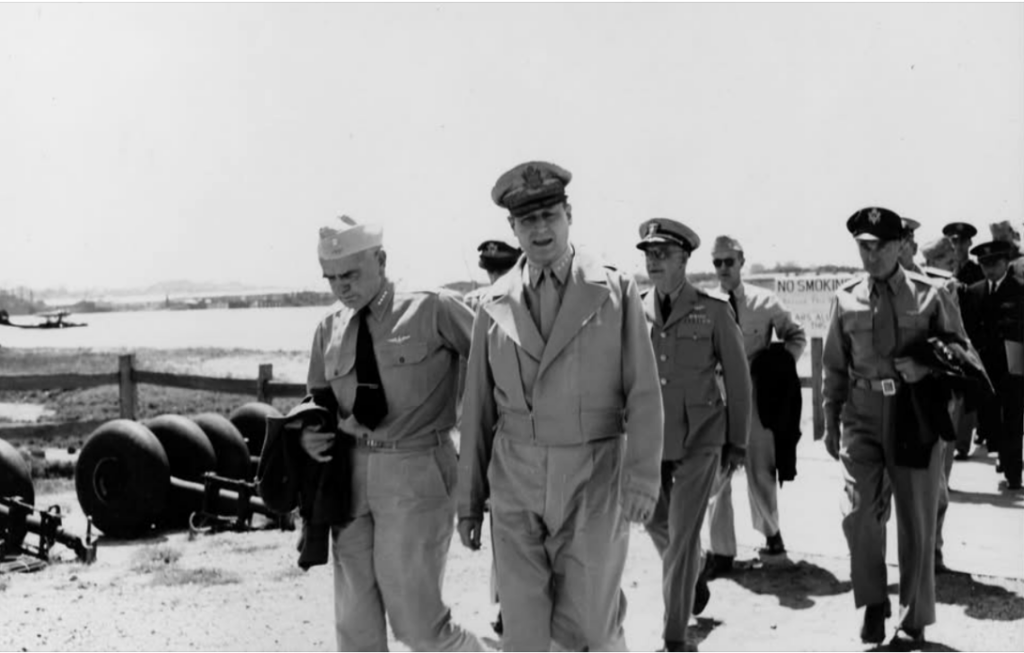
A photograph taken in Brisbane on 9 October 1943 captures three of the most senior American commanders in the Southwest Pacific: Admiral William F. Halsey, General Douglas MacArthur and Vice Admiral Arthur S. Carpender.
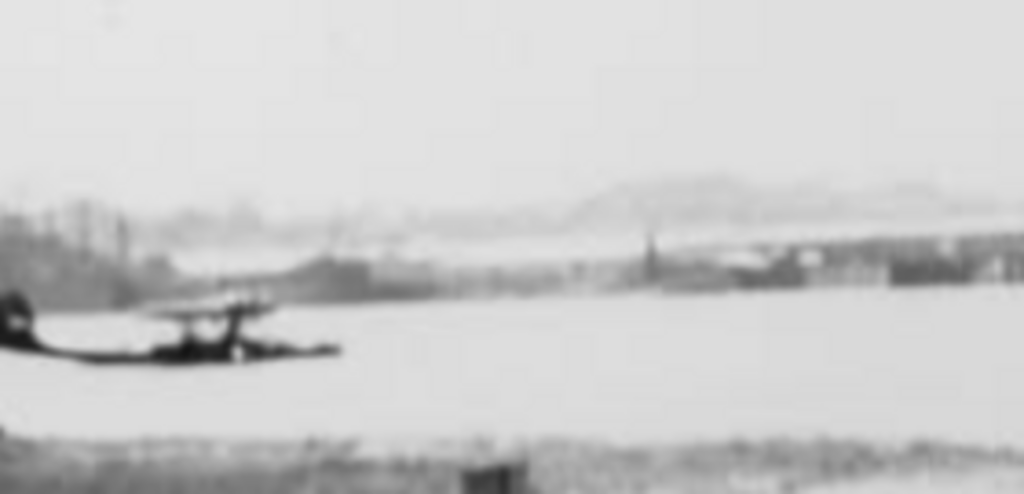
The men were photographed at the US Naval Seaplane Base at Colmslie, which supported the US Navy’s Naval Air Transport Service, commonly known as NATS. On the Brisbane River in the far-left background is a distinctive three-engined Dornier Do 24 flying boat.
The aircraft had originally served with the Marine Luchtvaartdienst, the Dutch Naval Aviation Service, in the Netherlands East Indies. By the time this photograph was taken, however, it was almost certainly operating as an RAAF aircraft.
Research by Brisbane wartime historian Peter Dunn OAM suggests that it was most likely A49-1 of No. 41 Squadron RAAF.
Identifying the aircraft
The aircraft is too distant for its serial number or markings to be read. Its identity therefore cannot be established conclusively from the photograph alone.
However, the precise date of the photograph provides an important clue.
The original caption dates the photograph to 9 October 1943, a date also corroborated by an entry in General MacArthur’s Office Diary. The ADF Serials history for A49-1 records that the aircraft departed Rathmines in New South Wales for Townsville on 2 October 1943.
During the journey, it developed engine problems at Brisbane and was detained there while repairs were undertaken. It did not leave Brisbane until 16 October.
A49-1 was therefore in Brisbane on 9 October, the exact day the photograph was taken. This makes it the most likely candidate for the Dornier visible on the river.
The identification remains circumstantial rather than definitive, but the combination of aircraft type, location and service dates provides a strong case for A49-1.
From the Dutch Navy to the RAAF
The Dornier Do 24 was a German-designed flying boat developed specifically for the Royal Netherlands Navy. The Dutch required a long-range maritime aircraft capable of operating across the immense island territories of the Netherlands East Indies.
The Do 24 was an all-metal flying boat powered by three radial engines. It had a wingspan of more than 27 metres and used stabilising sponsons attached to the hull rather than conventional wingtip floats.
Before the Pacific War, Dutch Dorniers operated from bases including the major naval air station at Morokrembangan, near Surabaya. They undertook maritime reconnaissance, patrol, rescue and transport operations.
Following the Japanese attacks in December 1941, the aircraft were used intensively during the defence and evacuation of the Netherlands East Indies. Most were destroyed in combat, lost in accidents or attacked while moored at their bases.
Five surviving Dorniers reached Australia in February 1942. A sixth arrived in March. The first five were attached to the RAAF soon after reaching Australia and became A49-1 to A49-5.
A49-1 had originally served with the Dutch Naval Aviation Service as X-5. It was formally transferred to the RAAF on 29 April 1942.
The sixth aircraft, the former X-24, followed a different path. It was initially allocated to the Netherlands Forces Intelligence Service and operated between Australia and the Netherlands East Indies. It was not taken on charge by the RAAF as A49-6 until 9 November 1943, one month after the Colmslie photograph was taken.
The documented presence of A49-1 in Brisbane on 9 October makes it a much stronger candidate than X-24.
No. 41 Squadron RAAF
The first five Dorniers were eventually operated principally by No. 41 Squadron RAAF, a maritime transport unit based at Townsville.
The squadron carried personnel, freight and supplies between Australia and forward operational areas in New Guinea and elsewhere in the Southwest Pacific. Its flying boats were particularly valuable in places where conventional landing grounds were unavailable or inadequate.
RAAF records show that the five aircraft collectively flew almost 1,700 hours, transported nearly 2,000 passengers and carried approximately 350 tonnes of freight.
A49-1 alone flew more than 236 hours, carried 168 passengers and transported more than 57,000 pounds of freight during its RAAF service.
The aircraft nevertheless presented considerable maintenance difficulties. They had arrived in Australia without a complete supply of spare parts, specialist equipment, servicing manuals or tools. With only a small number of Dorniers available, maintaining them became increasingly difficult.
The engine trouble that kept A49-1 in Brisbane during October 1943 was therefore part of a wider problem that affected the Australian Dornier fleet.
Two flying-boat bases on opposite sides of the river
The photograph also illustrates the concentration of Allied flying-boat activity along Brisbane’s Hamilton Reach.
The three commanders were standing at the US Naval Seaplane Base at Colmslie, on the southern side of the river. The US Navy occupied the site in 1942 and developed it to support the Naval Air Transport Service and transient naval flying boats.
The Dornier was probably not moored at the American base. It appears to have been across the river, in the mooring area associated with the RAAF Flying Boat Base at Hamilton.
Flying-boat facilities had been established near Hamilton Wharves before the war, initially supporting civil services operated by Qantas and other airlines. The Department of Civil Aviation developed mooring and reception facilities there, and the long, relatively straight section of the Brisbane River became an important flying-boat operating area.
The RAAF subsequently established its own facilities at Hamilton. Additional moorings were laid near Colmslie and Gibson Island, while No. 41 Squadron aircraft regularly passed through Brisbane. The location was therefore a logical place for A49-1 to remain while its engine problems were investigated.
The photograph brings these two neighbouring facilities together: the American commanders and US Navy base in the foreground, and an RAAF flying boat of Dutch origin at the Hamilton moorings across the river.
A Dutch-designed aircraft in Australian service
The Dornier is only a small background detail in a photograph dominated by MacArthur, Halsey and Carpender. Its history nevertheless adds another layer to the image.
It was not, by October 1943, simply a ex Dutch military aircraft visiting Brisbane. It was most likely A49-1: a former Dutch Naval Aviation aircraft that had escaped from the Netherlands East Indies and continued the war in RAAF service.
Its presence on the Brisbane River reflects the way Allied personnel and equipment were reorganised following the fall of the Netherlands East Indies. Dutch aircraft, ships and personnel were absorbed into or worked alongside Australian and American forces, often continuing to operate far from their original bases.
The photograph therefore connects several parts of Brisbane’s wartime story: MacArthur’s Southwest Pacific headquarters, senior US naval commanders, the Naval Air Transport Service at Colmslie, the RAAF Flying Boat Base at Hamilton and an aircraft that had survived the collapse of Dutch resistance in the Netherlands East Indies.
What initially appears to be a barely visible aircraft on the river is most likely a rare photograph of RAAF Dornier A49-1 during its enforced stay in Brisbane from 2 to 16 October 1943.
Acknowledgement:
With thanks to Peter Dunn OAM, “Australia @ War”, for identifying the location, investigating the likely identity of the aircraft and providing the relevant entries from the ADF Serials history, General MacArthur’s Office Diary and the October 1943 US Navy inspection report.
See also: The Dutch Dorniers in Australia: Flying boats in exile during WWII and United States Naval Air Station at Colmslie.