A group photograph taken aboard the Netherlands hospital ship Oranje in Sydney on 2 March 1943 records a little-known connection between one of the most celebrated Dutch ships of the Second World War and one of Australia’s greatest maritime tragedies.
Within weeks of the photograph being taken, 28 Australian personnel who had served aboard Oranje were transferred to the newly commissioned Australian hospital ship Centaur. Eighteen of them died when Centaur was torpedoed and sunk off the Queensland coast on 14 May 1943.[1]
The photograph therefore captures more than a group of people at the end of one period of service. It records the moment when Dutch and Australian wartime medical histories became inseparably connected.
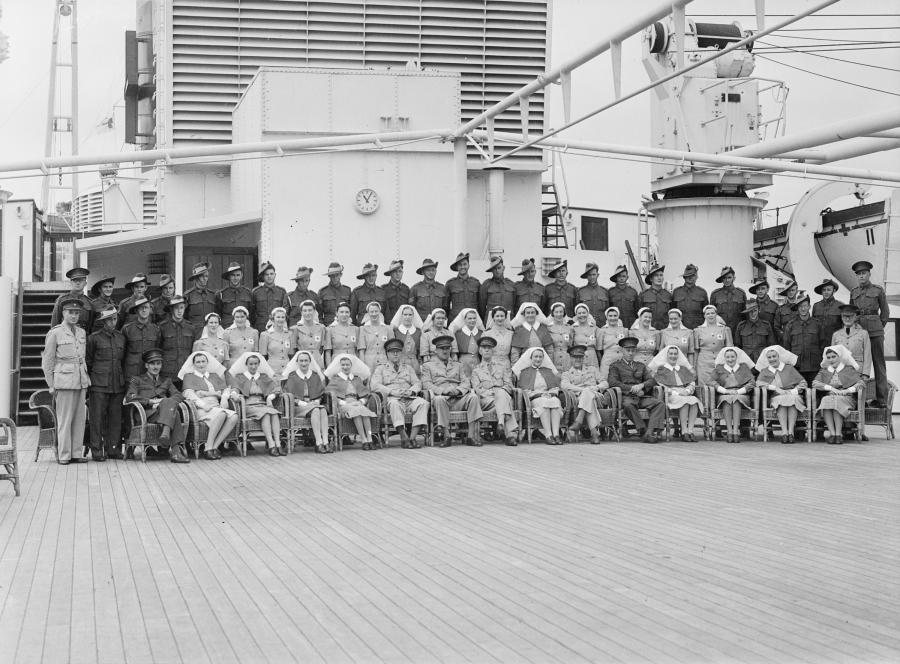
Australians aboard the Dutch hospital ship Oranje
Oranje had been completed in 1939 as a fast passenger liner for the Netherlands Steamship Company. Following the German occupation of the Netherlands and the rapid expansion of the war, the Netherlands Government-in-Exile offered the ship for conversion into a hospital ship. See : Hospital ship Oranje: Dutch medical service for 32,461 Allied patients
After arriving in Sydney on 31 March 1941, Oranje was fitted out with medical wards, operating theatres and accommodation for patients and staff. The Dutch Government continued to provide the ship, her captain and crew, while medical personnel were drawn from several Allied countries.[2]
When Dutch doctors and nurses were increasingly required elsewhere following Japan’s entry into the war, Australian and New Zealand personnel joined the medical complement. The resulting service aboard Oranje was an important example of practical Dutch–Australian cooperation: a Dutch-owned and Dutch-crewed vessel carrying Allied wounded under a multinational medical staff.
Oranje completed 41 wartime voyages and transported 32,461 patients. Her speed, which allowed her to travel without convoy protection on many voyages, made her an unusually valuable hospital ship.[3]
Early in 1943, Australia began withdrawing its personnel from Oranje as staff were required for Australia’s own expanding hospital-ship service. A number of those Australians were reassigned to Centaur.
The photograph taken on 2 March 1943
The Australian War Memorial holds a group portrait of Australian personnel who served aboard Oranje. For many years, the Memorial’s version was a copy print supplied by Centaur survivor Frederick Bessill Chidgey, who appears in the photograph and helped identify many of the people shown.[4]
Further archival work located the original negatives among material transferred to the Australian War Memorial from the New South Wales State Publicity Censor after the war. A separate negative from the same series bears the handwritten name “Oranje” and the date 2 March 1943.[5]
That date is important. It establishes that the photograph was taken only a few days before members of the group began transferring to Centaur.
Research undertaken by the Australian War Memorial identified 28 Australian personnel connected with the photograph who subsequently served aboard Centaur; 27 of them appear in the portrait. Only ten of the 28 survived Centaur’s sinking. The other 18 were killed.[6]
The identification of the original negatives added clarity to the image and restored its historical context. What might otherwise appear to be a conventional shipboard portrait became a record of people standing at a decisive point between service aboard Oranje and the fatal voyage of Centaur.
Centaur becomes an Australian hospital ship
Centaur had been built as a passenger and cargo vessel operating between Western Australia, Singapore and other ports in Southeast Asia. In November 1941 she participated in the rescue of survivors from the German raider Kormoran following its battle with HMAS Sydney.[7]
The ship was converted into a hospital ship early in 1943 and commissioned as 2/3 Australian Hospital Ship Centaur. She was painted white and carried the internationally recognised markings of a hospital ship: large red crosses on her hull and deck, with a green band running around the vessel.
Centaur’s medical complement included personnel who had already gained experience aboard Oranje. Their transfer illustrates how the Australian hospital-ship service benefited directly from the multinational medical organisation developed on the Dutch ship.
The relationship was particularly close among the Australian Army Nursing Service members assigned to Centaur.
The nurses of Oranje and Centaur
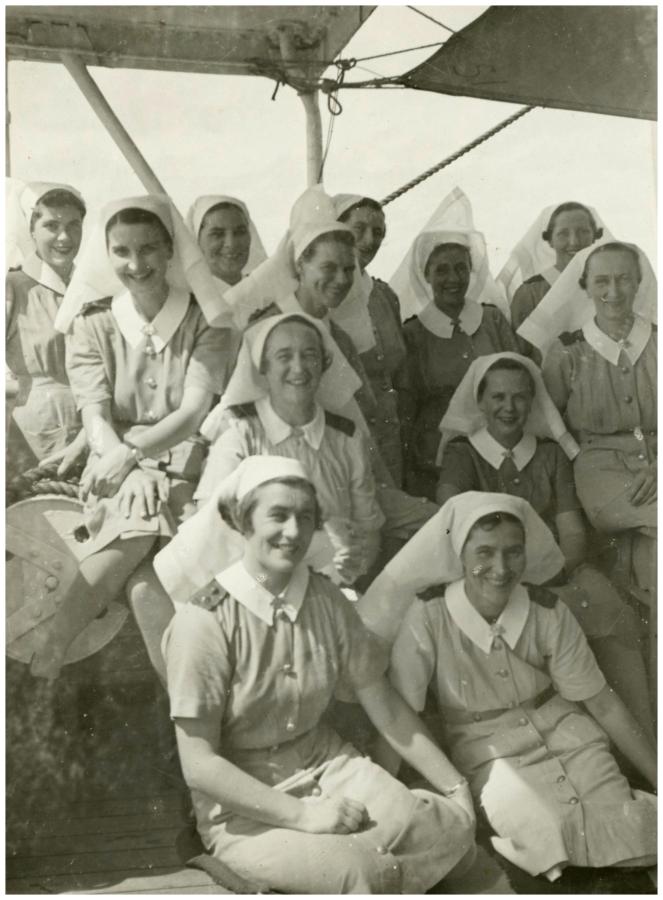
Nine names are written on the back of the print, with the statement that they had previously served on 1 Netherlands Hospital Ship Oranje. The other unnamed nurses have since been identified.Australian War Memorial
Another photograph in the Australian War Memorial collection shows the 12 Australian Army Nursing Service nurses who sailed aboard Centaur on her final voyage. Research confirmed that all 12 had previously served aboard Oranje.[8]
Their names were:
- Sister Ellen Savage
- Matron Eleanor Maud Pocock
- Sister Mavis Isobel Bainbridge
- Sister Anne Mackenzie Donnell
- Sister Myra Florence Dwyer
- Sister Muriel Jean Hobbs
- Sister Inez Marie McMillan
- Sister Helene Margaret Muir
- Sister Mary Agnes Harrington
- Sister Edith Mabel Middleton
- Sister Ethel Adeline Muriel Russell
- Sister Wilhelmina Rosalie Runnels
Only Sister Ellen Savage survived the sinking.[9]
The experience these nurses had gained aboard Oranje made them valuable members of Centaur’s medical staff. Their story also places Oranje within the history of Australian military nursing, rather than solely within Dutch maritime history.
Centaur’s final voyage
Centaur left Sydney on the morning of 12 May 1943, bound for Cairns. She carried her crew and medical staff, together with personnel, stores and equipment belonging to the 2/12th Field Ambulance. There were no patients aboard.[10]
At approximately 4 am on 14 May, while travelling off the Queensland coast, Centaur was struck by a torpedo. The attack occurred without warning. The ship caught fire and sank rapidly, leaving little time to launch lifeboats or organise an evacuation.
Of the 332 people aboard, only 64 survived.[11]
The Australian Government protested that Centaur had been clearly marked and illuminated as a hospital ship. Japanese responsibility was denied at the time, but postwar research identified the attacker as the Japanese submarine I-177, commanded by Lieutenant Commander Hajime Nakagawa.[12]
The sinking caused widespread outrage in Australia. Hospital ships were protected under international law, and Centaur’s markings and purpose had been notified through the appropriate diplomatic channels.
Sister Ellen Savage
Sister Ellen Savage was the only one of Centaur’s 12 nurses to survive. She suffered serious injuries, including fractured ribs, a broken nose and palate, burst eardrums and extensive bruising. Despite her condition, she assisted other survivors while they waited for rescue.[13]
Survivors were located by an RAAF aircraft on the afternoon of 15 May and were subsequently picked up by the American destroyer USS Mugford.[14]
Savage was awarded the George Medal for her courage and devotion to the wounded following the sinking. Her survival preserved an eyewitness account of the disaster and created a living connection between the medical services of Oranje and Centaur.
Eighteen lives linking two hospital ships
The loss of 18 former Oranje personnel aboard Centaur is a significant part of the wider Dutch–Australian wartime story.
Oranje and Centaur are often remembered separately. Oranje is celebrated for her extensive service carrying more than 32,000 Allied patients, while Centaur is remembered primarily for her unlawful destruction and the heavy loss of life.
The group photograph taken on 2 March 1943 brings those histories together. It shows that the two ships were connected not merely by their common role as hospital ships, but through the people who served aboard them.
The Australians who transferred from Oranje carried with them experience gained in a Dutch ship, working with a Dutch crew as part of a multinational medical service. Their subsequent service aboard Centaur represents a direct transfer of knowledge and personnel from the Netherlands’ wartime maritime organisation to Australia’s hospital-ship service.
The portrait also reminds us that archival photographs can acquire meaning gradually. The recovery of the original negatives, confirmation of the date and identification of those pictured transformed an incomplete image into evidence of a remarkable and tragic connection.
Oranje survived the war and continued transporting wounded and repatriated personnel. Centaur did not. The Australians who served aboard both ships stand at the intersection of these contrasting histories—one a story of sustained medical service and survival, the other of sudden destruction and profound loss.
Endnotes
- Australian War Memorial, “From Copy to Clarity: Before Centaur,” 14 May 2026.
- Jack Ford, “The Netherlands Merchant Navy in the Pacific War,” Journal of Australian Naval History, vol. 6, no. 1, 2009, p. 80.
- Ibid.; see also DACC, “Hospital ship Oranje: Dutch medical service for 32,461 Allied patients.”
- Australian War Memorial, group portrait of Australian personnel who served aboard Oranje, collection item P04298.001.
- Australian War Memorial, original negative associated with the Oranje photographic series, collection item AWM2024.1099.1.
- Australian War Memorial, “From Copy to Clarity: Before Centaur.”
- Australian War Memorial, “Centaur,” Encyclopaedia.
- Australian War Memorial, photograph of Australian Army Nursing Service nurses aboard Centaur, collection item 044428.
- Australian War Memorial, “From Copy to Clarity: Before Centaur.”
- Australian War Memorial, “Centaur,” Encyclopaedia.
- Ibid.
- Ibid.
- Australian War Memorial, “From Copy to Clarity: Before Centaur”; Australian War Memorial, “Centaur,” Encyclopaedia.
- Australian War Memorial, collection record for the wristwatch of Driver George McGrath, REL/16201.001